Prof. Rubby Dhunpath Calls for Greater Recognition of Teaching Excellence
The most important work in higher education often happens far from the spotlight. It happens in lecture halls before sunrise, in consultations that stretch beyond office hours, and in the quiet determination of academics committed to helping students succeed against the odds.

This powerful message formed the centrepiece of the 2026 National University Teaching Awards (NUTA), where South African University Teachers (SAUT) celebrated the educators whose dedication continues to shape lives, expand opportunities and strengthen South Africa’s future.
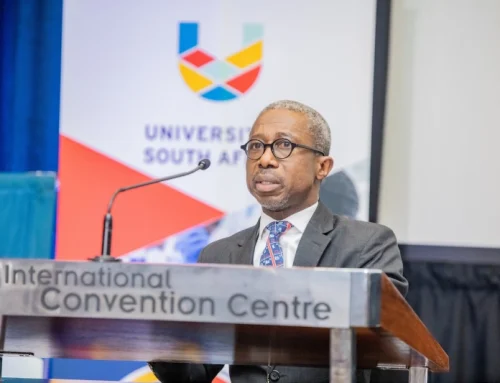
Delivering a thought-provoking vote of thanks, Prof Rubby Dhunpath challenged delegates to look beyond the evening’s accolades and reflect on the often-invisible labour that sustains universities and transforms students.
“Teaching is the work universities depend on most but see least. Most of what we celebrate this evening happens where nobody is watching: in a lecture hall at eight in the morning, in a consultation that runs over time, in a pile of assignments marked late at night. It happens behind closed doors, it leaves few citations, and it seldom features in the metrics by which institutions rank themselves.”
His remarks captured the spirit of an awards programme dedicated to recognising teaching as a cornerstone of higher education and national development. While universities are frequently measured by research outputs, innovation and global rankings, Prof Dhunpath reminded the audience that the true value of universities is ultimately reflected in the students whose lives are changed through learning.
The National University Teaching Awards, coordinated through SAUT and supported by the Department of Higher Education and Training, recognise academics who demonstrate excellence, innovation and scholarship in teaching and learning. Yet, as Prof Dhunpath noted, the awards represent something bigger than individual achievement. They acknowledge a collective commitment to ensuring that teaching receives the same respect and recognition as research.
Tracing the evolution of the awards, Prof Dhunpath highlighted how NUTA emerged from earlier national efforts led by the Council on Higher Education and HELTASA, both of which championed the idea that teaching should be evaluated with the same seriousness as academic research. Today, the programme continues to evolve by asking a critical question:
“What does excellence mean in an unequal system?”
Rather than simply celebrating those with the greatest resources, NUTA seeks to recognise lecturers who respond creatively and effectively to the realities their students and institutions face. This approach has informed the work of SAUT’s National Coordinating Committee and Executive Management Committee, which have expanded award categories, revised excellence criteria and introduced mentorship programmes aimed at broadening participation across the sector.
These efforts are beginning to produce tangible results. According to Prof Dhunpath, participation in the awards is becoming increasingly representative of the country’s diverse higher education landscape.
“In 2026, we’ve had 25 of our 26 public universities participate. We are also seeing the award trends shifting slowly. Now we can tell a story of representativity and equity.”
The address also paid tribute to the individuals whose vision and commitment have sustained the programme over many years. Special recognition was given to Dr Whitty Green, whose early leadership at the DHET helped establish a national framework for teaching development, as well as to Prof Diane Grayson and the University of the Witwatersrand, which hosted and administered SAUT for much of its history.
Prof Dhunpath further acknowledged the contributions of mentors, adjudicators, administrators and support staff whose behind-the-scenes efforts make the awards possible. More than 100 teaching portfolios were reviewed during the adjudication process, representing years of academic dedication and innovation.
Importantly, he challenged universities to ensure that celebrating teaching excellence becomes more than an annual event.
“By nominating colleagues whose distinction lies in teaching, what you are saying publicly is that teaching counts at your institution.”
His message was particularly poignant for the award recipients, whose recognition was framed not simply as a reward for doing their jobs well, but as acknowledgement that they have elevated teaching into a form of intellectual scholarship that advances the sector.
“Your recognition tonight is not a reward for doing your job well. It is an acknowledgement that you have elevated teaching as intellectual labour: something to be theorised, tested, revised and shared.”
As the evening ended, Prof Dhunpath left delegates with a simple but powerful appeal that resonated beyond the ceremony itself.
“When you see good teaching, name it. Say thank you to the person doing it. That, after all, is what this whole evening is about.”
In celebrating South Africa’s distinguished university teachers, the National University Teaching Awards reaffirmed a fundamental truth: teaching remains the heartbeat of the university project. Every graduate, every professional and every future leader carries the imprint of an educator who believed in their potential. Through NUTA, South Africa honours those educators and recognises that investing in teaching excellence is ultimately an investment in the nation’s future.
Media enquiries: Ms Gcina Nhleko (APR), Manager: Corporate Communications (083 283 7222)