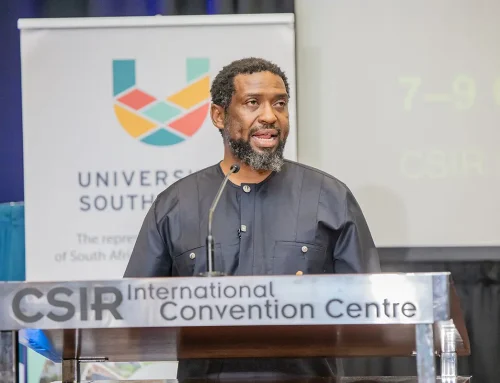
Professor Leketi Makalela on language, identity and curriculum transformation
Curriculum transformation without language is cosmetic. That was the argument at the centre of the keynote address Professor Leketi Makalela gave to the Community of Practice for the Teaching and Learning of African Languages (CoPAL) at its face-to-face meeting in Johannesburg on 24 June 2026. Makalela is Professor of Applied Linguistics at the University of the Witwatersrand.
He came to the meeting with strong credentials in this debate. He advises the Department of Basic Education on languages and literacy, holds distinguished visiting professorships at the City University of New York and King’s College London, and recently published the Handbook of Translanguaging in the Global South. Speaking on the theme “Language, Identity and Curriculum Transformation in South African Universities,” he set out to interrogate what he called higher education’s “holy cow.” Everyone asks, “What about the curriculum?” he observed, without asking which curriculum they mean or what a multilingual one would actually look like.
He answered that South African universities have become very good at the visible signs of multilingualism and very poor at the substance. Institutions produce impressive language policies, multilingual websites and signage in many languages, all the colourful things you can see, while the classroom stays untouched. And the classroom is where a multilingual university is actually made or unmade. The real question, he argued, is not what languages appear on the building. It is what happens in the lecture theatre.
Multilingualism as memory, not invention
Makalela located the roots of the problem in what he called “linguistic apartheid.” This is the assumption, inherited from the European Enlightenment, that a nation requires a single language and a single classroom. He traced it to a period when language became the marker of the boundary between the sovereign state and the foreigner, and when Europe exported to Africa the conviction that a single language, ideally the coloniser’s, was the vehicle of civilisation. To keep perpetuating that logic in African universities, he said, is to exclude African languages, and he compared it bluntly to the segregated facilities of the apartheid era.
Against this, he set the Ghanaian concept of Sankofa, the injunction to go back and fetch. “Africa does not need to invent multilingualism,” he said. “It needs to remember it.” He pointed to the kingdom of Mapungubwe, the multilingual trading city at the meeting point of South Africa, Zimbabwe and Botswana, where Karanga, Kalanga, Sotho, Khoi and San people lived and traded together. This, he argued, shows that African multilingualism is not a fiction of the imagination but part of what he called the “cultural DNA” of African-language speakers. When lecturers are asked to bring other languages into their classrooms, he stressed, they are being asked to draw on a competence their students already have.
That led him to a distinction he returned to throughout the talk: the difference between the multilingualism South Africa has imported and the multilingualism it might reclaim. When the country says it has eleven or twelve official languages, he argued, it is really describing twelve monolingualisms, sealed and unrelated, with the relationships between them missing from policy altogether. He illustrated the point with two street scenes. In New York, the largest city on earth, every language is spoken, but an Icelandic speaker talks to an Icelandic hearer and an Arabic speaker to an Arabic hearer. That is a vertical multilingualism, each language pocketed within its own speakers. On Small Street in Johannesburg, it is completely different. Languages flow into one another without boundaries: one speaker uses isiZulu, another answers in Tshivenda, a third replies in Sesotho, and the conversation still works. That, he said, is the “Ubuntu of languages,” the recognition that no language is complete without the others and that they are always fitting into each other.
Ubuntu translanguaging and the twenty-first-century classroom
Makalela framed this relational view of language as a distinctly twenty-first-century way of thinking. The past century, he argued, was defined by separatism, with everything disconnected from everything else. This century runs the other way. The internet of things, artificial intelligence and the whole language of “twenty-first-century skills” all rest on the premise that everything is connected. Yet academics who happily preach connectedness in every other field insist on treating languages, the very thing that makes us human, as sealed-off, self-contained entities. That, he said, is anti-twenty-first-century thinking.
The resource for doing it differently, he suggested, is one South Africa already holds. “I am because you are,” the relational epistemology of Ubuntu, is itself a twenty-first-century competence. The country does not need to go looking elsewhere for the skills it is told it lacks. From this starting point, he developed the idea of Ubuntu translanguaging and distinguished it from a generic, imported version. Much translanguaging scholarship emphasises fluidity and the flow of linguistic repertoires, which he welcomed as far as it goes. His own emphasis fell on relationality: the human relations of dependency in which one language completes another.
He was careful to tie this to policy on the ground. Mother-tongue-based bilingual education, he noted, had reached a genuine milestone. For the first time, Grade 4 pupils in 2025 wrote bilingual examinations in an African language and English. On the public commentary cautioning against the ratios involved, the 80/20 and 70/30 splits and so on, he argued that critics were missing the logic of the model. Mother-tongue-based bilingual education begins with the mother tongue and sustains it for as long as possible; international research suggests a minimum of 6 years. A 50/50 split in Grade 4 would flip pupils back to English and undo the problem the policy is there to solve. The gradual increase of English, a little in Grade 5, more in Grade 6, a 50/50 balance only by Grade 7, is already a large concession to English, designed to reassure parents. At the same time, the African language is steadily stabilised.
He linked this to a warning about technology. Because the digital footprint of African languages remains limited and the tools have been built on English-centric logic, artificial intelligence will not necessarily provide the sector with the answers it needs. Ask it to generate a literacy programme for isiZulu, he said, and it will hand back a phonics-based approach copied from English. That approach does not fit the language, and it is one reason, he argued, that some 81% of children cannot read for meaning. What it leaves out is what he called the “African big five”: morphological awareness, the neglected foundation of reading in African languages.
The two elephants in the classroom
At the heart of the address were what Makalela described as two “elephants” sitting in every classroom, two forms of disproportionate marginalisation. The first is about not only what students know but how they come to know it. Epistemic access, in his terms, means embedding both. The second concerns the outcomes the curriculum sets. On both counts, he argued, universities are failing their students.
The result is what he called an “unfinished colonial curriculum.” Teaching through a single language, he argued, does not protect depth. It reduces it, stripping away the world views and conceptual breadth that other languages carry.
A model for incremental change
Makalela was insistent that his critique was grounded in a method and that those who say multilingual teaching cannot work are usually the ones who have never tried it. Two obstacles come up again and again, he said: lecturers who declare that multilingualism “does not work” without ever piloting it, and lecturers who do not plan their lessons at all and follow a prescribed book. Multilingual infusion, by contrast, has to be deliberate, strategic and incremental. You do not, in his words, wake up one day and decide to drop Sesotho into the lesson.
The model he offered rests on the idea that a lesson is a microcosm of life, with a beginning, a middle and an end, or, in another image, a starter, a main course and a dessert. In the pre-lesson stage, students activate prior knowledge in whichever languages they have, and the lecturer scaffolds the two or three concepts without which the lesson cannot be understood. None of this requires the lecturer to speak the students’ languages. Faced with concepts such as “liability” or “asset” in the economic and management sciences, every student, even in a class of a thousand, first works alone and writes in their own language, so that translanguaging happens for everyone within a single minute. Cognate languages can then group students to compare and confirm their understanding, before non-cognate groups are brought together around the same concept, domesticating strangeness by design. The lesson ends with reflections in a language other than the one used to teach it.
Until the sector gets to that point, Makalela concluded, talk of African languages in higher education remains “far, far removed” from realisation. You cannot transform the curriculum, he argued, without transforming the place of African languages within it, and where language is left out, decolonisation itself falls short of something deeper. The task he set the community was to begin, deliberately and step by step, to open the space long reserved for English so that African languages can sit alongside it, not as an add-on to the curriculum but as part of how students come to know.
Some of this work is already documented. The University of Cape Town’s Faculty of Humanities recently published Reflections on Multilingual Teaching and Learning Practices, a collection of case studies from its Multilingualism Education Project showing how academics across disciplines, from engineering to medicine to sociology, have begun to teach through isiXhosa and other African languages. The booklet, which draws on Makalela’s own critique of monolingual “oneness,” is a reminder that the incremental approach he set out is not only a proposal but also a practice that some institutions have begun to build.
Mduduzi Mbiza is a contract writer for Universities South Africa.