Sector leaders examine the anatomy of institutional capture
Owing to growing concerns among university leaders about actors seeking governance influence outside universities’ statutory provisions and sound established practices, Universities South Africa (USAf), through its Leadership and Management Strategy Group, hosted the first webinar on 23 March to explore threats to the integrity of higher education governance.
These threats manifest in sustained and targeted attacks on executive leadership; political interference; and stakeholder pressure to control university resources and weaken institutional authority. The risks include coordinated misinformation designed to distort public perceptions of universities and some vice-chancellors (VCs).
Themed Institutional Governance: Confronting the Risks of Institutional Capture, the webinar, co-hosted with the Department of Higher Education and Training (DEHT), attracted council members, registrars, deputy vice-chancellors, risk and compliance officers, and executive directors from across the public university system.
The context

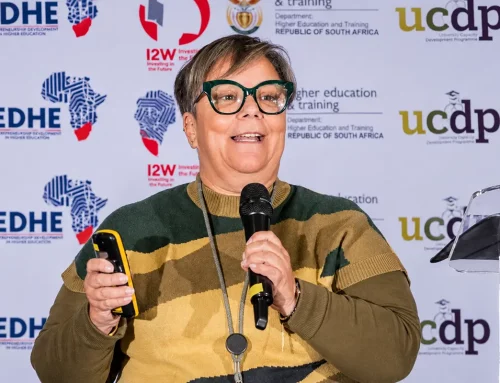
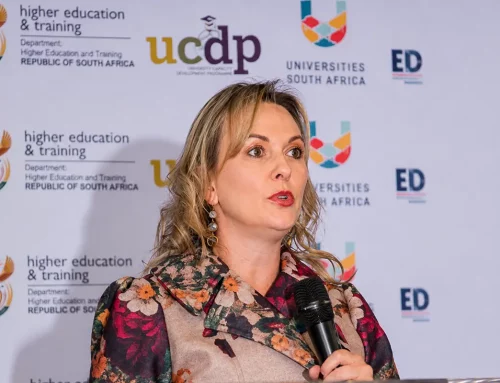
Professor Thandi Lewin (left), recently appointed Deputy Director-General: University Education Branch in the DHET, opened by mapping the pressures on public universities globally and, specifically, in South Africa. She noted that universities are simultaneously expected to produce employable graduates, conduct high-quality research, and remain stable institutions — all amid rapid economic, political, and technological change. In South Africa, this is compounded by poverty, inequality, and unemployment, which generate public expectations of universities that frequently exceed institutional capacity. The resulting frustration, she said, is eroding political trust in universities and is weakening their ability to self-regulate.
Lewin pointed to a growing gap between genuine accountability and compliance-driven oversight, describing much of the latter as performative rather than substantive. She also noted that cooperative governance, while embedded in South African policy and legislative frameworks, is frequently misunderstood or selectively applied, with layers of reporting and audit mechanisms that can obscure rather than strengthen institutional purpose.
She identified three converging drivers of institutional capture: misunderstanding of what universities are and what they do; unresolved social justice grievances and unmet expectations that motivate efforts to exert control over institutions; and outright criminality. In each case, she said, the result is the erosion of universities as public institutions serving the public good
Defining institutional capture
Institutional capture is systematic, deliberate, and intentional. That was how Professor Jonathan Jansen (right), former rector of the University of the Free State and now Distinguished Professor of Education at Stellenbosch University, defined the process by which governance and management at South African universities are being undermined.
He was one of two keynote speakers at the webinar alongside Professor Thandwa Mthembu, Vice-Chancellor and Principal of the Durban University of Technology.
Jansen, who authored the book titled Corrupted, defined institutional capture as a systematic, deliberate, and intentional process of undermining governance and management to trigger institutional instability and shift authority to other power centres within the university. He distinguished generalised dysfunction from capture in the full sense, which he defined as occurring when the entire core of a university’s operations is undermined to enable looting.
He outlined both visible and less visible forms of capture. Visible forms include the buying and selling of degrees. Less visible forms include the corruption of research administration processes, such as individuals submitting implausibly high numbers of publications to maximise state subsidy income, academics publishing from students’ supervised theses without the students’ benefit, and the deliberate targeting of predatory journals to increase one’s chances of promotion.
Jansen identified what he described as the routinisation of violence against those who resist corruption as a feature distinguishing the current situation from what plagued universities a decade ago. He noted that staff members at some institutions have died for standing up to corrupt networks.
He singled out several structural conditions enabling institutional capture. These include failure to maintain the boundary between governance and management, evident when vice-chancellors make governance decisions or council chairs make management decisions. He also cited student representatives sitting on tender committees, institutional forums exceeding their statutory advisory role, compromised council membership, and management creating openings for disruptive politics through poor financial decisions, contract overruns, or the appointment of politically connected individuals.
By way of recommendations, he suggested reducing council size to around seven members; removing sitting fees; prioritising the appointment of financially self-sufficient members; curtailing ministerial appointments to governing bodies; and subjecting prospective council members to vetting to exclude individuals heading dysfunctional or corrupt municipalities. He advocated for council chairs and deputies who are demonstrably independent and of integrity. He reduced redress to the only question he said matters in university governance: What is in the university’s best interests?
What the university is not
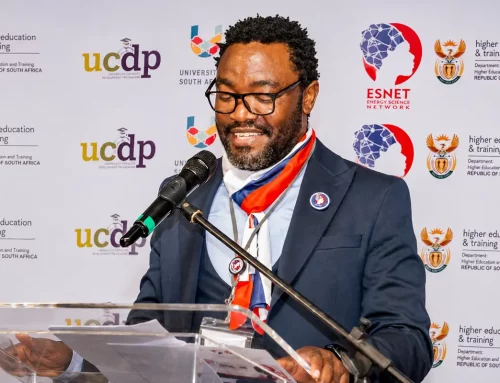
Professor Thandwa Mthembu (left), Vice-Chancellor and Principal of the Durban University of Technology, framed institutional capture as a fourth crisis added to what he described as the existing triple crisis of hegemony, legitimacy, and the unique institutional systemic being of universities.
Instead of dwelling on definitions, Professor Mthembu chose to focus on what the university is not. “As I said earlier, when the university is no longer what it is and or when the environment in which it operates forces it to be what it is not, it would have been hollowed out of its essence, and it would have been captured. Its purpose would remain bastardised. Its very existence as we know it would cease..”
He then focused on two concepts he described as noble, namely democracy and transformation, and how their application in university environments can hollow out the institutional purpose.
On democracy, he drew a distinction between what he called aggregative democratic practice, drawn from the political arena, and the deliberative form of democratic practice suited to universities, which is grounded in dispassion, reason, evidence, and rationality. He argued that when student organisations apply politically inclined democratic practice to university decision-making, including decisions about academic calendars, lecture attendance, and examination outcomes, the university loses its defining character. He described this as intellectual capture.
On transformation, Mthembu cited a recent public debate around the proportion of foreign nationals in South African academic posts, currently estimated at between 7.7% and 12%, depending on the source. He contrasted this with figures of approximately 33% in the United Kingdom and over 23% for pre-tenure academics in the United States, arguing that applying transformation frameworks that treat a comparatively small proportion of international academics as a problem misapply the concept, weakening the sector’s competitiveness.
Drawing on his experience at the Central University of Technology and at DUT, Mthembu described specific instances of attempted capture, including a 2018 meeting in which individuals who claimed to have supported his appointment, but without his express knowledge, later explicitly demanded a tender allocation in return. Other instances of capture attempts or corruption in security services at DUT were: a 32% unexplained budget increase for security guarding services in March 2025; the suspension of approximately five senior management officers since June 2025 — following allegations of irregular and corrupt practices; and a 2024 legal battle in which external council members sought to remove the Council Chair and the Vice-Chancellor.
He closed with a set of wisdom nuggets for fellow vice-chancellors and senior managers:
- Know the Higher Education Act, institutional statutes, the university policies, standard operating procedures, front to back, back to front. Read and read and read everything before you.
- Establish a good and clean working relationship between the Vice-Chancellor and the Registrar. The Registrar must be knowledgeable, authoritative and firm, and the Chair of Council, who must be in command, must understand this connotation of deliberative democracy very well and must be fully engaged in his or her work and not idle. Idle chairs are very dangerous.
- Do the right thing all the time and with utmost integrity.
- Keep prodigious records of your actions and decisions, facts and evidence, not only with yourself but with others. You could share records with your PA for corroborative evidence, in case your records are destroyed.
- Have the courage of your convictions in assisting the Registrar in applying relevant legislation and policies, even against the Council when it strays.
Other perspectives on Council size
Two audience members responded on the Zoom chat platform to Jansen’s recommendation regarding Council size. Ms Penny van der Bank, Deputy Registrar for Governance, Ethics, and Compliance at Stellenbosch University, noted that reducing Council size would require amending the Higher Education Act, as the Minister is entitled to appoint up to five members, and the current 60/40 internal-to-external split produces larger councils by design. Similarly, Mr Sikkie Kajee, non-executive Chairman of the Board of the Automobile Association of South Africa, cautioned against too small a Council size, saying that it risked groupthink.
Observations from practice
Also responding via the Zoom chat platform, Professor Patrick Fitzgerald (left) of the Graduate School of Public and Development Management at the University of the Witwatersrand, drew on personal experience as a former university administrator in two separate tenures, as a Council Chair, and as an executive at three different institutions.
He offered several observations on governance failures and structural reform.
Fitzgerald described as inevitably disastrous, any involvement of council members and vice-chancellors in tender and procurement processes. He also noted that at universities where council members are not paid, between 40% and 60% of government appointees do not attend subsequent meetings beyond the first.
On appointment processes, he argued that failure to delegate appointment decisions to properly constituted committees leads to double-guessing by individuals who were not part of the selection process, whether they are Council members or part of the Executive. He proposed that final approval of appointments should be limited to assuring the integrity of the process rather than changing decisions.
He described unions led by middle management as frequently acting as a shadow executive, pursuing middle-class and not working-class interests. He also identified weak executive leadership that delegates management decisions upward to councils as a capture enabler. He noted that council members without executive experience often go on to seek to direct and second-guess university leadership.
On Council composition, Fitzgerald argued that where institutional statutes allow too many discretionary appointments, a small group in Council can, over time, expand its influence by appointing cronies. To address this issue, he cited two institutional statutes he had been involved in drafting, which prescribed that numerous council members be selected by designated professional organisations such as the South African Institute of Chartered Accountants, the Law Society, and the Computer Society, as a way of ensuring member independence and no connection to existing networks.
He further proposed that Council quorum criteria should require a majority of external members to be present for a meeting to be quorate.
Following the two keynote addresses, four higher education experts took turns sharing perspectives on: systemic risk, regulatory oversight, and quality assurance; governance integrity and the role of students, staff, and civil society; executive leadership, institutional culture, and accountability lessons; and practical governance dilemmas faced by councils when political, commercial, or internal interests exert pressure.
Mduduzi Mbiza is a commissioned Universities South Africa writer.