What universities owe their staff and students in an AI-driven world
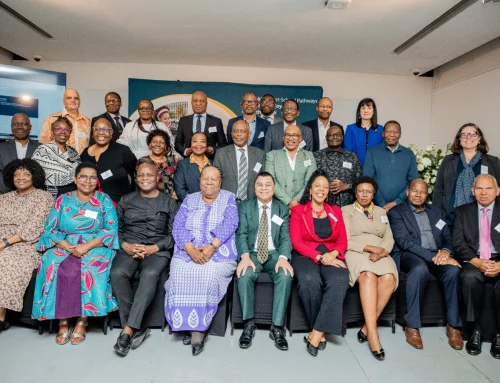
Artificial intelligence is no longer a distant prospect in higher education; it is already reshaping how students learn, how academics teach, and how both are expected to work. On 12 August 2026, the USAf Community of Practice on Digital Education in Learning and Teaching (DELT CoP) convened a webinar titled “What do universities owe their staff and students as AI transforms the way we learn, teach and work?” Universities are accustomed to asking what students and staff owe them, in terms of integrity, productivity, and compliance; this session inverted the question.
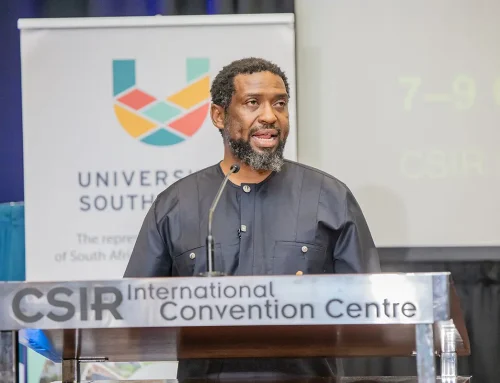
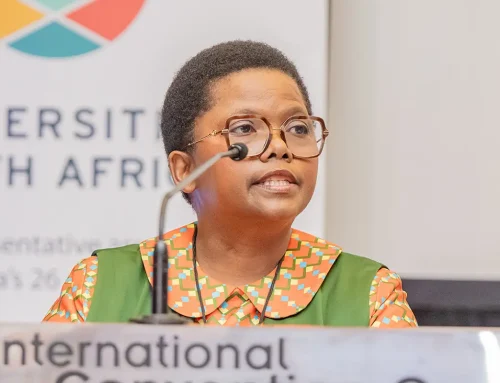
Moderated by Professor Nyna Amin of the University of KwaZulu-Natal, it paired two scholars who approach it from opposite ends: Professor Danny Liu of the University of Sydney, who thinks from the classroom outward, and Professor Willie Chinyamurindi of the University of Fort Hare, who thinks from the institution inward.
Liu opened by setting out why the question is urgent. He pointed to a Stanford study of United States payroll data suggesting that entry-level opportunities for fresh graduates have declined since generative AI arrived, even as mid-career and senior roles have held steadier. He set this against World Economic Forum surveys in which employers increasingly ask for human qualities such as resilience, curiosity, empathy, and the capacity to keep learning. Students, he noted, sit between these pressures, tempted in their own studies by tools that will do the work for them. He cited one study in which students who relied on generative AI earned higher marks on take-home tasks but scored lower in examinations, a gap he described as a learning penalty.
The view from the classroom
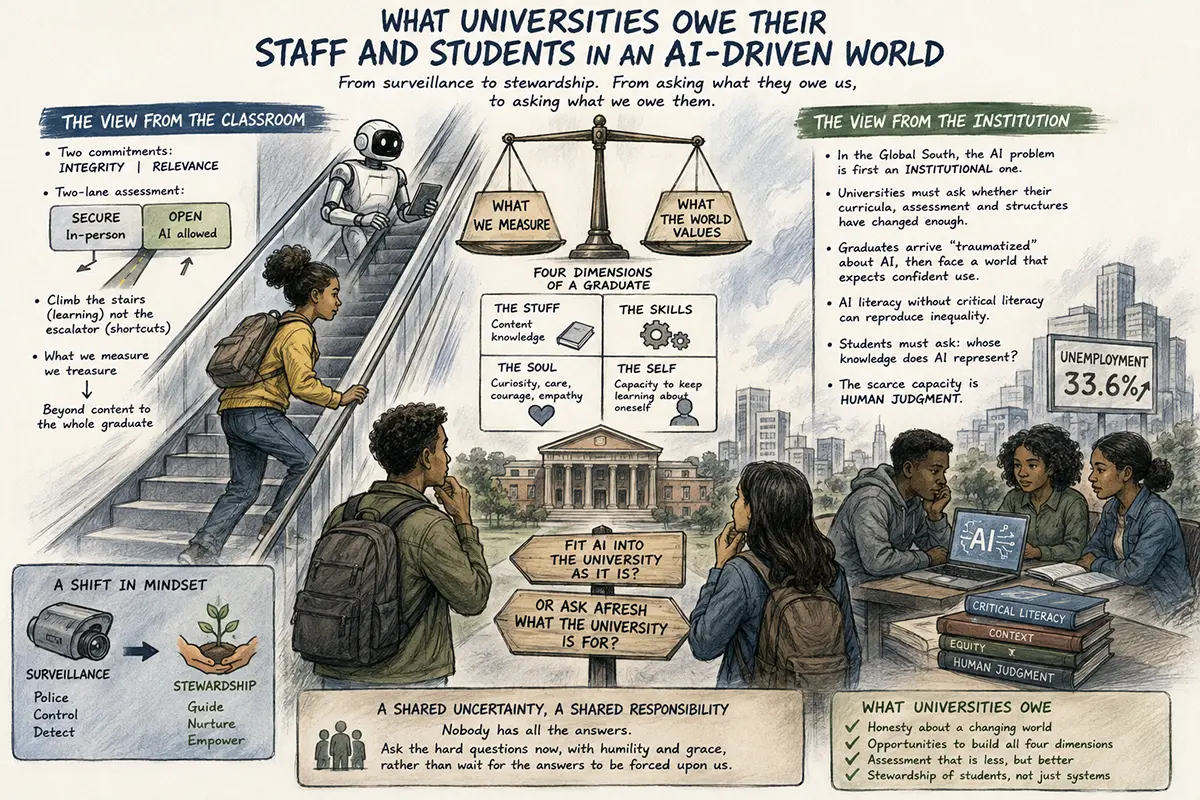
For Liu, the institutional duty rests on two commitments: integrity, so that a graduate can do what their qualification claims, and relevance, so that what they learn still matters in a changing world. On assessment, he distinguished between two responses. The first tells students what they may and may not do with AI, a rule that universities cannot enforce and one that quietly weakens the task. The second, which he regards as more honest, redesigns the task itself. The University of Sydney now sorts every assessment into what he calls a two-lane approach: one lane secure and completed in person, the other open and premised on students using AI. In the open lane, he argued, the educator’s role is not to police but to guide, much like a waiter who does not stop a diner from choosing but points them toward the healthier option.
Turning to how students learn, Liu contrasted climbing the stairs with taking the escalator. At work, the aim is to reach the top quickly; in education, the climb itself is the point, since that is what builds the muscle, and a student who hands the climb to AI may pass the task yet lose the learning. His larger concern was a misalignment between what universities measure and what the world now values. He set out a frame of four dimensions: the stuff, or content knowledge; the skills; the soul, meaning qualities such as curiosity, care, and courage; and the self, the capacity to keep learning about oneself. Employers now ask for graduates strong in all four, he suggested, yet most assessment still tests only the first. “What we measure we treasure,” he said, and the sector may be treasuring the wrong things. In its place, he urged a shift from a culture of surveillance to one of stewardship, not only of AI but of the students universities are entrusted to nurture.
The view from the institution
Chinyamurindi began by praising Liu’s attention to “the way real people use AI,” then set the discussion in the South African context. Newly released figures, he noted, put unemployment at 33.6%, a figure that rises further under the expanded definition that counts those who have stopped looking for work; any debate about AI, he warned, cannot ignore that larger world. His central argument was that, in the Global South, the AI problem in universities is not first a student problem but an institutional one. Universities expend enormous energy asking whether students use AI responsibly, he observed. Yet, the more uncomfortable question is whether institutions themselves are responding responsibly, and whether their curricula, assessment practices, and academic structures have changed enough for an AI-rich world.
He illustrated the point with an industry executive who complained that graduates arrive at work “traumatized” about AI, warned throughout their studies that using it amounts to cheating, only to find that employers expect them to use it with confidence. Yet Chinyamurindi cautioned that AI literacy, without critical literacy, could reproduce inequality rather than reduce it. He noted that at Fort Hare, some students had learned subjects such as mathematics in a home language rather than English, so building AI skills on uneven foundations risks widening gaps rather than closing them.
Students, he insisted, must be able to ask whose knowledge an AI system represents. As machines increasingly produce our writing, our code, and our slides, he argued, the scarce and valuable capacity becomes human judgment. This led to the question that reframed the dialogue: whether the task is to fit AI into the university as it is, or to ask afresh what the university is for.
A shared uncertainty
The discussion that followed rested on a shared admission that nobody yet holds the answers. Asked why some lecturers are reluctant to let students use AI, Liu pointed to a fear of appearing not to know, and proposed humility as the only real remedy. Asked how the soul of a graduate might be assessed when it is so hard to teach, he separated teaching from learning: such qualities are hard to teach directly, but they can be designed for, as when a science class abandons recipe-style laboratories and invites students to design their own experiments.
Other questions were more practical. When a participant reflected that students can feel misled, having believed a degree would guarantee a job, Liu agreed that institutions owe them honesty about a world still taking shape. Asked whether a standalone graduate-attributes course might be the answer, he preferred to weave those attributes through the disciplines themselves. He pressed on the question of how to redesign assessment without overburdening lecturers. He suggested that much of what universities already assess carries a low signal-to-noise ratio, so the real task is to assess less but better. The discussion also asked whether teachers remain the sole source of learning, now that social media and other technologies compete for attention. It acknowledged that traditional pedagogy can seem outdated unless approached with humility.
Drawing the threads together, Professor Amin observed that AI revisits enduring questions rather than inventing new ones, from cognitive offloading to plagiarism to critical thinking, while offering a rare chance to reconsider what higher education is for. What united a room spanning two continents, she reflected, was the recognition of a shared predicament. Liu closed on the same note, urging the sector to ask the hard questions now, with humility and grace, rather than wait for the answers to be forced upon it.
written by Mr Mduduzi Mbiza