A Bachelor’s pass on its own does not open doors to university education
It is a perennial challenge, yet it manifested in unprecedented ways in January 2026, as parents increasingly turned to Universities South Africa (USAf) for assistance, lamenting their children’s rejection from higher education institutions despite having achieved several distinctions.
However, USAf had no magic wand to wave. As the representative association of public universities, the organisation identifies systemic challenges and engages policymakers and other stakeholders to find appropriate solutions. That is why on 2 October 2025, USAf convened a half-day dialogue to explore this issue, which has beset the sector, particularly in recent years. The aim was to foster public understanding ahead of the 2026 academic year and to identify potential solutions, even if these might take years to materialise.
Under the theme Rethinking Post‑School Education and Training for Youth Employment in South Africa, the event addressed the twin challenges of limited university places and the risk of long‑term unemployment among unskilled youth in a modern economy. From this platform, USAf also sought to explore alternatives beyond public universities, that is, diverse learning pathways that could alleviate pressure on higher education while equipping young people with marketable skills.

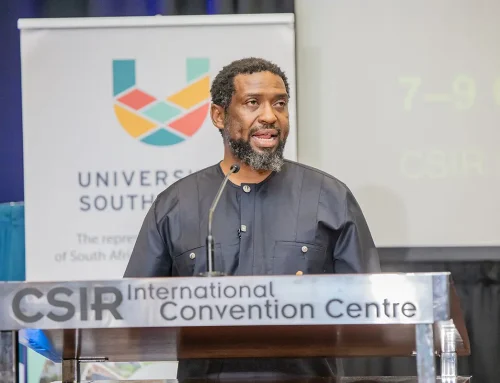
Professor Martin Gustafsson (left), Advisor to the Department of Basic Education and Economics Professor at Stellenbosch University, presented on School Completion Advancing More Rapidly than University Growth: Implications for Youth and National Development.
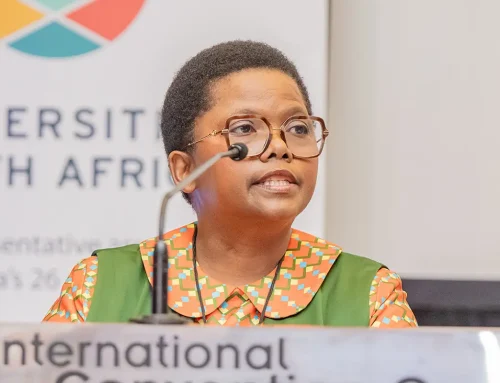
Setting the stage for four other distinguished experts invited to participate as a panel alongside him, Professor Gustafsson examined long‑term trends in school completion, university access, and the interplay between educational progress and labour market outcomes.
Mathematics is the decisive factor in university entry
Professor Gustafsson explained that, although he had long believed the Bachelor’s pass to be the key determinant of university entry, he was confronted with a rude awakening: “Mathematics is the real threshold.
Mathematics is required, at specific mark levels, for two‑thirds of first‑year university programmes. Requirements range from 40% to 60%, often in combination with physical science.”
With basic schooling not producing enough learners with these mathematics marks, it was inevitable that so many learners with a Bachelor’s pass would be denied entry to most university programmes. He said in some instances, universities were relaxing their requirements by admitting students who did not meet the mathematics thresholds – a not-so-ideal solution, he said.
He offered more explanations for this conundrum.
School success and the post-school bottleneck
Drawing on household and administrative data, Professor Gustafsson showed that the number of learners qualifying for bachelor’s or diploma-level studies had grown significantly over the past three decades (see the graph below), from 337,000 in 1994 to 526,000 in 2024.
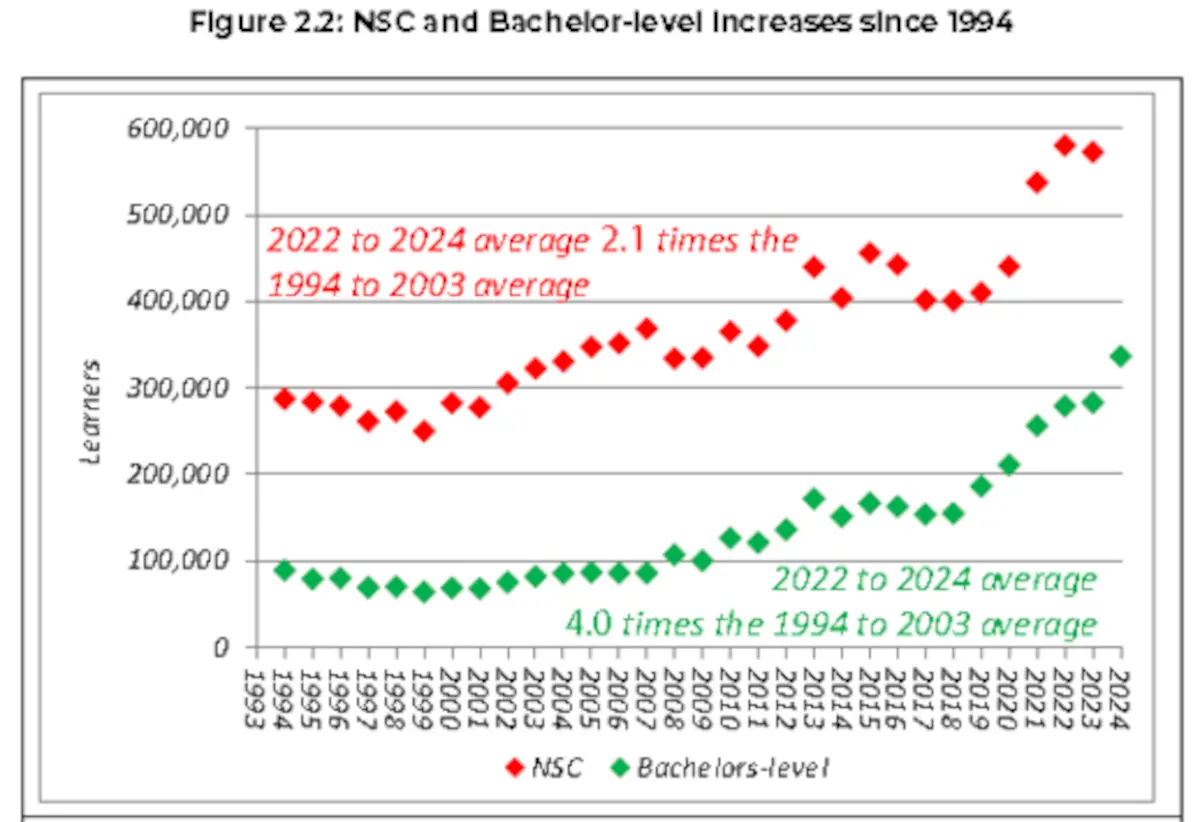
However, university admissions had not kept pace. Only about 213,000 students had entered university as first-time undergraduates in 2023. “We have tripled the number of learners who qualify for bachelor-level studies over the past three decades,” he said, “but the number of spaces available at universities has not kept up with that growth.”
He mentioned that in recent years, about 40% of qualifying school leavers get into university compared to 64 % in 2010 – another pointer that universities’ absorption capacity has not increased at the same rate as the number of school leavers who qualify.
Quality matters
Professor Gustafsson acknowledged that the international perception of South Africa’s schooling sector had improved significantly from previous years. Although “participation in schooling is extremely high by global standards, and successful completion is average for our income level, the challenge is repetition. About 30 per cent of Grade 10 learners are repeaters. “
He also mentioned that although South Africa’s National Development Plan acknowledges schooling quality as a problem, the Trends in International Mathematics and Science Study (TIMSS) data show some improvement. “In 2003, South Africa was below the curve. In 2023, we were on the curve. Our quality is still not high, but it is no longer exceptionally low…. Furthermore, the McKinsey Spark and Sustain report highlights South Africa, Peru, and Morocco as three developing countries that have improved schooling quality the most over the last 20 years.”

The scores learners obtain in the National School Certificate exam often fall short of the Mathematics and Science standards universities expect for entry into certain degree programmes.
However, considering schools’ performance in Mathematics, Professor Gustafsson concluded that increasing Bachelor-level passes is not enough.
Towards viable solutions
“If we want to expand universities, to give more young people opportunities and to grow the economy, we must consider quality. Every university graduate contributes to more than one job. We have a skills-constrained economy. Both the public and private sectors struggle to find people. In the Department of Basic Education, for example, we want statisticians and financial analysts. Many apply, but often the department decides that none are ready. The skills crisis is real.”
He also mentioned that in the current scenario, it is easier for universities to expand in Humanities than in Science, Technology, Engineering and Mathematics (STEM) disciplines. He said South Africa needs growth in STEM fields, and those require mathematics.
At this juncture, Professor Stephanie Allais, Professor of Education at the Centre for Researching Education and Labour, in the School of Education at the University of the Witwatersrand, disagreed with Professor Gustafsson’s view that expanding enrolments in Humanities would be easier than for STEM programmes.
She wrote on the Zoom Chat platform: “We have expanded universities much faster than we have expanded university funding,” she argued. “…We are placing an enormous burden on lecturers – the same logic applies as what you used, in relation to maths teachers. And it’s not true that you can teach Social Sciences and Humanities in huge numbers – the ‘skills crisis’ that you refer to relates largely to students’ ability to read and write complex prose. Teaching writing and reading well at the university level needs a low number of students per lecturer.”
Furthermore, Professor Gustafsson acknowledged that expanding universities comes with funding pressures. “Spending per university student has risen substantially, especially after Fees Must Fall, largely due to the National Student Financial Aid Scheme (NSFAS). This is good for students, but it has limited the number of students that can be funded. The World Bank report, Tertiary education enrolments must rise, argues that if spending per student rises too high, expansion becomes impossible.
Professor Allais also challenged Gustafsson’s notion that rising school achievement levels must lead to rising university enrolment, labelling it “flawed.” “The key problem is the economy,” she said. “The fact that graduates get better jobs doesn’t mean that if all members of each age cohort were graduates, they would all get better jobs.”
Maths literacy or pure mathematics?
While schools increasingly favour Mathematical Literacy over pure Mathematics, simply to boost their pass rates, the professor offered a different perspective. “Too many learners take pure Mathematics without being prepared. Almost half do not attain the minimum 30 per cent pass. Should they be in the pure Maths class? Gauteng reduced participation and pushed up the number of learners, achieving 60 per cent.”
Professor Gustafsson added that the national government’s Medium-Term Development Plan (MTDP) aims to increase the number of learners achieving 60 per cent or more in Mathematics by 2029. “The emphasis on Mathematics is correct,” he remarked, “but what seems missing is an evidence-based strategy for achieving this. We need clearer signals to learners about subject choice and the evolving meaning of a bachelor-level matric.”
Growth versus funding pressures
Amidst all the pressure to balance participation with quality and affordability, Professor Gustafsson noted that university enrolment is expected to grow by only nine per cent by 2029 – notwithstanding the higher population growth — while TVET enrolments are projected to more than double over the same period.
“Balancing post-school enrolments and per-student costs is not receiving enough attention,” he warned. “This applies to both TVET colleges and universities. There has not been enough analysis on unit costs and how these might be reduced. It is worth asking whether NSFAS can be redesigned to lower per-student costs. Reducing these costs is often viewed negatively, but doing so could allow more young people to access the system.”
He concluded by calling for stronger alignment across the education system. While the emphasis on school success and the subject mix is correct, he said greater attention must be given to how these achievements connect to post-school and labour-market outcomes.
He added that learners and parents need clearer information about subject choices and what a bachelor-level matric means, in practice. “We must send clearer signals to youth around subject selection and the evolving meaning of a bachelor-level matric.”
‘Mateboho Green is Universities South Africa’s Manager: Corporate Communications.