A R520 million bursary roll-out to 5200 students is a powerful leap for higher education
A R520 million new university bursary scheme offered by the Services Sector Education and Training Authority (Services SETA) in partnership with Universities South Africa (USAf) will assist 5200 South African university students to kick-start their tertiary studies.
This funding is open to first-time entering university students enrolled in qualifications within the focus of the Services SETA. The amount per student is capped at R100 000 per year for the duration of their studies, provided they maintain satisfactory academic progress and meet their field-of-study requirements.
This collaboration results from a shared vision between Universities South Africa (USAf) and the Services Sector Education and Training Authority (Services SETA). It aims to close funding gaps, improve student access and align university skills development with the needs of the Services SETA Sector Skills Plan 2025 – 2030.
USAf is a representative body of all 26 public universities in South Africa. Services SETA is a statutory body – mandated by the Skills Development Act of 1998 – that facilitates skills development, training and education within the services sector, promoting employment and entrepreneurship. As the largest SETA, it funds learnerships, internships and bursaries and also links qualified learners to industry.
To date, all 26 public South African universities have received R20 million, allowing 200 students at each institution to focus on their studies without the stress of financial uncertainty. Authorities at the Services SETA believe that the early distribution of funds is critical for administrative efficiencies and timely and proper verification. It also minimises reliance on emergency, last-minute funding.
USAf celebrates the support

Speaking at the project’s recently held inception workshop, Dr Phethiwe Matutu (left), CEO of USAf, said: “We know that South Africa is among the most unequal societies in the world, and that university education has repeatedly shown to be an equaliser in terms of social mobility. However, funding remains a major barrier to access to university education. This announcement marks a day of both jubilation and immense responsibility on our part as partners of the Services SETA Bursary Project.”
She referred to the National Student Financial Aid Scheme (NSFAS), which uses a combined household income ceiling of R350 000 per annum for its primary bursary scheme.
This creates a “missing-middle” gap where households earning just above this threshold, while often still facing significant financial pressure, do not qualify.
“Even those from low socio-economic backgrounds who manage to get into the first year are often later excluded due to the unaffordable costs of university education. So, the Services SETA Bursary Project provides a huge relief and will help ensure that we retain existing talent, regardless of their socio-economic background. This grant injection also reduces the ballooning student debt plaguing our universities,” she said.

Dr Phethiwe Matutu, CEO of USAf, and Mr Sibusiso Dhladhla, Acting CEO of Services SETA, at the bursary kick-off workshop on 10 April.
Dr Matutu said that USAf, along with Services SETA, would appoint external auditors and ensure that auditing was well underway before the end of the financial year, enabling universities to receive the next tranche of funding on time for returning students next year.
She appealed to universities to immediately allocate, reprioritise or return the funds that would not be utilised this year.
“As USAf, we pledge to do our best in ensuring that the secured funding expands access and success in higher education, and in ensuring that this investment yields the desired results on our economy and the society at large.”
A long-lasting legacy
Mr Sibusiso Dhladhla, Acting CEO of Services SETA, referenced past issues faced by his organisation, currently under administration for governance challenges.
“The first thing is to own up to what happened in the past and move to change things. This is one of the ways we want to rebuild our reputation. We want to show that we are an institution of value to our constituencies and to our beneficiaries. Our goal is to affirm this kind of programme so that it becomes a benchmark for other sectors to adopt. This is the legacy we would like to leave behind.”
Efficiency and accountability are key
Mr Mahlubi Mabizela, Director: Operations and Sector Support at USAf, urged all universities to instil efficiency and accountability when it comes to this new bursary scheme: “We need to strive for 100% wherever we have set targets. We just finished the first programme phase, even though some documentation remains outstanding from two of our 26 member universities. We have set targets of the end of October 2026 for the second phase and of March 2027 for the third phase. Universities must strive to align with and meet these milestones for this project to succeed.”
That sentiment was echoed by Mr Makhaya Blaai (right), Acting Executive Manager in the Office of the CEO, Services SETA.
“Some students have unpaid accounts dating back years. Many past practices did not work, including mandatory registration fees that students could not meet before their bursaries were paid. Realising that we needed an immediate and long-lasting solution, we decided, as the Services SETA, to pay institutions up front. It is a leap of faith on our side.
“We have changed our bursary model because the previous arrangement didn’t help the beneficiaries we sought to help. We have short-circuited our processes to make sure that young people access higher education.”

He encouraged universities to look at their internal systems so that each administrator understands their impact on the entire value chain: “If something is not done accurately or on time, it affects every other process.”
He said Services SETA had appointed USAf as a strategic partner to minimise problems associated with the awarding of bursaries. “I can safely say it’s a panacea for the problems faced in the past by students. We took a leap of faith with responsible people who, we trust, will timeously supply all audit-related matters for this academic year.
“By the time universities close at the end of 2026, we want to have all results from this year’s cohort so that we can pay in advance for their studies next year. Students need to come back to class and not to an administrative nightmare.
“As we progress after this first year, we will be able to see if the R20 million allocation to each university is sufficient, which will inform our future approach. Universities unable to spend their full allocation this year need to inform us so we can allocate the funds elsewhere.
“One of the fundamental tasks of leadership is to build, create and maintain hope in our young people. They leave their homes to acquire knowledge and better themselves for societal benefit. We have the chance to touch lives for the better.”
Bursary project milestones
Ms Boitumelo Malele, Manager at USAf’s Project Office, said it was important that universities meet all the bursary scheme’s financial accounting, reporting requirements and milestones so that by the end of 2026, the R520 million allocation is fully accounted for.
“We started the year with stakeholder buy-in, and by the end of March, payments to universities were achieved, except at two universities. The current phase, which ends in July, entails recruiting eligible students and channelling them into the necessary systems. During the period between July and September, we will be analysing students’ fee statements to confirm payment of their bursaries.
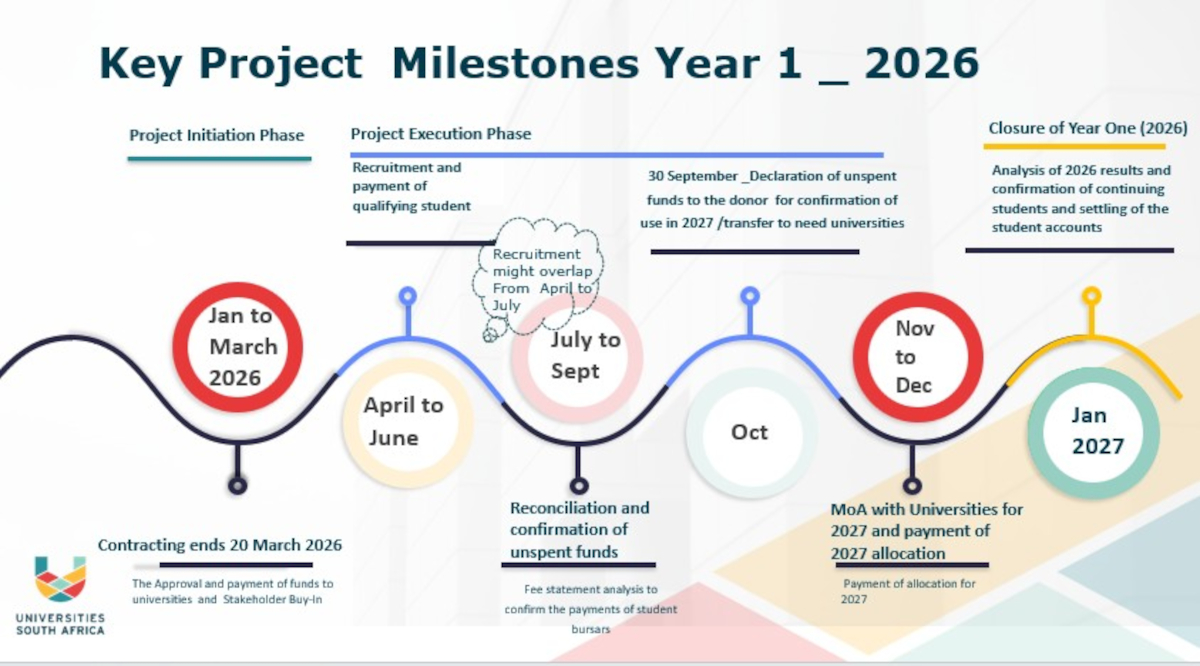
“By the end of September, we would like all unspent funds to be declared to Services SETA for reallocation in 2027. We need to re-allocate those funds.”
She said that both student support and attendance monitoring were critical.
“Universities must submit progress reports on funded students to the Services SETA every six months. In addition, they are required to notify the Services SETA in writing of any changes in a learner’s circumstances. This includes providing a list of Services SETA-funded students whose studies have been terminated, or who have dropped out.
“The university is required to submit to Services SETA a disbursement of funds report within 30 days of the end of a funded academic year, and the academic results of funded students. The university must submit a signed beneficiary list of students who have met the Services SETA criteria for continued funding in 2027, together with supporting documentation.”
Bursary eligibility criteria
Mr Sibusiso Selepe, Manager: Bursary and Special Projects at Services SETA, emphasised that the bursaries were available to newly-entering, unemployed students. Only South African citizens enrolled at public institutions may apply.
Janine Greenleaf Walker is a contract writer for Universities South Africa