AI debates concerning universities – ‘the robots are marking each other!’
The signs are unmistakable: learning and teaching at institutions of higher learning will never be the same in the age of rapidly advancing artificial intelligence (AI). And while AI has presented many opportunities, universities still face many challenges, including developing and implementing policies and pedagogical innovations.
Recently, the University of Cape Town (UCT) adopted a university-wide framework that governs the integration of AI technologies into teaching, learning and assessment. The University also decided to abolish the use of detection tools such as Turnitin’s discredited AI Score to identify machine-generated student work, from 1 October 2025.
In the US, a student this year filed a formal complaint against her university, demanding a tuition refund after discovering her professor was secretly using AI.
These issues were recently under the spotlight at the University of the Free State’s seventh annual Thought-Leadership Panel discussion on 17 July.
Facilitated by University of the Free State (UFS) Vice-Chancellor and Principal Professor Hester Klopper, the panellists were Professor Pamela Dube, Vice-Chancellor and Principal of the Central University of Technology (CUT); Professor Paul E Green, Deputy Vice-Chancellor: Teaching & Learning at Sol Plaatje University; Dr Phethiwe Matutu, CEO of Universities South Africa (USAf) and Dr Max Price, a now retired former Vice-Chancellor of the University of Cape Town, whose recently published memoir, Statues and Storms – Leading Through Change, offers his account of UCT during the turbulent and transformative period of #RhodesMustFall and #FeesMustFall student movements of 2015-2017.
The theme of this Thought Leadership was Reimagining Higher Education for Employability and Sustainability.
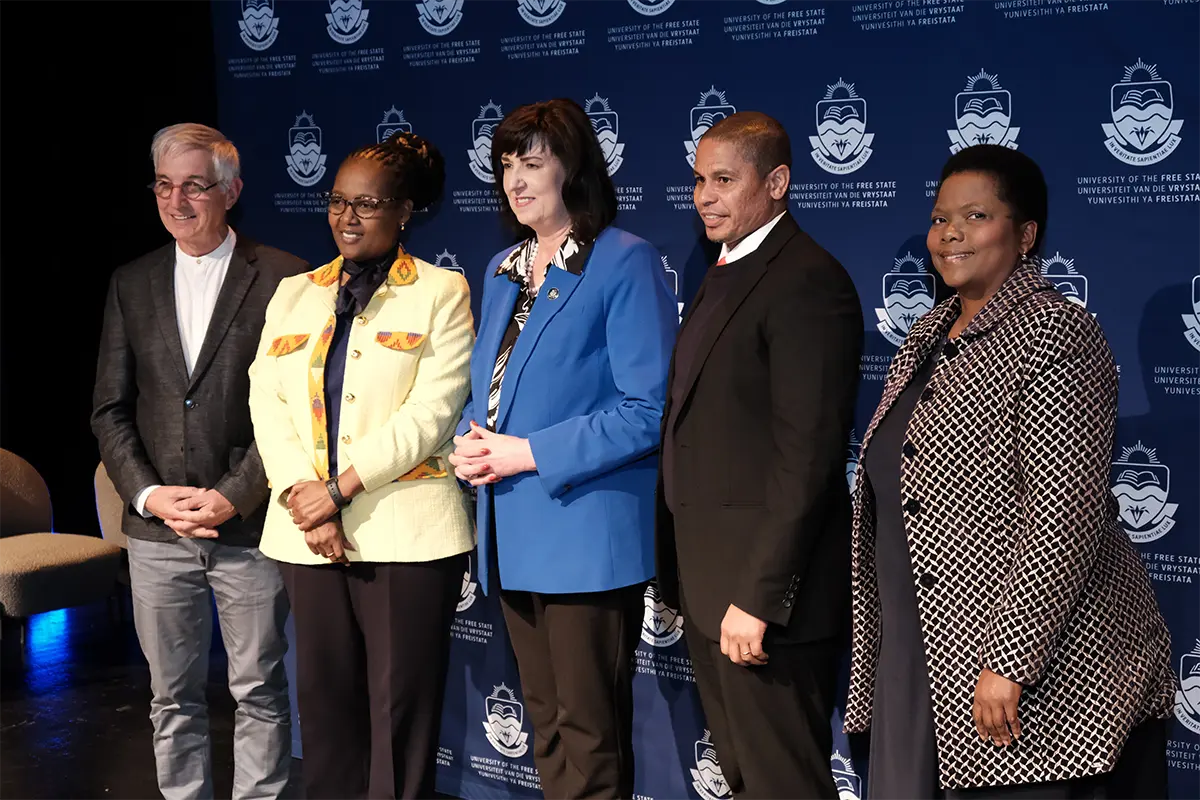
From left: Dr Max Price, a former and now retired Vice-Chancellor and Principal of the University of Cape Town; Professor Pamela Dube, Vice-Chancellor and Principal of the Central University of Technology; Professor Hester C. Klopper, Vice-Chancellor and Principal of the University of the Free State (the host); Professor Paul E Green, Deputy Vice-Chancellor: Teaching and Learning at Sol Plaatje University; and Dr Phethiwe Matutu, the CEO of Universities South Africa.
Professor Green emphasised the urgency for universities to adapt to AI, citing a UNESCO study projecting the loss of nine million jobs within the next three to five years due to artificial intelligence.
Embracing AI
“We speak of curriculum renewal, and academics must discuss the impact of AI in the various disciplines. It will be a sad day when we realise we are producing graduates for jobs that no longer exist—replaced by AI.”
He said that while ethical frameworks are inevitable, universities must be proactive and not wait for regulations.
“When calculators and computers were introduced and the Internet first came about, we didn’t just sit around waiting for guidelines; we started working with them. AI is here, many people are making use of it, and so we have to co-exist with it and embrace it.”
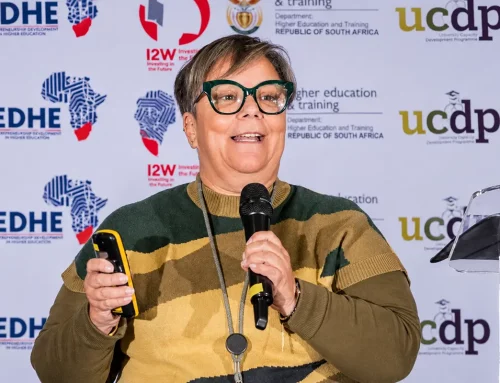
Dr Matutu (right) said that USAf has established a Community of Practice on Digital Education in Learning and Teaching (DELT CoP), which also explores AI issues. She also cited Carleton University in Ottawa, Canada, which has stopped penalising students for using AI.
‘The robots are marking each other!’ – Matutu argued
“When considering whether to incorporate generative AI tools into a course, lecturers will need to start by determining whether these types of tools align with the course learning outcomes,” she said. “For academic disciplines, it will be important to rethink how to continue using essays and other forms of written assessments to evaluate students’ knowledge and skills in light of generative AI.”

Dr Matutu also mentioned the fact that some universities in the US have started using AI to evaluate assignments. “So the robots are marking each other! The students are upset about being marked by a robot without an academic being involved. However, many of the essays are written by ChatGPT.”
However, equally important to how AI is used is the issue of who is being left out.
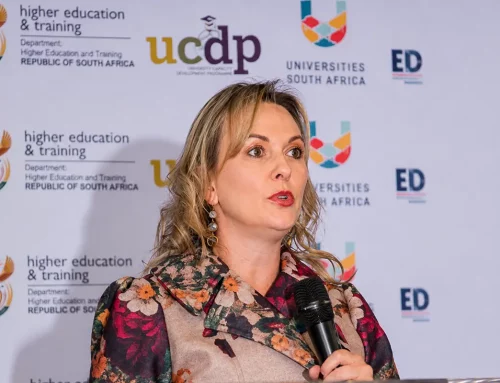
“As much as we need policies and guidelines around the ethical use of AI, universities need to play a role in making sure that the use of AI and other fast-changing technological advancements are inclusive. At the core, for me, is the human-centred approach to the responsible use of AI,” commented Professor Dube (left).
“We must consider creating dedicated task teams to explore these technological developments and the impact they have on our academic agenda. There is probably more plagiarism now than before, not just from students but also from staff. We need formal guidelines. Sometimes I feel that I work for a legal office because many of these issues come to the Vice Chancellor’s office. This necessitates dedicating a competent team to deal with these many investigations and to guide the University’s response.”
Beyond policy guidelines, Professor Dube said technological advancements need to be addressed on a practical level — in the classroom, to get students and graduates “future-ready”.
“While reminding ourselves that we are the ones who introduced these technological expansions, we need to maintain some level of control. We will always lag behind these fast-changing developments. However, we must ensure clarity about who they serve, for what purpose, and that the soul of the university is not compromised.”
The UFS Thought-Leader Series, now in its eighth year since 2018, has established itself as a leading programme that contributes to local, regional, and global knowledge. It gathers distinguished, nationally recognised leaders and change makers who contribute meaningfully to public discourse on social, economic, and political issues facing South Africa and the globe. The series gained popularity as it progressed to a webinar platform, except for one face-to-face panel discussion annually in collaboration with the Free State Literature Festival.
Past participants in the series included Professor Bonang Mohale, Chairman of Bidvest and SBV Services and Chancellor of the University of the Free State; Mr Joel Netshistenzhe, a former political activist and now Executive Director of MISTRA; Professor Thuli Madonsela, the former Public Protector and now Law Professor and Chair in Social Justice at Stellenbosch University. Leading academics, scientists, and many civil society activists, including Dr Imtiaz Sooliman, Chair of the Gift of Givers, have also graced this event, which is freely accessible and open to the public.
Janine Greenleaf Walker is a contract writer for Universities South Africa.