AI will not fix broken university systems, data scientist warns
Professor Vukosi Marivate urged universities to test artificial intelligence, invest in African expertise and protect human judgement rather than mistake access to technology for educational progress.
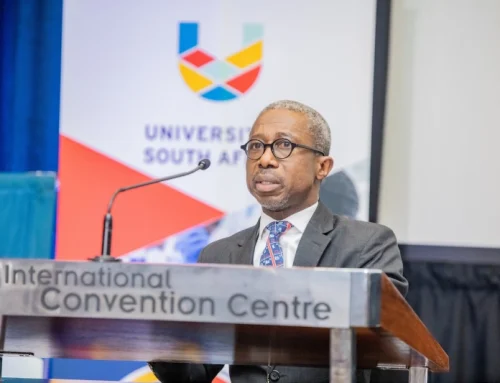
Artificial intelligence (AI) may help universities produce lessons, analyse research, and develop new services faster, but it will not, by itself, repair weaknesses in teaching and assessment. Institutions that fail to test these technologies also risk deepening existing inequalities, warned Professor Vukosi Marivate, holder of the ABSA University of Pretoria (UP) Chair of Data Science and Director of the African Institute for Data Science and Artificial Intelligence at the University of Pretoria.
“The AI that exists does not mean that things are improved,” Professor Marivate warned. He said universities needed evidence that the technology strengthened learning, assessment and research, rather than assuming faster production of material amounted to educational progress.
The warning came during “Data and Digital Transformation” on Thursday, 8 October 2026, Day Two: Reimagining Universities, at the 4th Universities South Africa (USAf) Higher Education Conference. Held from 7 to 9 October at the Council for Scientific and Industrial Research (CSIR) International Convention Centre in Pretoria, the conference carried the overarching theme “Co-Creating a Resilient Future”.
Professor Marivate addressed the plenary chaired by Professor Lynn Morris, Deputy Vice-Chancellor: Research and Innovation at the University of the Witwatersrand. He challenged universities to shape AI technologies to meet African needs rather than remain customers of systems designed elsewhere.
The problem was there before the chatbot
Professor Marivate rejected the assumption that generative AI had created higher education’s assessment difficulties. “It’s not the AI that broke our assessment. Assessment was already long broken,” he said, pointing to the market for paid assignment assistance that preceded chatbots. Generative AI had reduced the cost of obtaining ready-made answers, exposing assessment practices that placed too much weight on submitted work and too little on students’ understanding.
“Please do not use AI detectors. It doesn’t matter who promises you what,” Professor Marivate told delegates. He argued that systems designed to mimic human writing would defeat attempts to reliably distinguish machine-generated text. Universities should instead assess how students develop, test and defend their work.
Professor Marivate urged lecturers to restore the stages of learning that automated answers can conceal. A machine might produce an examination paper in seconds, but the lecturer still had to test every question against the learning objectives. “The validation was never going to go away,” he said.
Fast output is not proof of learning
Professor Marivate said artificial intelligence could shorten the execution stage of an assignment while increasing the demands of planning and verification. He illustrated the problem with AI-generated computer code: an experienced developer could spot an implausible solution, but a novice who had never written the code might not recognise the mistake.
That left younger students and researchers particularly exposed, he warned. “They never learn to do validation because they never did the execution in the past.” His concern was not simply that students could submit incorrect work, but that they might leave university without the judgement needed to identify errors.
His response was not to exclude AI from teaching. He advocated deliberate exercises in which students plan before using machines, work through feedback with others and test what is produced. The aim was to make the learning process visible even where technology could perform parts of the task.
“I will prioritise process over product,” Professor Marivate said, citing principles developed in his laboratory. He urged students to make time for independent planning, discussion and what he called “radical scepticism” rather than accept machine-produced answers without question.
African languages expose the limits
Professor Marivate challenged the assumption that systems developed elsewhere would work reliably in African settings. Referring to demonstrations of chatbots responding in local languages, he said they made conspicuous mistakes once tested beyond familiar examples. “You need to test these things,” he insisted.
He cited African-language research as a central part of his work, alongside examples of AI supporting medical decision-making, detecting environmental changes in satellite images and improving understanding of changing settlement patterns. These applications illustrated a field much broader than chatbots.
Researchers could, for instance, train models to identify protected trees in satellite images and flag possible damage for inspection, he explained. Others could analyse roads and settlements to help inform planning between population censuses. Such work depended on local data, specialist expertise and validation.
“How do we become co-creators and not just users?” Professor Marivate asked. He urged universities to build African-language datasets, local models and research infrastructure, and to use those assets to address problems identified by African researchers and communities.
The African Institute for Data Science and Artificial Intelligence at Pretoria, which he said had recently held its inaugural conference, was intended to support collaboration among researchers across disciplines. He linked its purpose to mentorship and institutional support for students, early-career academics and people building the wider research ecosystem.
Buying software is not building capacity
“Capacity over tools,” Professor Marivate urged. He criticised the rush to adopt products offered to universities before academics had established whether they worked. Institutions, he said, needed people who could “validate, evaluate” and challenge suppliers’ claims before a technology was deployed across a campus.
The costs also mattered. He referred to paid access to sophisticated AI services as an expense that could compound quickly when multiplied across students and employees. Assuming that everyone had access to the same systems, he said, overlooked inequalities in who could use them and under what conditions.
Professor Marivate cited a Microsoft report published earlier this year indicating that fewer than 25% of South Africans aged 15 to 64 had directly used a generative AI product. He cautioned universities against assuming that students enjoyed widespread access simply because such tools were familiar in technologically confident academic circles.
Local deployment could sometimes help institutions keep data within their control, he explained, although it required technical capacity and suitable equipment. Questions about privacy, reliability and responsibility could not be settled merely by choosing the latest commercial platform.
Professor Marivate insisted that human accountability could not be delegated to software. Citing a 1979 IBM presentation, he reminded delegates: “A computer can never be held accountable.” Universities and governments, he argued, must remain responsible for decisions taken with the assistance of automated systems.
Delegates challenge the investment choices
A delegate from the University of the Free State questioned the scale of global AI investment when communities still needed basic support. Another speaker urged universities to develop a shared understanding of the technology rather than responding on an institution-by-institution basis. Their questions brought the debate back to choices about funding, academic responsibility and public benefit.
A third contributor asked why South Africa continued to consume imported technology rather than produce innovations of its own. Professor Marivate replied that universities and funders could not demand certainty before supporting research. “You’re supposed to be exploring the world,” he said, arguing that experimentation was central to discovery.
He challenged the belief that African researchers should stay out of fields dominated by better-funded countries. Waiting until success was assured, he argued, would prevent the country from developing the skills and infrastructure required for future breakthroughs.
Professor Marivate told delegates that South Africa spent 0.67% of gross domestic product on research and development, against targets of 1.5% in the National Development Plan and 1% under the African Union. He argued that universities needed investment from other parts of society, especially the private sector, because government could not simply double existing research budgets.
Professor Marivate questioned why businesses supported established foreign suppliers while overlooking local research. “What we end up doing as a consumer is now actually subsidising the other countries’ R and D ecosystems,” he said. He urged South African institutions and investors to back domestic capabilities even when initial experiments failed.
Universities must test what they buy
Professor Marivate said the early rush to introduce AI applications in education and health had often preceded evidence of their value. The questions had changed, he told delegates: “Show us efficacy.” He argued that a university could not treat access to a chatbot or a new platform as proof that students were learning more.
Professor Marivate rejected the claim that Africa had missed its opportunity to develop useful AI. “There’s nobody who’s coming to save us,” he said, warning that overseas vendors were willing to sell products without ensuring they met local needs. Universities had to invest in their own expertise, experiment and retain the capacity to reject systems that failed their tests.
Professor Morris closed the session by returning to Professor Marivate’s appeal for universities to examine the value of AI before adopting it and to become co-creators of technology rather than passive users.
Bhekisisa Mncube is a contract writer for Universities South Africa.