An early-career scientist is chasing a breakthrough in African medicine
It begins in Maseru, Lesotho’s capital, a place surrounded by mountains and memory. Mr Carlos da Silva grew up watching the world change from the vantage point of a childhood shaped by family duty, ambition and the unspoken expectation that education would carry him beyond his home borders.
He does not describe it as privilege. “My parents were both working professionals. My mother became a qualified teacher around the time I was born, and my father worked in construction,” he tells me.

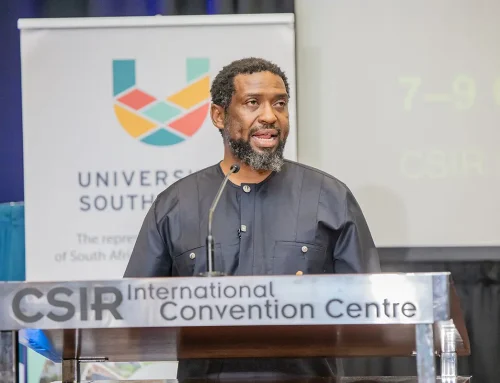
Da Silva (left) was speaking on the sidelines of the Advancing Early Career Researchers and Scholars (AECRS) 2025 Workshop at an OR Tambo Airport venue, outside Johannesburg, on November 28, 2025.
“I was born in Maseru, and I grew up in a family where education was taken very seriously,” he says. “My sister was the first to graduate, and my brother went into medicine. They opened the path, and I followed.”
He was the youngest child by more than a decade. His siblings were already at university while he was still learning to write his name. The dinner-table conversations were different from those in many households. They spoke about anatomy diagrams and medical textbooks; about building careers and carving out a life beyond what was expected. His older brother placed posters from a science competition on his wall. The images were cryptic and mesmerising.
“When I was six or seven, my brother used to show me his medical textbooks. He would explain things to me that I did not understand, but it was exciting,” he recalls. “He was the one who made me want to become a scientist.”
That early seed never left him.
A journey that crossed borders and expectations
The family moved to South Africa when he was still young. His schooling and early academic life took place in Bloemfontein and later Cape Town. He studied biomedical technology and later completed a postgraduate qualification in medical laboratory sciences. The path was not glamorous. It required navigating an academic landscape notoriously difficult for early-career scholars.
He remembers the transition vividly.
“I did my undergraduate studies in Bloemfontein, then I went to Cape Town for further studies. South Africa became my second home, but it was very different from Lesotho. You need to adjust quickly.”
The expectation to succeed did not come from external pressure. It was woven into the family identity. His sister became a lawyer. His brother entered medicine. His parents worked multiple jobs and created stability not through wealth, but through sacrifice. He speaks of them with respect, not sentimentality.
“They believed education was the only way to secure a future. They were right.”
The turning point: science and the pandemic
Da Silva graduated into a world on the brink of crisis. CoViD-19 tore through South Africa, stretching both healthcare and science to breaking point. It was not just a global health emergency. It was a test of the country’s scientific capacity.
He began his Master’s research when laboratories shut down, and academic routines fell apart. Supervisors moved online. Experiments stalled. Meetings vanished into screens. The world was paralysed, yet the need for solutions was urgent.
“It was chaos at first. Everything stopped,” he says. “My research had to continue from home. I had to lecture and study at the same time. But you have to keep going.”
His research focused on three South African indigenous plants with potential antiviral and anti-inflammatory properties. One shrub, found mainly in the Eastern Cape, showed the most promise.
“We wanted to see whether these plants could fight the virus. There were no drugs then. No one understood the virus properly,” he says.
The results were striking. The plant reduced the viral load and the inflammatory process associated with severe CoViD-19. The implication was profound. It suggested that locally sourced medicinal plants could serve as the basis for future therapeutic interventions.
“We saw that the plant could decrease inflammation. That is what makes CoViD-19 so dangerous. It was a breakthrough,” he says.
Yet the project’s future depends on funding and supervision.
“There is still more to do. We have to identify the chemical compound and repeat the results. It needs support.”
Academic ambition comes at a cost
The ambitious scholar is now looking for a PhD supervisor. He has applied to programmes at the University of the Witwatersrand. The barriers he faces are familiar: funding, mentorship and institutional access. He understands the risk of disappearing into the system. Many young scientists leave academia before they reach the doctoral level. Others go to the countryside and disappear. He does not want to leave the country. He wants to contribute here.
“It takes passion,” he says. “Experiments fail. Life gets in the way. You have to want to finish.”
His view is practical but hopeful. He speaks about scientific research not as an academic exercise but as a public good.
“There is still a need for intervention. CoViD-19 will continue. We need African solutions.”
The programme that changed his trajectory
Da Silva joined the Advancing Early Career Researchers and Scholars (AECRS) programme earlier this year. He received an email invitation and began attending the webinars and engagements that followed.
Run by Universities South Africa (USAf) and funded by the Department of Science, Technology and Innovation (DSTI), the programme was created after consultations with all 26 public universities revealed a crisis in the academic system: promising young researchers were falling through the cracks.
AECRS provides the support that the sector lacked. It offers structured mentorship, the Community of Practice for Postgraduate Education and Scholarship, and two national platforms.
Thuso Connect matches postgraduate scholars and potential supervisors across institutions.
Thuso Resources is an open-access library of training materials, research instruments and postgraduate development tools.
He attended webinars. He engaged with supervisors and peers from different universities. He found mentors and collaborators.
“I received the email, and I was interested immediately. I started attending, and I saw the direction. They want people from different universities to connect,” he says.
Thuso Connect and Thuso Resources became part of that journey. The platforms offer mentorship and shared research tools. They allow early-career scholars to access supervisors, academic communities, and open-access materials nationwide.
“A supervisor is right there on the platform. You can talk to someone who understands your field,” he says.
He has already begun supervising undergraduate research projects. He is becoming the mentor he once needed.
A scientist shaped by displacement and resilience
Da Silva’s academic trajectory is not only the product of individual ambition. It is shaped by migration, opportunity and the informal networks of African families who cross borders in search of education. His story is part of a much larger pattern. Southern Africa continues to produce some of the continent’s most promising scientists, but the academic environment remains fragile.
His story is also about belonging. He navigates two identities – Lesotho and South Africa – but his scientific language has always been universal.
“Science has no borders,” he says.
Yet he is clear about where the work should take place.
“Why must we wait for solutions from outside? The plants are here. The knowledge is here. The problem is here.”
The future written in a laboratory
Da Silva believes the field is still wide open. He knows that breakthroughs come slowly and that he may never win global recognition. But he also knows that someone must keep looking, keep testing, keep asking.
“There is already a window of opportunity,” he says. “We saw the results. We need to continue the research.”
He is driven – not by glory – but by the idea that African science has not yet been allowed to reach its potential. He carries the legacy of a childhood shaped by books and mountains and the conviction that science belongs to everyone.
He came to South Africa more than two decades ago. He stayed because this country became the place where his future took shape. The laboratory he once imagined as a child in Maseru has become real.
The question now is, who will support him as he takes the next step?
A life measured not only in research, but in purpose
Da Silva has a message for the next generation of postgraduate students and early career researchers. “It will be difficult. But you must have the passion. You have to want it.”
He does not romanticise it. He has lived its complexity. He has seen research interrupted by pandemics, funding gaps and personal challenges. Yet his belief in science is unwavering. “I realised this is what I want to do,” he says.
His journey proves one thing. Africa’s next major scientific breakthrough may not come from a global laboratory or multinational pharmaceutical company. It may come from a plant in the Eastern Cape and a young scientist who began his life in Maseru and refused to stop asking questions.
Da Silva is still at the beginning of his story. The work is not complete. The future is waiting.
Bhekisisa Mncube is a contract writer for Universities South Africa.