Beyond youth access to Post-School Education and Training to employability: Recommendations from USAf’s inaugural Thought Leadership event
What emerged from the Inaugural Thought Leadership event of Universities South Africa (USAf) on 2 October 2025 was not a single solution, but a set of ideas pointing to the need for a more diversified, integrated and economically responsive post-school education and training system.
We cluster the recommendations into sub-themes, below.
1. Mathematics as a gateway subject
One outstanding insight was the insufficiency of a Bachelor’s pass as a passport to enter university education.

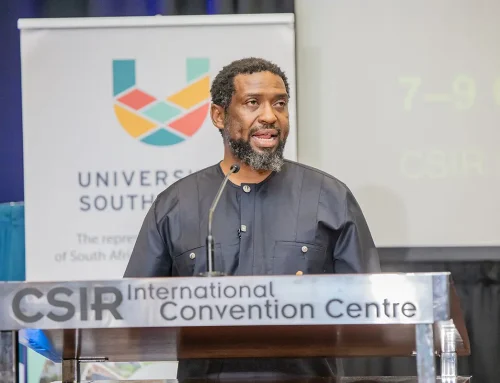
Drawing from national data, Professor Martin Gustafsson (left), Advisor to the Department of Basic Education and Professor of Economics at Stellenbosch University, demonstrated that Mathematics, rather than the Bachelor’s pass itself, functions as the decisive threshold for entry into most university programmes.
Illustrating that two-thirds of first-year university programmes require Mathematics at specific mark levels, often alongside Physical Science, he argued that the system sends unclear signals by celebrating Bachelor’s passes without explaining that subject combinations, particularly Mathematics, determine actual eligibility for study. From his contribution emerged this recommendation: Learners and parents require accessible, centralised information linking subject choices to university admission requirements and post-school pathways well before Grade 12.
An interesting debate ensued. One was reacting to Professor Gustafsson’s intimation to restrict participation in pure Mathematics for learners who appear to be struggling in the subject. That raised views around entrenching inequality and diverting attention from systemic issues such as uneven teaching quality and weak foundational learning. Another delegate questioned the use of Mathematics as a gatekeeper without alignment to curriculum demands, particularly in non-STEM disciplines.
Professor Stephanie Allais (right), Professor of Education in the School of Education at the University of the Witwatersrand, recommended strengthening learner support in foundational Mathematics to ensure they master the subject from basic schooling to exiting tertiary.
2. Career guidance and parental involvement
While converging on Mathematics as a critical gateway subject, these perspectives recognised that subject choices that shape access to post-school pathways are often made years before learners receive credible career guidance or clear information about admission requirements, occupational routes and labour market realities. This underscored the need for early-career guidance, improved teaching quality, parental involvement and clearer signalling about post-school education and training options.

Mr Sakhile Phiri, Lecturer and Programme Coordinator in Development Studies at Nelson Mandela University, echoed this view by arguing for greater learner exposure to the full spectrum of qualifications offered across the PSET sector, as well as clearer articulation pathways into further study and the labour market.
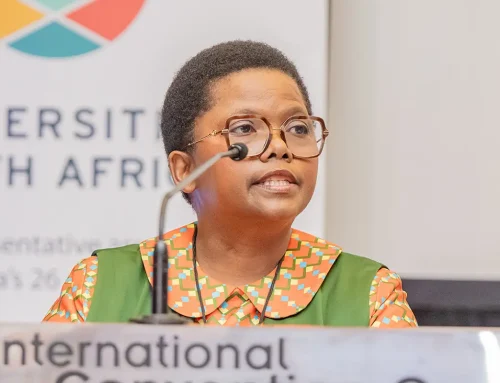
Ms Nuraan Davids-Latief (left), Lecturer and PhD candidate in Information Systems at the University of the Western Cape, emphasised integrating career guidance into teaching from as early as Grade 8, particularly to help learners understand the long-term implications of taking or not taking Mathematics. Contributors also highlighted that without credible information, parental expectations often reinforce a narrow definition of success centred exclusively on university education
3. Repositioning TVET Colleges as future-oriented pathways
In his presentation on TVET Colleges as Feasible and Future-Oriented Post-School Education and Training Pathways, Dr George Mothapo, Secretary-General of the South African Public Colleges Organisation (SACPO) and Principal of Sedibeng TVET College, called for a deliberate national effort to reposition technical and vocational education as a future-oriented and viable option.
He noted that although TVET colleges produce artisans and occupational graduates aligned with economic demand, they are generally perceived as “second-choice” institutions. Elevating their status, he argued, must begin with dismantling the narrative that, without a university degree, there is no hope of economic success.
Dr Mothapo (right) emphasised that rehabilitating the image of artisanship requires:
- Visible investment in TVETs’ infrastructure and programmes.
- Lecturer professional development, recognising that it takes an artisan to produce an artisan. They must, however, be equipped with a teaching methodology.
- Robust industry partnerships to ensure programme relevance and credibility, and to secure work-integrated learning opportunities.
- Clear progression routes for students to advance academically or professionally.
- Strong employment outcomes that demonstrate the value of vocational qualifications.
He reiterated that TVET colleges are not just an alternative for those who’ve been rejected elsewhere but a destination of choice for those who know what they are likely to become at colleges.

4. Articulation between TVET colleges and universities
When Dr Mothapo highlighted the fragmented recognition of Nated qualifications and the limitations of institution-specific articulation agreements, another delegate questioned why articulation of TVET graduates into universities remains marginal and whether funding mechanisms meaningfully support such transitions.
Dr Ruth Andrews, Manager: Experiential Learning at Stellenbosch University, advanced this discussion by calling for the breakdown of silos between universities, TVET colleges and community colleges. She contended that functional articulation requires shared quality frameworks, credit recognition and curriculum alignment across the Department of Higher Education and Training (DHET), the Council on Higher Education (CHE) and the South African Qualifications Authority (SAQA). Without this, institutional diversity risks reinforcing hierarchy rather than enabling mobility and progression.
Thus, a recommendation emerged for stronger, system-wide articulation between TVET colleges, universities and other post-school institutions.
5. Correcting the myth surrounding the Bachelor’s pass

At a system level, it emerged that enrolment planning and resourcing at public universities further complicates articulation, as Dr Denyse Webbstock (left), Senior Director for Institutional Planning, Evaluation and Monitoring at the University of Johannesburg, explained. She demonstrated how multi-year enrolment agreements linked to funding, staffing and infrastructure govern enrolment growth, prompting a call for clear and deliberate public information to enable societal understanding that a Bachelor’s pass qualifies a learner for consideration but does not entitle them to admission. This requires universities, policymakers and sector bodies to collectively correct the misconceptions that fuel admissions crises year on year.
Regarding expanding universities to increase their absorption capacity, Professor Stephanie Allias cautioned against expansion without sustained investment, particularly in the Humanities, where teaching reading and writing well requires low student-to-lecturer ratios. The Dialogue participants agreed that expansion must be aligned with funding and strengthening education and training for realistic labour market outcomes.
6. Recognise public, private and community education and training provision as a shared system
Dr Carin Stoltz-Urban (right), Chief Operations Officer of Inscape Education Group, confronted entrenched divisions between public and private institutions, arguing that private providers meet the same quality standards yet remain marginalised in funding, national planning and public positioning. Dr Shirley Lloyd, who represented the Association of Private Providers of Education, Training and Development (APPETD), supported Stoltz-Urban, further asserting that the apparent exclusion of private providers from national reports distorts the national picture of post-school capacity.

Dr Stoltz-Urban added: It is worth considering whether the DHET might extend certain block grants – such as the Teaching Input Grant, Teaching Output Grant, and the Research Output Grant – to private institutions as well and perhaps keep their National Student Financial Aid Scheme (NSFAS) to public HEIs. Such an initiative could enhance access to higher education for a broader population, considering the limited spaces in HEIs. Also, private HEIs try their best to maximise retention and throughput rates, “arguably for profit”. However, the benefit would be more people with qualifications. We can always talk about the quality of these resultant graduates.
Together, these contributions reinforced the recommendation that public, private and community education and training providers must be understood as parts of a shared ecosystem rather than competing silos. Dr Lloyd observed that the ANC’s 1994 vision of integrating education and training was yet to be realised.
That said, the delegates added that even a more integrated and diversified post-school system and expanded capacity and access across providers would not guarantee meaningful economic participation if the labour market remained unable to absorb the growing graduate numbers.
7. The economy as the missing variable
Professor André Roux (left), Head of Academic Programmes in Future Studies at Stellenbosch University, presented a sobering view that education alone cannot resolve youth unemployment in the changing economy.
He recommended shifting attention from access alone to alignment between learning and livelihood, emphasising lifelong learning, adaptability, entrepreneurship and economic agency emerged as essential capabilities.
He said today’s and future work demands learning agility, adaptability, empathy and transdisciplinary thinking encompassed in the acronym STEAM, representing Science, Technology, Engineering and Mathematics [STEM] disciplines, with an A added to the mix to include Arts.
“So you need learning competencies: cognitive and reflective competencies; human competencies; cognitive competencies; technological competencies; and active strategies to develop essential skills. It is important to point out that technology is one of the competencies — not the only and dominating one.”
One delegate said it was time society embraced other ways of income generation outside of full-time employment – the so-called gig economy. This, however, required intentional development of the requisite skill sets.
Ultimately, there was general agreement that post-school education and training need to respond to emerging and future labour market needs to enable youth absorption into the economy.
To sum it all up, Dr Ruth Andrews (right) suggested the solutions below.
- Focus on youth employability, not just qualifications: She argued that too many graduates of both universities and TVETs struggle to transition into work because the system prioritises certification over employability. Embedding work-integrated learning (WIL), experiential learning, apprenticeships, and entrepreneurship training across all post-school institutions is key (Akoojee & McGrath, 2017). Programmes must connect directly to growth sectors such as the green and digital economies, health and creative industries.
- Strengthen TVETs and community-based colleges as engines of skills development by aligning curricula to industry needs; employer partnerships for apprenticeships and internships; modern facilities and digital access. She said Germany’s dual system is a successful model of industry-college collaboration. Dr Webbstock supported the idea of strengthening TVETs, which aligns with the current policy aspirations.
- Expand Community Colleges as bridging and second-chance institutions, offering literacy, digital skills, life skills, and pathways into formal HE/TVET, serving those who are out-of-school, the unemployed, or in rural, underserved areas. Dr Andrews added that partnering with local municipalities, NGOs, and employers can help anchor them in communities. She cited the Danish VUC colleges as a strong model of viable partnerships.
- Reimagine TVETs and Universities as integrated hubs for innovation and inclusion: They need to broaden their role beyond qualifications production by:
- Offering affordable and stackable short courses, micro-credentials, and blended learning options.
- Creating innovation hubs that link students to start-ups, SMEs, and social enterprises. (Cloete, 2016; Brown et al., 2020).
- Strengthen Private Sector–Education Partnership: Shared investment in skills ecosystems. Private sector funding, equipment donations, and mentoring can strengthen under-resourced institutions, particularly TVETs and community colleges (OECD, 2017).
- Bridge the trust gap: South Africa has often suffered from weak coordination between the state, business, and education (Cloete, 2016). Multi-stakeholder platforms can help rebuild trust and create joint accountability for youth employability.
- Policy and systemic support: Success requires joined-up policy across the departments of Higher (DHET) and Basic Education (DBE), and industry. Use data systems (like graduate tracking) to monitor where students go and how pathways can be improved.
The 2 October event was the first in a series aimed at shaping the national discourse on the challenges confronting the sector, influencing policy reform and identifying other corrective measures that the university sector could adopt.
Equipped with the wisdom gathered on 2 October, USAf’s task is now to translate the recommendations into action as the organisation gears up for the next theme in the ongoing series. The next event is envisaged in May 2026.
Thoriso Kolobe is a Communication Consultant commissioned by Universities South Africa.