Bridging the gap between education and employability
South African students at institutions of higher learning continue to face barriers – not only of financial exclusion – but limited access to work-integrated learning (WIL), which helps bridge the gap between theory and employment.

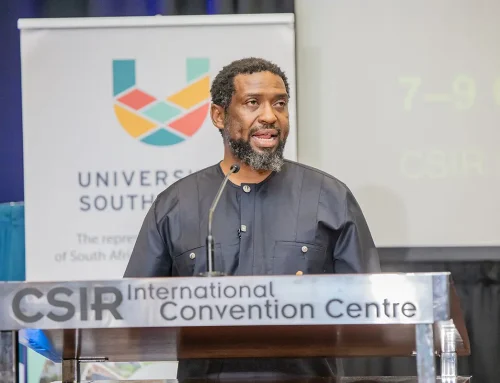
“We have to address the elephant in the room: the high unemployment rate in South Africa and, very alarmingly, that one out of four graduates is unemployed,” said Professor Paul E Green (left), Deputy Vice-Chancellor: Teaching & Learning at Sol Plaatje University.
Professor Green made this point as part of a four-speaker panel recently hosted by the University of the Free State in Bloemfontein. The event, held on 17 July, marked the University’s eighth annual Thought-Leader Panel Discussion, titled Reimagining Higher Education for Employability and Sustainability.

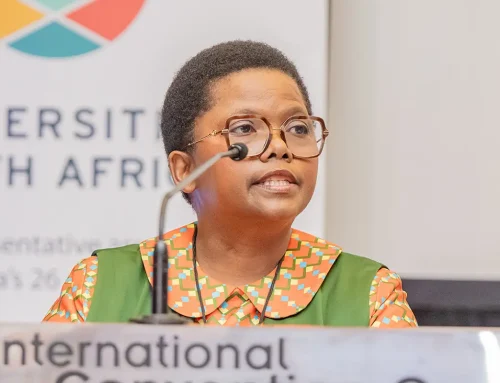
Hosted by Professor Hester Klopper (middle, above), the UFS’s Vice-Chancellor and Principal, the discussion included (from far left), Dr Max Price, a now retired former Vice-Chancellor of the University of Cape Town, whose recently published memoir, Statues and Storms – Leading Through Change, offers his account of UCT during the turbulent and transformative period of #RhodesMustFall and #FeesMustFall student movements, of 2015-2017; Professor Pamela Dube, Vice-Chancellor and Principal of the Central University of Technology (CUT); Dr Phethiwe Matutu, CEO of Universities South Africa (USAf); and Professor Paul Green, Deputy Vice-Chancellor: Teaching & Learning at Sol Plaatje University.
“I’m not advocating that WIL is the overall panacea, but it is a necessary intervention,” Professor Green stated. “Studies indicate a significant gap between a graduate’s theoretical knowledge and their ability to apply it. We must look at countries where WIL has been very successful. We need national government involvement to get business and industry to partner with universities in terms of the co-education that needs to take place.”
Professor Dube (right) agreed that universities needed to prepare their students for the workplace. To achieve that, they must form strategic partnerships and work with a variety of partners, including the Government and Business.
“We are not only preparing our students for the corporate world, but also equipping them to be responsive and responsible citizens. As universities of technology, we distinguish ourselves through a curriculum that ensures students’ industry exposure by their third year. Our staff, too, must stay abreast of rapid technological advancements.

“We are committed to producing work-ready graduates in today’s fast-evolving landscape. We assess our impact not only through Work-Integrated Learning (WIL) placement rates—which, I’m proud to say, often reach 99.9%—but also by the fact that more than half of our graduates are employed by the very industry partners who hosted them during WIL. Our database of more than 2,000 employers, both local and global, continues to grow. It is a mutually beneficial relationship, as our partners also gain valuable insights from engaging with us.”
One of the biggest problems universities face, she said, is funding. “Government does not subsidise WIL. We rely on our industry partners for this continuous learning from the classroom to the workplace, and back.”
Entrepreneurship is vital
Dr Matutu (left) informed attendees that WIL practitioners have drafted and submitted a proposed Work-Integrated Learning (WIL) policy to the government, emphasising the importance of official adoption and funding of such initiatives.
“Our economy is not growing at the same pace as our youth population. If you look at our population pyramid, you’ll see that young people aged 19 to 34 make up 30% of the population— a stark contrast to developed countries, where youth account for only 10%. This demographic reality means we cannot rely on the same strategies used by developed nations. Entrepreneurship is therefore critical, and must be nurtured and embedded into our curricula so that some of our graduates are empowered to become job creators. Entrepreneurship among students is also a valuable form of WIL that needs to be developed and supported.”
Professor Green said that if he had to propose one bold and actionable intervention to reposition South African higher education, it would be to introduce a credit-bearing national integrated work-study programme to enhance work-readiness.
“We need an intervention from the very top to pull in the private sector to get involved in skilling our students.”
Professor Dube agreed wholeheartedly. “We need to adopt WIL as an effective pedagogy. It must be implemented at a national level, bringing together universities, industry, and all relevant stakeholders. As universities, we also need to focus on various sectors and work collaboratively. The National Skills Development Plan (NSDP) 2019 was designed to boost South Africa’s economic growth, job creation, and social development by enhancing the skills and capabilities of the workforce. However, its implementation has yet to gain momentum. We have not yet piloted the plan successfully in a single area to demonstrate its impact and enable scaling it nationally as a best-practice model.
In his response, Dr Price (right) opposed the suggestions to pull everyone together.
“I think one of the strengths of our university system is the autonomy that universities have in a differentiated higher education landscape as opposed to a one-size-fits-all scenario, which is a bad idea in my opinion. The promotion of WIL and work-study groups could be of great benefit to the universities of technology, but could be a serious threat to other universities. I would want to ensure that the kinds of autonomy we have continue,” he said.
Quality of programme offerings
“We’ve got to pay much more attention to the quality of what we’re teaching, and take a hard look at graduate unemployment and why we’re not making a more significant contribution to the economy. Many employers doubt the work-readiness of some graduates and how well their institutions equipped them for the workplace. There are many factors, including investment in teaching that has been declining incrementally over the past 20 years. It’s very hard to maintain quality if you’re going to keep cutting teaching budgets. This has partly resulted from the massification of higher education. While we understand the politics behind it, in my view, we must rethink this.”

He referenced the German-speaking part of Switzerland, which utilises a two-track system in secondary education, primarily differentiating between academic and vocational paths.
“Perhaps we should reduce enrolment numbers at universities and redistribute students into a system like this, which I think is much better, and one that we should pursue. However, we must ensure that the students we admit into university are properly prepared and that we support them properly to achieve a high-quality education. Otherwise, we are failing them, costing them a lot of money, and in turn, they are costing the economy even more.”
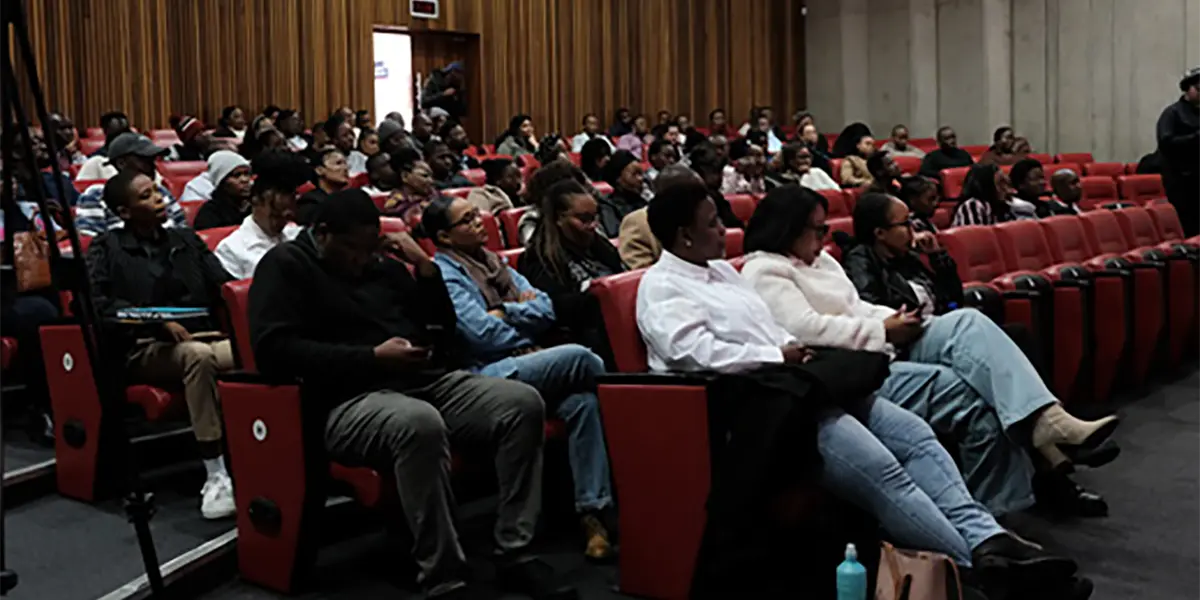
The in-person audience on 17 July.
Discussion
In an open discussion that followed this debate, an audience member asked about the contribution of the faith community at South African universities.
Dr Price said he was always struck, at UCT, by the fact that the largest student societies, by far, were the faith societies.
“They provide a community for students who come from all over the country and are often dislocated from their families. They give these students a home and play an incredibly important part in their adjustment and in their success. It’s also the faith communities that enable students to cope with the mental health challenges that they often face because universities just do not have enough psychologists, psychiatrists and other counsellors to deal with these issues.”
This was a view that Dr Matutu supported by echoing that faith-based groups are organised with a good infrastructure. “They are a base which universities can tap into,” she said, reiterating that universities can work with the societies that are active on campuses.
“Inculcating values within our graduates is a big issue receiving much attention lately. So, instilling value-based leadership and ethical values in graduates is not easy for universities. This is where church-based communities are better-placed to play a role.”
She said USAf had recently received a letter from the Anglican Archbishop of Cape Town, the Most Reverend Thabo Makgoba, referencing the G20 Summit and the importance of supporting the V20 Summit [1], both of which take place later this year in South Africa.
“It’s important to play a role in this movement. Universities produce our country’s human capital, which must adopt certain values to be able to lead,” Dr Matutu concluded.
The UFS Thought-Leader Series, now in its eighth year since 2018, has established itself as a leading programme that contributes to local, regional, and global knowledge. It gathers distinguished, nationally recognised leaders and change-makers who contribute meaningfully to public discourse on social, economic, and political issues facing South Africa and the globe. The series gained popularity as it progressed to the webinar platform, except for one annual face-to-face panel discussion in collaboration with the Free State Literature Festival. The event is free and open to the public.
Janine Greenleaf Walker is a contract writer for Universities South Africa.
[1] Values 20 (V20) is a global community of values experts and practitioners engaging with the Group of Twenty (G20) to provide evidence-based, human-centred policy solutions to global challenges. In the context of South Africa’s Presidency of G20 in 2025, V20 SA’s vision is to recommend values-based policy perspectives in SA’s public policy, and to influence G20 leaders in pursuit of evidence-based, human-centred policy solutions that will contribute to overcoming global challenges.