Closing the Gender Gap in STEM Careers – A Radiographer’s and a Sportswoman’s Perspectives
Radiology departments often display stark warnings: Pregnant women not allowed. The reason? Radiation poses serious risks to unborn children, including birth defects and childhood cancer.
These were the opening words of Dr Hafsa Essop at the University of Pretoria’s 7th Women in Science event on 8 August. A Senior Lecturer in UP’s Department of Radiography and founder of PregiDose—a mobile app designed to monitor foetal radiation exposure—Dr Essop is pioneering safer practices for pregnant radiographers. Though still in the process of commercialisation, PregiDose promises to be a vital tool for women in the field.

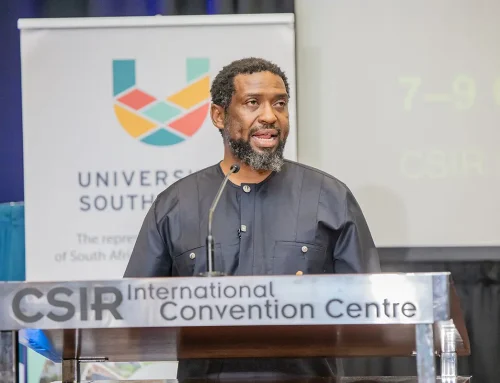
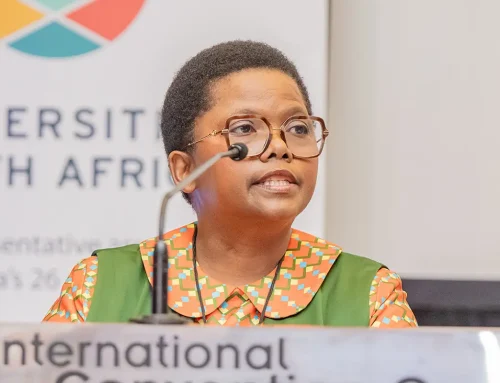
Dr Essop (above) was addressing an audience at the University of Pretoria’s 7th Women in Science event on 8 August, while also moderating a panel discussion sub-themed Closing the Gender Gap in STEM. She shared this platform with Dr Phethiwe Matutu, Chief Executive Officer of Universities South Africa, who spoke on Shaping the Future We Want: The Power of Inclusion and Diversity, and Ms Thato Semono, Head Girl at TuksSport High School, who addressed the topic Imagine a World with More Women and Girls in Science.
Identifying the problem
To date, the only available solution has been a dosimeter—a R15,000 device that tracks radiation exposure. But when Dr Essop, herself a young mother juggling an academic career with two toddlers, asked colleagues how they used it, she was stunned by the response: “I don’t know, I never used it—I kept it in the drawer.”
This revelation sparked her PhD research. She found that not only were women unaware of how to use the device, but many employers weren’t providing it at all.
“This became the focus of my first article drawn from Phase 1 of my research,” she said, “a study that quantified the issue.” She presented her findings at a Society of South African Radiographers conference in Cape Town in August 2023, drawing attention from academics and industry professionals alike. Her talk, The Voice of the Vulnerable: A Situational Analysis, struck a chord.
“People came up to me and said, ‘Wow, we didn’t know this was happening.’ Others said, ‘Thank you—this has been a long-standing issue, and finally someone is addressing it.’” That moment affirmed for her the power of research to drive change.
Understanding the depth of the problem
In Phase 2 of her research, Dr Essop conducted a workshop with experts, formerly pregnant radiographers, and representatives from the South African Health Products Authority (SAHPRA) in January 2023. The goal was to dig deeper into the issue of foetal dose recordkeeping.
“During my pregnancies, while others celebrated me at baby showers, I couldn’t stop thinking about the struggles of pregnant radiographers,” she shared. “Employers would say, ‘if you can’t work without a dosimeter, then leave.’ Women feared losing their jobs and stayed, doing the bare minimum to protect themselves. They faced gossip, prejudice, and isolation—often from fellow women who labelled them ‘lazy.’”
The findings from this workshop revealed that safeguarding the mental health and safety of pregnant radiographers was a priority. That’s when she began building the PregiDose prototype—designed to tackle the very issues raised, from recordkeeping to accessibility. And so, the app (shown below) was born.

After completing the PregiDose prototype, Dr Essop registered to present it at the International Commission for Radiological Protection (ICRP) Symposium. Her submission was accepted—and she was shortlisted as a finalist for the prestigious Cousins’ Award, named after former ICRP Chairperson, Dr Claire Cousins. The award honours the best presentation by a young scientist or professional and is a coveted mark of scholarly excellence.

From left: Werner Rühm (Chair ICRP), from the Federal Office for Radiation Protection (Bundesamt für Strahlenschutz, BfS ), Germany; Ämilie Degenhardt, BfS; Amy MacIntosh, Macquarie University & Australian Nuclear Science and Technology Organisation (ANSTO), Australia; Hafsa Essop, University of Pretoria, South Africa; Claire Cousins, Fellowship of the Royal College of Physicians (FRCP), United Kingdom; Hisanori Fukunaga, Hokkaido University, Japan; and Christopher Clement, Scientific Secretary & CEO, ICRP, Canada.
The ICRP International Symposium on the System of Radiological Protection, held in Tokyo from 6–9 November 2023 (above), became the stage for Dr Essop’s presentation, alongside emerging scientists from Australia, Japan, and Germany.
Africa shared in South Africa’s glory

Dr Claire Cousins (right), the sponsor of the Cousins Award, presents the much-coveted prize (a trophy and a certificate) to Dr Essop.
“At the gala evening, when they announced my name as the Cousins’ Award winner, I was completely shocked,” recalls Dr Hafsa Essop. “Later, one of the judges told me, ‘Thank you for tackling a real-world problem—something tangible and useful in radiation protection.’”
Her most vivid memory from Tokyo? The moment fellow African researchers surrounded her, celebrating not just her win, but a collective African triumph. “It felt like they had come with me—we embraced it as an African victory.”
At the UP Women in Science event, Dr Essop shared photos from Tokyo and showcased handmade posters gifted to her by two supportive women in their 40s before her trip. The posters were filled with affirmations: ‘Phenomenal woman,’ ‘You’re so talented,’ ‘You’re a winner already!’
Closing the gender gap by uplifting others
“For me, closing the gender gap means creating and maintaining support systems,” she said. “It’s about older women paving the way—not with money, but words of encouragement. It’s about colleagues saying, ‘I’m proud of you,’ and truly meaning it. It’s also about supervisors who show up.”
She credits her supervisor, Professor Mable Kekana, for being that unwavering support. “Her schedule is packed, yet she always makes time for me. She’s like a mother at her daughter’s ballet practice—present, even if briefly. When my kids are sick, she encourages me to put them first. Closing the gender gap is about the whole village rallying behind you as a young scientist.”
Women study in the most trying of circumstances
Dr Essop echoed sentiments shared earlier by the keynote speaker of the day, Deputy Minister of Science, Technology and Innovation, Ms. Nomalungelo Gina. The Deputy Minister had voiced concern over the National Research Foundation’s PhD funding eligibility age cap of 35.
She noted that for many women, their late 20s to early 30s are deeply intertwined with childbearing and family-building responsibilities—often up to the age of 35. “Beyond that, they begin to focus on building their careers. That’s why some only pursue a PhD closer to 50,” she said, prompting laughter from the audience. “I’m still working on mine now, in my 50s—my children are grown, and I can finally concentrate on my studies. This isn’t the same reality for men. Yes, they’re fathers, but they don’t shoulder childcare responsibilities to the same extent. This is just one example of the barriers that hinder women’s career progression. I’ve raised this with the NRF and asked them to reconsider the age threshold.”
Reflecting on her own journey, Dr Essop shared a deeply personal moment: “Four weeks before the participatory design workshop—during Phase 2 of my study—my mother passed away. I had to show up while grieving, and show up I did, pushing through that year with courage. At the same time, I was caring for my elderly father. I pushed through it all, and I’m not sharing this for sympathy, but to highlight how easy it is for others to see only the highlights in one’s career. People admire the rainbows, but they rarely see the storms we weather during our PhD journeys.”
Bridging the gender divide while wearing many hats
Adding to the weight of her responsibilities, Dr Essop shared that she is happily married to an incredible husband with old-school values—who expects to find a home-cooked, hot meal waiting for him every day when he gets home. “So I wear multiple hats,” she said with a smile. “I’m a chef, a chauffeur, a teacher, a nurse—and sometimes, a fire-breathing dragon. Knowing that many of us juggle these roles, and even more, I look at today’s theme and ask: how do we close the gender gap when our plates are already so full?”
“As a woman, I’m deeply aware of the significance of these challenges,” she continued.
In her closing remarks, Dr Essop reflected on a point made earlier by Dr Phethiwe Matutu, CEO of Universities South Africa, regarding the misrepresentation of men in STEM fields, especially considering that 60% of undergraduate graduates are women. “Closing the gender gap isn’t about sidelining men,” Dr Essop opined. “It’s about partnering with them. Our strength lies in solving problems together. Women often carry more burdens, and our pain thresholds are remarkably high.”
Pointing to a photo in her PowerPoint presentation, she added, “Even in clinical practice, you see the gogos with worn-out knees, exhausted bodies, and you wonder: how did they get this far? They just keep pushing. This is where science and technology must step in. We need to use innovation to solve real problems. Often, the answers lie in engineering.”
She concluded with a note of encouragement: “We must plant seeds of innovation early. We need to embed the words ‘innovator’ and ‘inventor’ in our little ones. That’s what I’m doing with my four-year-and six-year-olds—in whom I already see future inventors.”
Continuous elevation is enough to motivate young women to change the world
Then the podium welcomed Ms Thato Semono, Head Girl at Tuks Sport High School. Although she does not study science, she embraced the opportunity to address university researchers and professors.
“I may not be a woman in science… but I’m a young woman, and I’m alive. To live is to be part of science—because science is simply humankind discovering and making the best use of the world around us. We all have a role to play. That must be why I’m here today.

“I stand here as Head Girl of a sports school, where girls reach further, run faster, and dream bigger every day,” she said to loud applause. “Today we’re asked to imagine a world with more girls in science. I think that world will be fast, easy, and brilliant—a world where girls talk chemistry without being told to ‘calm down,’ where takkies and goggles are taken as seriously as lab coats. Where ‘you’re too pretty to be smart’ becomes ‘you’re powerful—go change the world!’”
Ms Semono spoke of being raised in a home and community of women who had taught her the value of great, grace, and showing up — especially during tough times. She praised her mother, “my role model, my anchor, a woman of strength and humour, who taught me there’s nothing more important than a girl with a plan—and a backup charger,” sparking laughter from the audience.
She honoured her late grandmother, “whose wisdom oozed euphemia, courage, love, and resilience. She taught me to speak truth, even when the world goes quiet. She’s gone now, but every step I take continues her legacy.”
She credited her three teachers, including her retired principal, for “juggling knowledge with kindness, igniting curiosity, and instilling a growth mindset in all of us. Thanks to women like them, girls like me can take up our places, pursue our passion in both sports and academics, and break barriers.”
Her coaches earned praise too—especially “the fierce women who push me through the toughest days. My checkerboard coach taught me to find my next gear when my legs were burning. My gym coach showed me that strength is built through repetition, and that confidence matters as much as muscle. They showed me what earned willpower looks like.”
Girls must be motivated to take up their place in society
At the core of the Head Girl’s tribute were women who had shaped her resilience, taught her to stand tall, and inspired her to be more for herself. “That’s the beauty of the world we’re imagining: where girls don’t just ask ‘Can I?’ but say ‘I will.’ Where leadership, innovation, and discovery wear heels, sneakers, lab coats—and sometimes school uniforms,” she said to thunderous applause. “And where more women stand up, and more girls are inspired to do the same.
“So I say YES to more women and girls in science—more women making the world better. Thank you, University of Pretoria, for believing in young voices. And thank you to every woman, every role model, who helped me find my Viva, Bafhadzi, Viva!
The Women in Science commemoration seeks to honour the achievements of exceptional women in STEM and to explore pathways for strengthening the pipeline of the next generation of women and girls in science, as South Africa moves towards a more inclusive and gender-equal future. The 2025 event was hosted at UP’s Future Africa campus on the eve of National Women’s Day.
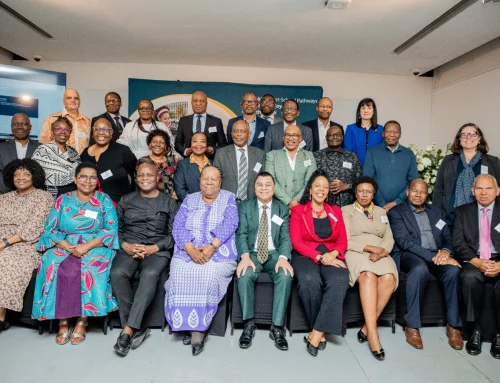
The audience was made up of scientists and researchers representing the University of Pretoria and other institutions, namely Nelson Mandela University, the University of South Africa, senior officials from the departments of Higher Education and Training (DHET) and Science, Technology and Innovation (DSTI), representatives from the Academy of Science of South Africa (ASSAf), the German Development Agency (GIZ) South Africa, Loreal South Africa, and Greenhill Laboratories.
‘Mateboho Green is Universities South Africa’s Manager: Corporate Communications.