HELM facilitates understanding of the three institutional types provided for in a new policy
“We do not need all of our institutions in higher education aspiring to become universities. We need a differentiated higher education system.”

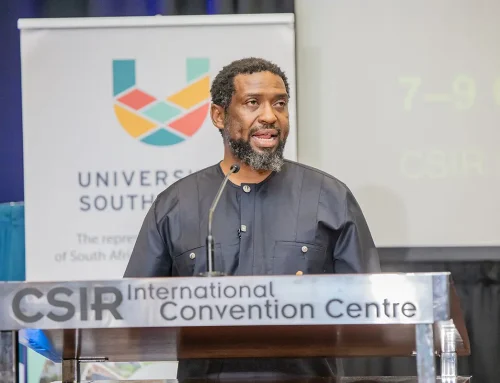
This was the message delivered by Dr Whitfield Green (left), the Chief Executive Officer of the Council on Higher Education (CHE), during the Higher Education Leadership and Management (HELM) ENGAGE 21 webinar held on 4 March 2026. HELM ENGAGE is a series of monthly intellectual engagements hosted online by Universities South Africa’s HELM programme on topical issues in higher education.
Dr Green was one of three panellists invited to provide insight into the recently approved Policy for the Recognition of South African Higher Education Institutional Types, which was published by the Department of Higher Education and Training (DHET) and gazetted in October 2025.
The discussion, themed “Common Ground: Rethinking Universities Together,” brought together higher education leaders to reflect on the new policy implications for relationships between different institutional types and how they collectively serve students and society.
The “size and shape” of the system
Dr Green said the policy should be understood within the broader context of what he described as “the evolution of the size and shape of South Africa’s higher education system,” he stated. He traced the historical development of South Africa’s higher education landscape, beginning with the system structure before the advent of democracy.
He then turned to the policy itself and noted, “What the new institutional types policy is seeking to do is to pull public and private higher education institutions, as well as public colleges, into a continuum of higher education institutions”.
The apartheid higher education landscape
Painting the pre-1994 picture, Dr Green said the higher education system was “highly fragmented and racially segregated. Universities, technikons and colleges were established along racial and geographic lines, reflecting the policy priorities of the apartheid state.”
At the time, he continued, the system consisted of approximately 21 public universities, 15 Technikons and a large number of colleges, including around 120 colleges of education responsible for teacher training.
He further said these institutions were located in specific regions and designed to serve particular population groups, with programme offerings shaped by the development objectives of that era’s government.
Transformation post-1994
Dr Green then outlined how policy formation and reform unfolded after the transition to democracy. He began by highlighting the aims of White Paper 3: A Programme for the Transformation of the Higher Education System (1997), which set out a vision for a single national system capable of expanding access while maintaining institutional diversity.
He informed the delegates that the White Paper proposed a programme-based higher education system that would be planned, governed and funded as a coordinated national system while recognising diversity in institutional form and mission. “Through a series of mergers and incorporations, the system was reconfigured into the 26 public universities that we have today.”
Policy developments leading to institutional types
Dr Green continued to map the policy developments that eventually led to the introduction of new institutional types within the sector. He referenced later policy developments, including the White Paper on Post-School Education and Training (2013) and the National Plan for Post-School Education and Training, both of which emphasise the importance of a differentiated system capable of responding to national development needs.
Explaining that higher education must be understood within this broader framework, Dr Green said: “Higher education does not exist on its own. It is part of a wider post-school education and training system that includes TVET colleges, community education and training colleges, and other skills development institutions.”
Within this broader system, the idea of institutional differentiation continues to evolve.
A continuum of higher education institutions
Dr Green pointed out that amendments to the Higher Education Act created the legal basis for recognising different institutional types within the higher system.
“A public higher education institution may be established as a higher education college, a university college or a university, depending on the scope and range of its operations.”
Higher education colleges, Dr Green said, focus primarily on undergraduate teaching and learning and may offer qualifications from higher certificate level. University colleges operate within a more limited scope but may develop into universities over time. Universities, by contrast, have a broader mandate of offering undergraduate and postgraduate programmes, including doctoral degrees, while also undertaking research and community engagement.
Differentiation within the system
Dr Green also clarified the principle of differentiation, stating that “it should not be seen as creating a hierarchy within the system,” he said. “It is about recognising that different institutions have different roles to play within higher education.”
He noted that the policy introduces several forms of differentiation: mission differentiation, programme differentiation and structural differentiation across institutional types.
Higher education colleges, he added, are intended to focus strongly on teaching and learning, addressing what he described as a tendency towards “mission drift”, where institutions go on to emulate the traditional research-intensive university model.
The policy, he stated, aims to clarify institutional mandates while supporting a system that can expand access, strengthen teaching and learning, and promote research and innovation across different institutional types.
A discussion
Dr Green’s presentation prompted a discussion, with delegates seeking to understand how the framework would apply to specialised institutions.
Ms Celeste Labuschagne, Lecturer and Learning Framework Developer at Belgium Campus iTversity in South Africa, asked: “In light of this, will Belgium Campus iTversity fall under the university college classification since we concentrate on a niche market even though we have postgraduate degrees?”
Mr Jozua Loots, a retired executive at the South African Revenue Service (SARS), asked: “Will private institutions be considered ‘specialised universities’ if they have a deep focus across all levels of the Higher Education Qualifications Sub-Framework (HEQSF), appropriate research and engagement, but with an intentionally narrower range of disciplines?” he asked.
In response, Dr Green said: “For me, it is not what you fall under, but what you see yourself doing in the sector. Rather than being forced to occupy a particular institutional type category, it is about the institution being clear about its vision, its mission, its mandate and what its contribution is.”
He noted that institutions which do not yet meet the criteria for a particular institutional type may need to develop in that direction over time. “In that case, it will be a developmental trajectory to get to where you want to be,” he explained.
Further audience questions and comments highlighted uncertainty regarding procedural pathways, with participants asking whether private institutions must first register as higher education colleges before transitioning toward university or university-college status. Another concern was that institutional differentiation could evolve into hierarchy rather than complementarity. Participants explicitly questioned how the system might guard against stratification between institutional types.
In conclusion, Dr Green positioned the Institutional Types Policy as representing another step in the ongoing effort to shape a unified but differentiated higher education system in South Africa.
The CHE, of which Dr Green is head, is an independent statutory body mandated by the Higher Education Act of 1997 to advise the Minister of Higher Education and Training on all matters of higher education to advance equity and quality goals in the system, to enable a response to economic and social development needs, to provide effective and efficient management and contribute to the public good.
A perspective from private higher education
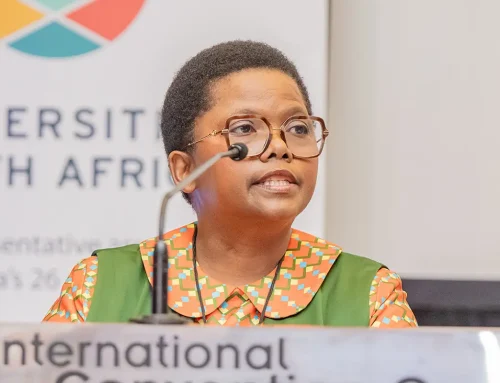
Dr Linda Meyer (right), a Board member and Spokesperson of the South African Private Higher Education (SAPHE), said private higher education provision has grown significantly over the past two decades and now plays an increasingly important role in expanding access to higher education.
She explained that private institutions have historically focused strongly on teaching and learning, while public universities have carried the broader mandate of research, teaching and community engagement.
She said the growing demand for higher education means that the sector is reaching a critical moment in its development. “We need to accept, as a sector, that we are now at a point of inflexion.” Pointing to the capacity constraints faced by public universities, Dr Meyer stated that “The only way to expand access is by integrating private higher education.”
Reframing relationships across the higher education sector
Citing the common national regulatory and quality assurance framework that both private and public institutions operate within, Dr Meyer said these shared regulatory frameworks provide a strong basis for closer collaboration across the sector.
Dr Meyer also argued that recognising different institutional types and mandates creates new opportunities for public and private institutions to work more closely together, especially considering the institutional contributions to broader system goals.
In her opinion, “the question is no longer whether private institutions should exist alongside public universities, but rather how we work together so that the country can benefit from the strengths of both subsectors.”
Collaboration is feasible across subsectors
From the University of the Free State, Dr Senoelo Nkhase, Director: Institutional Research and Academic Planning, reflected on collaboration between public and private higher education institutions from academic planning and quality assurance perspectives. She noted that while subsector collaborations are always framed as complex in discussions, many elements of higher education work are already shared across institutions.
“Collaboration is not that difficult,” she said, adding that they, at the UFS, already collaborate with private higher education institutions. “Collaborations are easier at the operational level between individual academics and colleagues. These include guest lecturing arrangements, joint postgraduate supervision, cross-institutional benchmarking and participation in quality assurance processes. ”
The need to formalise relationships
Dr Nkhase (left) encouraged strengthening institutional collaboration as the next viable step, in particular, urging structured partnerships between institutions to support sector alignment. “Public universities may just need to move from informal collaboration practices towards more structured, effectively governed partnerships,” characterised by clearly defined agreements outlining the scope and responsibilities of each institution.
She saw formal collaboration frameworks as a mechanism for ensuring that partnerships maintain academic integrity and quality assurance standards.
She also maintained that collaboration between higher education institutions takes place alongside healthy competition, which could encourage institutions to refine their strategic priorities, strengthen their academic programmes and sharpen their institutional identities.
Thus, she cautioned institutions to navigate collaboration carefully, ensuring that partnerships support academic credibility while protecting institutional mandates and strategic positioning.
In support of collaboration, participants suggested shared infrastructure, collaborative research initiatives, joint academic programmes, and the use of private institutional capacity to accommodate students from oversubscribed public universities. One participant suggested that private infrastructure could potentially house public university students or support industry-oriented learning modules linked to public research outputs.
A question arose on policy instruments that might enable collaboration. Participants asked what funding mechanisms, shared platforms, or policy incentives might encourage sustained partnerships rather than isolated initiatives – necessitating broader advocacy and policy discussions to create enabling frameworks for joint initiatives.
Capacity development
A further theme emerging from the discussion concerned leadership development and staff capacity building across institutional boundaries. Participants expressed optimism about initiatives that gather academic and professional staff from different institutional contexts. However, they also asked how such initiatives could be designed to ensure that benefits are distributed across the entire system rather than reinforcing existing institutional inequalities. This perspective reflected the broader role that organisations such as HELM seek to play in fostering system-wide leadership development.
Thoriso Kolobe is a Communication Consultant commissioned by Universities South Africa.