How to ensure a sustainable student funding scheme
The higher education sector is at a critical crossroads as it adapts to meet the challenges of a rapidly changing world. The local context demands that universities engage in a way that continues a transformation journey that is socially responsible but equally culturally grounded and financially sustainable.
This was the message from the University of the Free State (UFS) Vice-Chancellor and Principal, Professor Hester Klopper (below), as she led her institution’s eighth annual Thought-Leader Panel Discussion titled Reimagining Higher Education for Employability and Sustainability.

Concerns around the long-term viability of the National Student Financial Aid Scheme (NSFAS) model and how it could be restructured, as well as reframing the curriculum through decolonisation, featured prominently in the conversation.
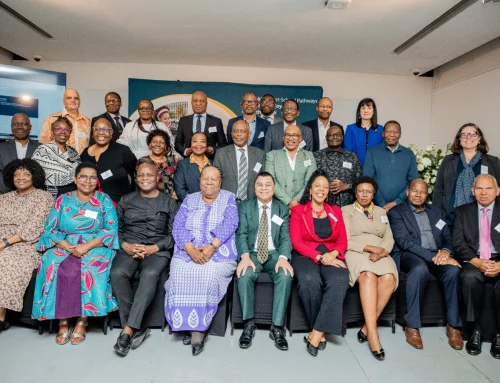
Joining Professor Klopper on the panel were Professor Pamela Dube, Vice-Chancellor and Principal of the Central University of Technology (CUT); Professor Paul E Green, Deputy Vice-Chancellor: Teaching & Learning at Sol Plaatje University; Dr Phethiwe Matutu, CEO of Universities South Africa (USAf) and Dr Max Price, a now retired former Vice-Chancellor and Principal of the University of Cape Town.

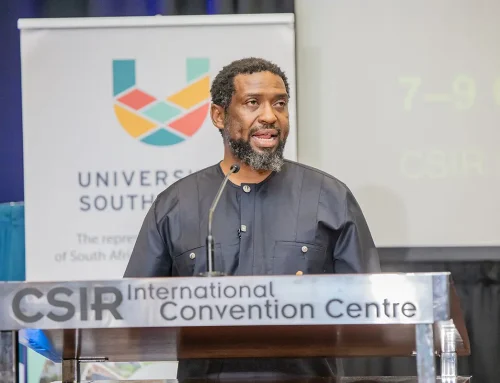
Dr Matutu (left) said the often contentious issue of fees was crucial when it came to a functioning university. “More than 60% of students on our university campuses are funded by NSFAS. As such, any developments affecting NSFAS have a huge bearing on university budgets and the quality of education we are able to provide. This presents a major risk for us.”
She explained that universities have three revenue streams – firstly, state subsidies, which have been declining, year-on-year; secondly, student fees, and the third-stream income from various funders.
SA universities rely on fees to function
“The challenge from the final stream,” she said, “is that it is earmarked so the first two streams pay for salaries, buildings, electricity etc. The third-stream income is crucial, particularly when it comes to research and innovation and sometimes community engagement work.
“If you look at enrolment per capita, our higher education system has experienced massification, where we have had to include students from previously disadvantaged backgrounds — a positive thing, in my view. However, that growth had to be matched with budget growth to serve those students.
“However, the per capita income has been declining year-on-year. While the student fees from NSFAS ensure the functioning of universities, other NSFAS systems, including information technologies, have not worked optimally. Whereas the current model might have been well thought through, the centralisation of student funding was neither tested nor proven to work. We urgently need to think about how best to make the system work, thinking outside the box but also doing the necessary research before solutions are randomly put in place.”
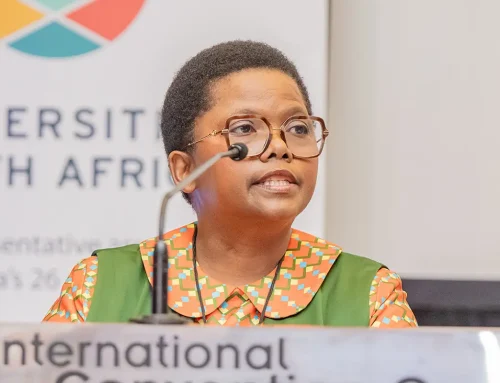
Dr Price (right) fully agreed: “The core problem, when it comes to the financial sustainability of our universities, is that NSFAS has been terribly managed and is broken.”
Graduates need to pay back the loans that funded their education
However, he said he believed it was the correct system and should be fixed.
“NSFAS was designed as a loan system, but this has been abandoned to the detriment of all South Africans. University graduates are very privileged in society, so they should repay the loans through an income-contingent repayment system. This is how the system was originally set up. It should be open to students of all income levels to cover their education and expenses and, after graduation, they start paying it back. There’s no interest charged while they’re still studying, and the amount to be paid back is proportionate to their income when they start earning. It’s a progressive kind of tax that is related to income.”

Dr Price said it was essential that the money repaid into NSFAS is administered through the tax system and not NSFAS, as the latter has no collection system.
“The stark reality,” he said, “is that the South African tax base is small and we are not going to get more money to fund more students. The only way is if people start contributing back.”
Professor Dube highlighted the broader impact of financial hardship: “Financial access is a matter of justice and retention. Students drop out not just because of fees, but because they cannot live and learn with dignity.”
Dr Price said that universities had had another sobering financial lesson in the last six months, with most research funding derived from abroad.
“Thanks to the current US political climate, in some places we’ve lost 30% of our research funding. We need to spread our risk by reaching out to other countries and players to fund our research. We must also note that the bulk of research is not taking place at universities. For example, ChatGPT did not emerge from universities. New immunotherapies are, by and large, not coming from universities but from the more resourced big pharmaceutical companies. Universities must create much closer partnerships with these players.”
The panel also encouraged a closer collaboration between universities and industry, provided that partnerships enhance, not compromise, the public mission of education.
Said Dr Matutu: “We have to look beyond Government, but recognise that the private sector will not invest in the university if there is no financial return. We must explore more creative public-private partnerships.”
Dr Price agreed that universities must proactively plant new seeds and create new partnerships.
“However, I don’t feel pessimistic – the track record of research universities is that every year they raise more in grants than the previous year and publish more. There are variations between individual universities, but citation rates have gone up every year. Technological advancements have also made collaboration easier and more accessible. You can access an archive anywhere in the world because it’s digitised. You don’t have to travel there at a huge cost for a sabbatical or to study.”
Curriculum reform; the pro-African vs global relevance debate
Professor Klopper said that while universities acknowledge the need to generate future-ready graduates and the curriculum reform that this necessitates, the question is: How do they strike the balance between a locally relevant and decolonised curriculum with global readiness? She emphasised the latter’s demand for skills including adaptability, digital fluency and contextual problem-solving, which render graduates more employable.

Professor Green (above) said that the system must accept that there are diversified sources of knowledge, that are not necessarily Eurocentric in perspective.
“South African universities have been established on this Eurocentric philosophy and a specific framework whereby knowledge was imparted in the written word as opposed to the African perspective of oral storytelling. People talk about balance, but that implies that there are two opposing views – the one being curriculum renewal and the other being competitive advantage. I would argue that they should not be on opposing ends of the continuum.
“Rather, we should look at how South African universities can engage in a curriculum renewal which also incorporates African ideologies and principles and embrace them. This does not mean we won’t be globally competitive. We should be able to address issues from a South African perspective by putting on an African lens, to address some of these challenges.”
In response, Dr Price noted the need for critical engagement.
“I worry that the idea of an African, or a decolonised, perspective sometimes gets essentialised. There’s no African, Western or European knowledge – this is the result of many centuries of mixing across continents, and it is a common heritage of us all. I also think that we run the risk, especially post-2015 and the decolonisation campaigns and movements, of becoming sentimental and uncritical of different sources of knowledge. We value them because they are indigenous or just because they are anti-colonial. That, too, is dangerous.
“We must maintain a critical questioning stance on any sources of knowledge. We need to check the evidence and test it and see what works and what doesn’t. We cannot drop standards and incorporate things in our curricula just because they come from a different perspective. However, that doesn’t mean that we should not be undertaking a curriculum reform that takes account of different belief systems.”
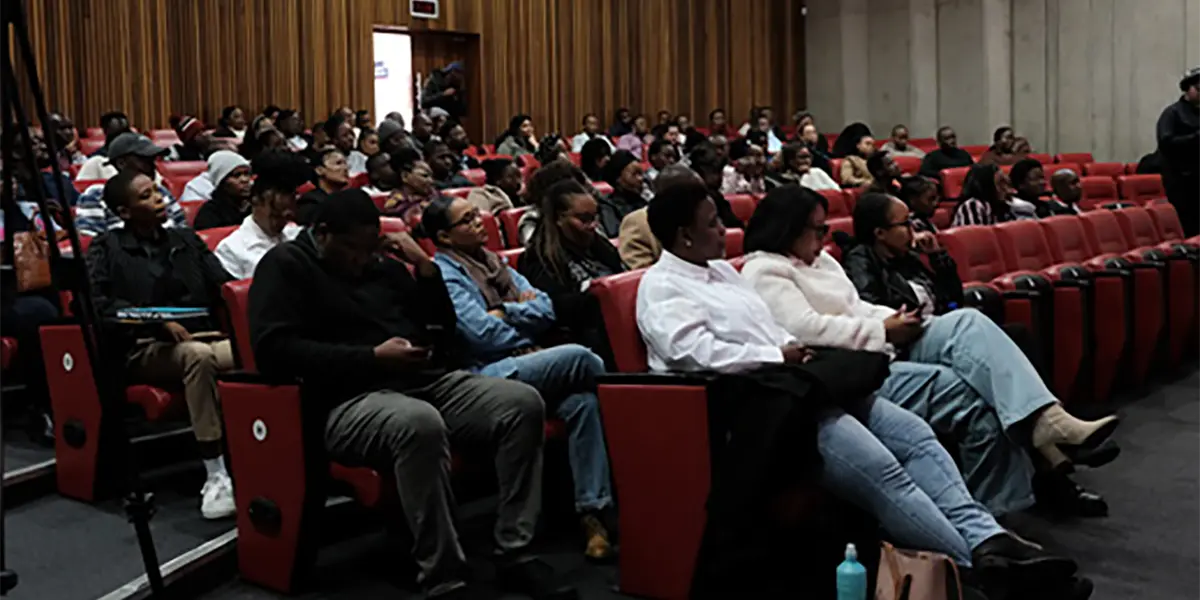
The live audience for the panel discussion on 17 July.
Discussion
In a question and answer session that followed the panel discussion, an audience member asked whether the university community and society at large understand the term ‘decolonisation in education’?
Said Professor Green: “There is a misconception that decolonisation has an ultimate destination, and it doesn’t. We must embrace the fact that decolonisation is a process, and this is often where tensions arise as people become impatient. There’s also a perception that decolonisation is linked with transformation, and transformation is just seen as a non-authentic gesture. If we want to be serious about transformation, it certainly has to be structural and done with intent.”
Dr Matutu addressed the issue of transforming the curriculum agenda and the need for coherence.
“USAf, together with the Council on Higher Education (CHE), recently partnered with the University of Johannesburg (UJ) to look at the baseline when we talk about curriculum transformation. We used self-evaluation reports and data submitted to the CHE from universities, and what we discovered is that there isn’t a uniform way that this is seen by universities.
“While some universities focused more on the decolonisation and Africanisation of the curriculum, others emphasised job-ready graduates and incorporating new elements such as AI into their programmes.
“A need was identified to create subject-matter-based Communities of Practice to facilitate academics’ understanding of what is meant by the decolonisation and Africanisation of the curriculum versus alignment with the latest economic trends,” she said.
The UFS Thought-Leader Series, now in its eighth year since 2018, has established itself as a leading programme that contributes to local, regional, and global knowledge. It gathers distinguished, nationally recognised leaders and change-makers who contribute meaningfully to public discourse on social, economic, and political issues facing South Africa and the globe. The series gained popularity as it progressed to the webinar platform, except for one annual face-to-face panel discussion in collaboration with the Free State Literature Festival. The event is free and open to the public.
Janine Greenleaf Walker is a contract writer for Universities South Africa.