It’s time for universities to turn research into products

It was thanks to his student book allowance that Zanodumo Godlimpi was able to build the first prototype of what was to become an award-winning prosthetic foot. Years later – with a Technology Innovation Agency grant, international patents and a national title behind him – his biggest obstacle, he says, is not money. It is getting through his own university’s procurement system.
“Most of the time, you think funding is the problem,” he told delegates at the 4th USAf Higher Education Conference held recently. “But in institutions of higher learning, we have a problem of not being able to access the funds we have received.”
The 2025 EDHE Studentpreneur of the Year, now a lecturer at Walter Sisulu University (WSU), was one of three panellists in a session titled “Innovation for a Changing World”. He was joined by Professor Joey Chifamba, a project scientist at the University of California, Los Angeles, and Dr Kim Lamont-Mbawuli, Deputy Director: Innovation and Technology Transfer at Tshwane University of Technology (TUT). The session was chaired by Professor Thobeka Ncanywa, Research Chair in Entrepreneurship and Financial Inclusion at Nelson Mandela University, and facilitated by Professor Herman van der Merwe, Deputy Dean: Teaching and Learning at North-West University.
All three kept coming back to the same problem. South African universities produce good research, yet little of it ends up as products that change people’s lives.
Prof Chifamba, who also heads an innovation hub in medical technologies and health sciences at the University of Zimbabwe, argued that universities keep trying to monetise research that was never designed to be commercialised.
“You can patent basic research outputs. But that is just knowledge. It cannot give goods and services and, unfortunately, most universities are trying to translate untranslatable material into goods and services.”
Only research and development can be turned into products, he said, and universities have traditionally done research, not development. The result is what he called a “deployment chasm” between academia and industry. “Most universities are systemically, structurally and operationally misaligned with the needs of market-driven environments.”
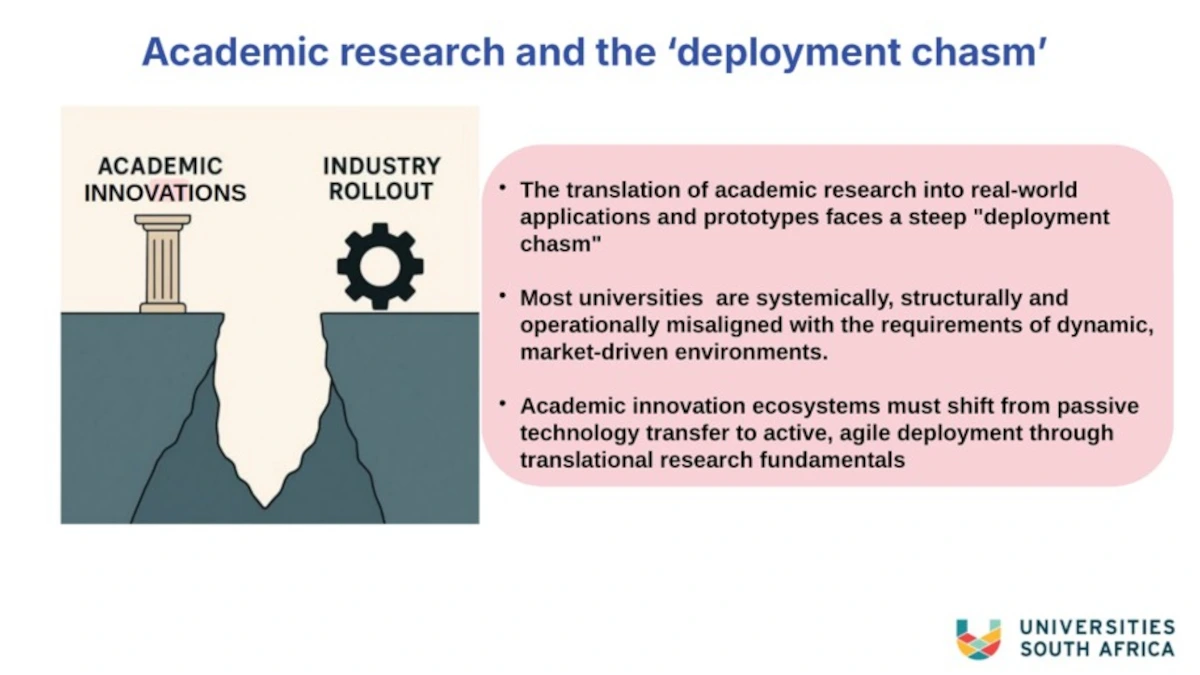
Prof Chifamba’s slide: the “deployment chasm” between academic research and industry.
Universities fund research at the start, he said, but leave a “funding void” when it is time to develop a product. Promotion rewards publications, not entrepreneurship, and he was scathing about how those promotions are decided.
“Career advancement is based on a peer review system, and a peer review system only talks to peers. It is like a group of friends; it is like a club that promotes each other,” he said. “Nobody from outside decides who becomes a professor. This is a two-hundred-year-old historical perspective in academia.”
The fix, in his view, starts with how research is designed. “Basic research does not give innovation. So unless there is a translational science aspect in the objectives themselves, unless the research becomes contractual, we cannot talk about academic research giving us innovation.”
Protect, then publish
Dr Lamont-Mbawuli, who holds a PhD in medical science and intellectual property law, set out how to build what she called a resilient technology transfer office (TTO). She began with a sobering figure: South Africa spends less than 0.8% of GDP on research and development.
“If we are supposed to innovate, if we are supposed to commercialise, why is research and development receiving such a limited amount of money?” she asked.
Many researchers, she said, avoid the TTO because they fear it will slow them down. “IP protection can actually run parallel to publication.” A provisional patent filed before publication secures the priority date, so researchers can publish and protect at the same time.
Commercialisation, she said, is like a road trip that needs a GPS in the form of a clear exit strategy. Will the university license the technology, or form a start-up, and how much equity should it take? And research should respond to market pull. “Instead of doing research only to close a gap in knowledge, do the research to close a gap in the market.”
The hardest stretch is the so-called valley of death, between technology readiness levels four and six, where risk is highest and funding scarcest. The Technology Innovation Agency is often the main source of support there, and she urged universities to set up their own innovation funds, released against milestones, to carry prototypes across the gap.

Dr Lamont-Mbawuli’s slide: a staged innovation fund to carry technologies across the “valley of death”.
She also wants TTOs judged on more than patents. “Frequently you hear: this TTO is doing well because it has five patents. But patents are not the only thing.” Licences, spin-offs, jobs and long-term partnerships, getting products market ready and industry engagements count too, she said.
“The TTO should not be considered a transactional patent, IP or licensing office,” she said. “It should be considered a strategic institutional capability for resilience.”
Closest to the problem
Mr Godlimpi’s journey began in 2017, during a work-integrated learning placement at a public hospital while he was an undergraduate health sciences student. There he met amputees who struggled to walk up and down slopes, especially in rural areas with poor infrastructure.
In 2018, he used his book allowance to build a proof of concept for a pneumatic prosthetic foot for below-knee amputees. At the time South Africa was battling load-shedding and many of his intended users in rural communities already had limited access to electricity, so designed a product that uses air instead of a motor that uses electricity, keeping it affordable and easier to repair locally.
The project went on to receive R485 000 from the Technology Innovation Agency, and patents have been filed internationally. In 2025, he was named EDHE Studentpreneur of the Year, winning R120 000, plus a further R25 000 in the Academic Research Commercialisation category. WSU is now licensing the technology to KinetiXcore, a company he owns, and research collaborations with UNISA and the South African Radio Astronomy Observatory (SARAO) are being developed.
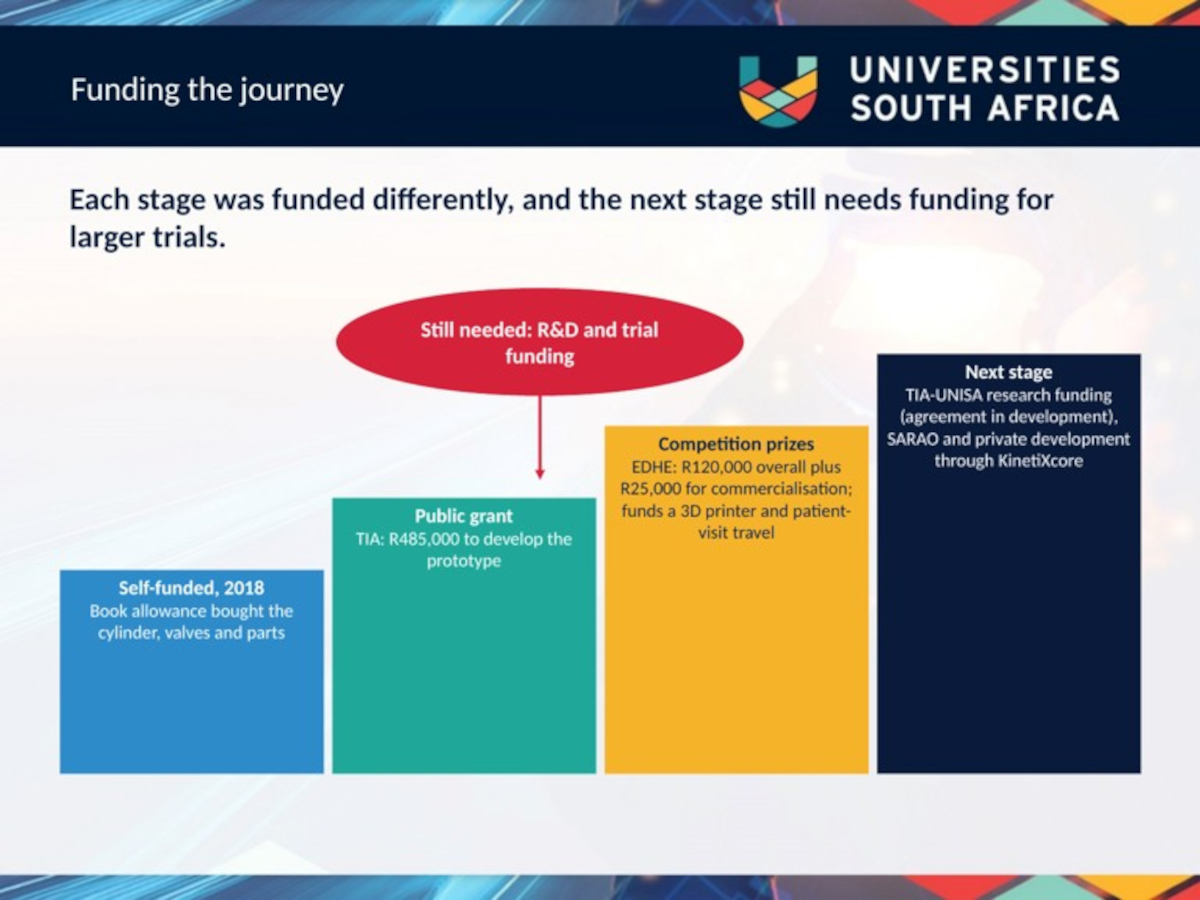
Mr Godlimpi’s slide: how each stage of the prosthetic foot was funded, from his book allowance to the next round of trials.
Students innovate, he said, when they have a real problem to solve, can see people like them succeeding, can reach the TTO and the Centre for Entrepreneurship, and have a safe space to try. “When someone makes it feel possible, not only permitted, it becomes easier for students to become innovative.”
He also offered practical advice on when not to patent. A patent lasts 20 years, but some technologies last only five. “So you need to move at speed rather than protect.”
His sharpest criticism was reserved for procurement. Buying equipment with grant money requires forms with seven signatures, “and one or two of those signatures you cannot find”. He has proposed that a private company manages projects and subcontract specialist work, and that discussion is still under way.
“Impactful universities are the ones that commercialise,” he said. “Our target market doesn’t get to read the papers we publish. The only way to reach the people who need help is through products that make their lives easier.”
Change one thing
Asked what single change would make African universities more innovative, Dr Lamont-Mbawuli said innovation must stop being an afterthought. Mr Godlimpi wants problem-based learning at the core of the curriculum, while Prof Chifamba called for campus-wide programmes in translational science.
On where entrepreneurship should sit within a university, Dr Lamont-Mbawuli said entrepreneurship and commercialisation “are married in community of property. They have to run alongside each other all the way.” Mr Godlimpi suggested that innovation teams include their own procurement officer, who would understand the urgency.
Dr Lamont-Mbawuli pointed to a largely untapped source of funding for the valley of death: research and development tax incentives that companies can claim under the Income Tax Act. TTOs rarely use them, she said, probably because of the paperwork involved.
Mr Godlimpi urged university leaders to see their institutions as places that de-risk projects, not only as generators of knowledge. Industry is wary of risk, he said, “so there is a gap in between, and that gap lies in de-risking projects”. AI is already lowering the barrier for entrepreneurs, who have to be their own HR, legal and procurement departments. “With entrepreneurship, the currency is time.”
Who owns our knowledge?
One of the most pointed questions came from a delegate who asked why nobody at the conference was addressing what he described as the theft of universities’ intellectual property by artificial intelligence (AI). Publications and master’s and doctoral theses, he said, have been loaded into large language models free of charge, with no compensation for the institutions that produced them.
“That is a whole other session,” Dr Lamont-Mbawuli replied. Copyright might offer a route, she said, but “if I change the look and feel of a document, I am arguably not infringing it. So there are many layers to that.” Patents are clearer. About 18 months ago, a patent application was flagged because AI had been used, and under South African law the inventor has to be a natural person. “So an algorithm or AI can’t be an inventor at present.”
Qualifications with an expiry date
Asked to complete the sentence “If universities want to remain relevant in a changing world, we must…”, Dr Lamont-Mbawuli said innovation should not be “a talk shop but a driving engine”. For Mr Godlimpi, “innovation must reach our target audience”. Prof Chifamba felt the spotlight falls too much on students, and that universities must focus more on their mentors
Janine Greenleaf Walker is a contract writer for Universities South Africa.