Mining the numbers: the state of research in South Africa
The presentation was divided into two sections. The first was a summary of a study carried out called The state of the South African research enterprise (2019) in which Professor Johann Mouton, Professor and Director: Centre for Research on Evaluation, Science and Technology, Stellenbosch University was the lead author. The second part constituted key reflections “of an aging professor.”
He began by considering the bugbear of South African research. The percentage of Gross Domestic Product (GDP) spent on Research and Development (R&D) has remained unchanged at around 0.8% for the past 15 years. “That means that we are ranked 44th in the world where the lead countries on this indicator in 2015 spent around four to five times more on R&D than South Africa.” Although he notes that South Africa is the highest in Africa, this is off a low base of 0.3%.
More importantly, he asserted, private business spending on R&D had declined from 54% to 36%, leaving government to fill this gap.
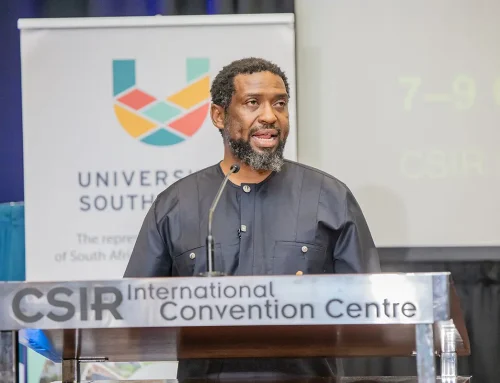
Caption: Professor Johann Mouton, Professor and Director: Centre for Research on Evaluation, Science and Technology, Stellenbosch University.

Research capacity statistics a bit misleading
“The most recent R&D statistics on the researcher capacity of the country would suggest a positive picture. The number of researchers increased by 3 400 over the past five years. However, closer inspection of these numbers shows that most of this increase is due to the growth in the numbers of postgraduate students and post-doctoral researchers. In fact, the increase in overall numbers masks a decline in full-time equivalents employed as researchers within universities. Within universities, full-time equivalent (FTE) researchers, not including postgraduates, declined from 5 098 in 2014/15 to 4 702 in 2015/16. This is the first time that this has happened in the last decade.” He therefore concluded that human resources capacity in South Africa’s higher education sector had stagnated.
Regarding the increase in the number of researchers with PhDs, there were signs of improvement, overall, Prof Mouton said.

The fields with the highest proportions of doctoral staff in 2015 were agricultural sciences and the natural sciences. Two of the more professional fields – engineering (updated 2017 figures note that engineering is at 42%) and health sciences – had the lowest proportions of staff with PhDs. But he also warned that the target set by the National Development Plan to reach 75% PhDs “is just a pipe-dream”.
Moreover, Prof Mouton, said that these figures obscured another counter-intuitive trend. There was “a commensurate shift towards greater internationalisation of doctoral graduates. The proportions of South African students in all fields who are doctoral graduates have declined on average from 81% to 60%. The rise in doctoral graduates is mainly due to increased graduations by students from the rest of Africa.”
Captions: Proportion of staff with a PhD (2000-2015).
Citations and international collaboration
On citations and international collaboration fronts, there was good news, Prof Mouton said. “South Africa’s citation impact has gone up gradually from 0.66 in the four-year citation window 1996 to 1999, to an impact score of 1.03 for the period 2011 to 2014 and to 1.13 in 2016. Keeping in mind that a score of 1.00 on this performance indicator represents the world average citation impact (determined mainly by the USA and world’s leading nations), South Africa has moved up from a performance level ‘below par’ to ‘international level’ status in less than two decades.”
Research by gender and race
Here again, there were signs of progress. Since 2005 women researchers had gone from 29% to 33% in 2016 in all fields. “Differences remain – many of which are commensurate with international trends. For example, engineering sciences remain a male-dominated field (despite a small increase in female authors), whereas female authors are much better represented in the health and social sciences.”
Over the same period of time, the change in black authors, in all fields, had gone from 16% to 34% by 2016, said Prof Mouton. “That is a huge shift in a very short time frame. Perhaps the most surprising is the leap in the field of Engineering.”
Rising numbers do not always reflect excellence
Prof Moutons then moved on to what he termed a more provocative summation of the system that had preoccupied him for his 25 years at Stellenbosch University. The rise in the numbers of papers published meant that the sector had responded, not only to the “publish or perish” imperative set out in the White Paper on Higher Education (1997), but also to the transformation (inclusiveness) and internationalisation imperatives.
Caption: Change in proportion of black authors (2005-2016).

He also pointed out an excellence imperative that combined quality with ethical integrity. “However,” he noted, “it does not mean that these imperatives co-exist harmoniously, or that they are aligned with each other. Rather it often means that they are in tension with each other”.
An increase in the number of publications or greater collaboration did not guarantee excellence, Prof Mouton argued, citing examples. The huge rise in the number of publications since 2005; from 7 000 to 19 000 in 2017, was the first of such examples. That alone meant a R20 billion investment in higher education. However, this increase had also been accompanied by unethical and gaming practices by a number of actors: from academics, to universities, publishing houses and editors. These practices, Prof Mouton noted, included predatory publishing and excessive conference proceedings which “is seriously compromising the integrity of academic publishing.”
He also reiterated the fundamental stagnation of the staff complement – growing by 2.1% per annum over the last 18 years. That was barely enough to reproduce the system. At the same time the number of publications had increased by 8%. This he argued, indicated an increased strain on already over-burdened staff.
In his concluding ‘Manifesto’, Prof Mouton submitted that science was the pursuit of truth and excellence. He said all the other imperatives – impact, relevance, transformation, efficiency, utility – were not ends in themselves but should be understood as subservient to the final and over-riding goal of excellence.
How resolute is SA about the pursuit of knowledge?
While acknowledging the importance of Prof Mouton’s debate and “manifesto”, Prof Rasigan Maharajh, Chief Director: Institute for Economic Research on Innovation at the Tshwane University of Technology, made it clear that these findings needed to be understood in relation to the global higher education system.

He recognised the declining position of South Africa’s investment in R&D. However, he also turned the stats around to look at the thriving economies. “Three days ago China celebrated its 70th anniversary. Inferring from some of their promotional messages, China believes it is now in an innovation-led developmental phase.” Science and Technology, he argued, had been China’s main tool used to improve the quality of life of her people
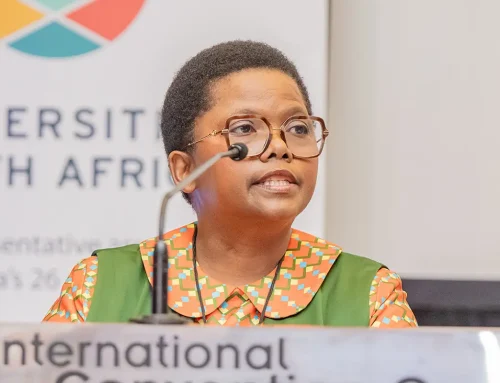
Captions: Prof Rasigan Maharajh, Chief Director: Institute for Economic Research on Innovation, Tshwane University of Technology.
Is there a will to resource the system to achieve the desired levels of knowledge generation and innovation?
Prof Maharajh challenged the notion that we were stagnating as a sector, arguing, rather, that “we have failed to reach the targets.” He also questioned the quality of interpretation given the status of research in SA and with it, the quality of decision-making especially at the policy making level. “Is there capacity to process this kind of information? What kind of facility is there to reconcile the setting of targets versus our performance and what resources are necessary to allow us either to catch up or transcend these targets?”
He agreed that there were fewer researchers in the SA system who were expected to produce more. This translated into the exploitation of researchers and underlined the unfair remuneration of doctoral candidates and post-doctoral fellows, Prof Maharajh emphasised. “It also means if there is any growth in the sector, it is mainly administrative. The growth is not reflective in teaching and research capacity. In the latter instances, we are contracting.
“Even when the figures are positive, these need to be interrogated to get to the underlying truth,” Prof Maharajh went on to say. “We may be producing more PhDs but what is the quality of these dissertations? Are they relevant to the economy and its development? We need to consider the decline in science and innovation within the broader context of the country’s economic decline, and the deterioration in social cohesion.”
In summing this all up, Prof Maharajh asked: “Are we interested in the pursuit of knowledge and are we willing to put aside the resources necessary for the instruments that generate that knowledge?”
Universities leaders need to learn to push back
Prof Adam Habib, Vice-Chancellor and Principal of the University of the Witwatersrand placed his questions in the context of how universities were managing the system. “We are producing more with less which is a good thing but it can only go so far. We need more resources in the system but the economy is not growing and the private sector is not investing sufficiently in R&D”. What if we made it mandatory for the likes of the private sector to allocate funding to universities for increased R&D, Prof Habib asked. The other thing that concerned him was the way that politicians were pushing the system for short-term political agendas and that the leadership of our universities were not pushing back enough. Prof Mouton agreed on the last point, saying that the short-term agendas were coming from a range of governmental institutions and that Vice-Chancellors had “to be more brave and courageous to push back at these directives. And that includes Universities South Africa (USAf).”
Prof Ahmed Bawa, USAf’s Chief Executive Officer, acknowledged USAf’s role. His question, however, went to the heart of the quality debate. Referring back to Peter Maasden’s input, he expressed his amazement at how Greta Thunberg was not just an important young voice on climate change but apparently the only voice. “Why are we so reticent in the sciences about voicing our findings?” he asked. He also questioned the national system of innovation which he described as a policy dream, which needed to be brought to life. Prof Maharajh affirmed Prof Bawa’s comments claiming that when the data was presented to government, the response was not a rational debate but an unexplained decision that was authoritarian in nature.
Research funding policy denies the reality on the ground
Prof Patricio Langa, Associate Professor at the University of the Western Cape’s Centre for Adult and Continuing Education, University of the Western Cape questioned the rationale behind the National Research Foundation (NRF) policy to apportion only 5% of research funding to foreign scholars. He said this policy seemed to contradict the data on the contribution of international PhD students and scholars, particularly those from the African continent, to the South African higher education system. “Why should these scholars only be allowed 5% when all the trends suggest that African PhD students will soon outnumber their South African counterparts?”
The second part of Prof Langa’s question was about the camouflaged forms of xenophobia that manifest in policy and actions of other institutions that deal with “foreign nationals” from African countries.
Caption: Prof Patricio Langa, Centre for Adult and Continuing Education, University of the Western Cape.

The hardship that many Africans wanting to study in South Africa went through to get permits at the Department of Home Affairs, represented the tip of the iceberg when it came to hidden forms of institutional xenophobia. Prof Mouton acknowledged the veracity of both these points and shared Prof Langa’s bewilderment at the NRF allocation restriction of foreign nationals and its potential to destroy this crucial area of growth.
Written by Patrick Fish, an independent writer commissioned by Universities South Africa.