Reshaping the university to become responsive
What are we good for?
The idea of the university that is plugged into and responsive to the physical context in which it finds itself was a recurrent theme of Universities South Africa (USAf) inaugural National Higher Education Conference, during early October. It was clearly articulated by Dr Diane Parker, Deputy Director-General: University Education Department of Higher Education and Training (DHET). For her a university that responded to the immediate challenges of the community was imperative if the National Plan for higher education was to work. For Prof Peter Maassen, Professor in Higher Education Studies: University of Oslo, Norway it was the idea of “the third mission” – the university’s engagement with society – that mattered most now and into the future. So, it was fitting that the same notion was revisited in the concluding plenary.
In his introductory remarks, Prof Ahmed Bawa, Chief Executive Officer at USAf pointed out that Prof Brink had strategically reconfigured the university of Newcastle so that it was able to meet the needs of the community it served.
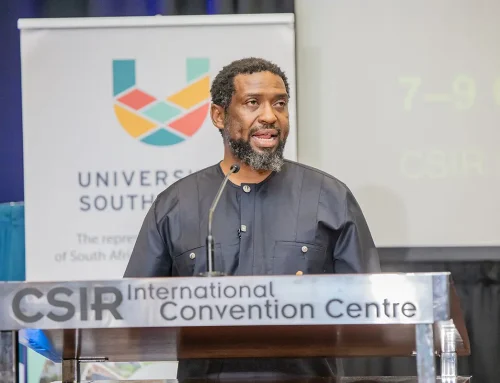
Prof Chris Brink, Emeritus Vice-Chancellor: Newcastle University, United Kingdom posed two questions of academia: “What are we good at” and “What are we good for”. “While academics can tell you, at some length, what they are good at, what they are good for tends to take them by surprise.”
Prof Brink recounted a story about a meeting he had attended in June 2019 to celebrate the 20th anniversary of the Bologna process (which allows student and staff mobility throughout Europe). However, he noted, most of the discussions at the event dealt with a document that was drawn up in 1998 by the leaders of universities in Europe. The Magna Charta Universitatum was drawn up to state the purpose of the university and most of the participants at the meeting thought that it had become obsolete. In the process of updating the documents, the gathering made it clear that the primary role of the university was a societal role.
Caption: Professor Chris Brink, Emeritus Vice-Chancellor: Newcastle University, United Kingdom.

Why excellence is not enough

Referring to Prof Mouton’s notion that the pursuit of excellence was the ultimate goal of research, Prof Brink argued that “excellence is necessary but not sufficient.” He proceeded to move on to the #FeesMustFall in the context of students saying that university leadership is not listening. Quoting Prof Ahmed Bawa, he talked to the social compact that was promised in 1994 and was still not met 20 years later. As Prof Bawa put it “for some student leaders during the upheavals that racked higher education between 2015 and 2017, the universities are seen to be a part of the infrastructure for a system that reproduces (new) elites while undermining the capacity of the poor to emerge from poverty, inequality, etc. … The development of a new social compact between the public university system and society is required if we are to transcend the more traditional roles of universities …”
Caption: In this book, Prof Brink devotes attention to the “good” ness of a university and the attributes that must be looked at in measuring that virtue.
That was the reason that universities needed to understand what they were good for, according to Prof Brink. He returned to the classic writers on the nature of the university: Wilhelm von Humboldt with his emphasis on research – faculties and assessments, publications and citations – and John Henry Newman’s focus on teaching – graduate employment, the role of the alumni, staff to student ratios and graduateness. More recently, and arising out of teaching and research was “societal engagement.” Prof Brink preferred this term to the notion that Prof Maasen had used earlier, of the “third mission.” Prof Brink said he found the latter too limiting as it conceived of the higher education enterprise as consisting of distinct silos whereas, for him, it was inextricably entwined.
Continuing with this historical re-thinking he moved on to the origins of the knowledge economy and the work of Francis Bacon (“knowledge is power”) and Adam Smith’s “the invisible hand” where, he argued, if teaching and research were done well “the benefits will appear in the economy in the long term, even though the results may be unpredictable.” This, argued Prof Brink, only addressed what higher education supplied, not what society demanded of a knowledge economy. “Universities have failed to pay enough attention to the demand side and have been overly concerned with the supply of knowledge,” claimed Prof Brink.
Research impact
He then conducted a thought experiment with the delegates present. “In your university you have an office called Community Outreach or Civil Engagement. Is that portfolio defined by what you want to deliver or is defined by what society needs? If you draw up a list of global challenges, national challenges and local challenges,” he continued, “and then see which academics can answer what challenges.” Having worked in England and now in Hong Kong, Prof Brink said that, internationally, every couple of years there was a national evaluation of research and these outputs were stringently rated.
Since about 2010, he continued, the notion of ‘impact’ had been added as a distinct measure. Impact was measured by “narrative case studies” that described how the university’s research had made a beneficial difference to people’s lives in the past five years. Globally, governments were no longer prepared to accept the invisible hand argument; having funded the universities they wanted to see how that funding was having a beneficial impact, continued Prof Brink. Although there was no impact measure in South Africa (yet), Prof Brink had been an advisor to the National research Foundation (NRF) and warned that ‘impact’ was coming in the new NRF strategic plan.
The origins of later research (at MA, PhD levels) was out of curiosity, says Prof Brink, meaning it emerges out of one’s own mind. This gives rise to the linear model.

“It is my contention that while it once served its purpose it is no longer sufficient,” says Prof Brink. Rather than a curiosity driven research, it is important to now begin with a societal problem and work one’s way backwards. That response to the societal challenge “is the measure of excellence,” he contends.

Prof Adam Habib, Vice-Chancellor and Principal of the University of the Witwatersrand argued, in response, that since 1994, the circular model had been in effect to a greater or lesser extent. He referenced numerous policy papers about the massification of the system and the notion, at one stage, that 82% of the research be the applied kind rather than curiosity-driven. Prof Habib was intimating that Wits, for one, had been embedded in its context for a long time already.
In response, Prof Brink asked the following: “if I came to your university and asked you for impact narratives that show the benefit to society, would you have these available?” He then went on to speak of the water shortage in Cape Town and noted that although three of the regional universities have Departments dedicated to some kind of water research, he heard nothing from them during the worst days. It may be that they were involved but they never communicated their impact, he concluded.

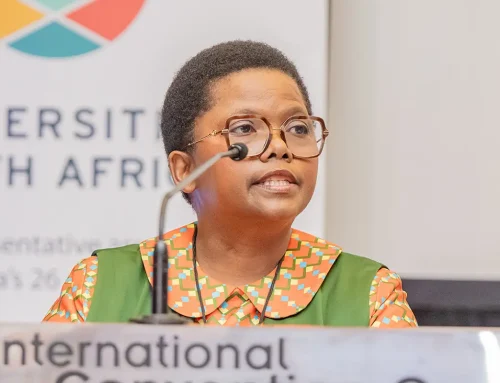
Prof Suellen Shay, in the Centre for Higher Education Development at the University of Cape Town pointed out that the current problems like crime, gender based violence and unemployment were also not featuring at the level of the curriculum yet.She contended that the responsive model could be extended beyond responsive research to responsive curricula. Prof Brink agreed wholeheartedly – further stating that undergraduate responsiveness was part and parcel of an effective sector response.
While in broad agreement with Prof Brink’s input, Prof Peter Maassen, Professor in Higher Education Studies at the University of Oslo in Norway said responsiveness needed to be more nuanced. “We do not know what we do not know,” Prof Maassen stated, making a case for curiosity-based research, even as we respond to the known challenges in society. Prof Brink conceded that there may well be a swing, in Europe at least, towards curious research. However, he likened it to a pendulum that swings back and forth through time.
Caption: Universities’ responsiveness to society needs to reflect in both research and in our curricula.
At this point, Prof Ahmed Bawa said while USAf noted the importance of a new kind of responsiveness in South African universities, there was another urgent need to shift the existing power structures within our universities, especially those hidden structures that made institutional change so difficult.
Written by Patrick Fish, an independent writer commissioned by Universities South Africa.