South African universities publish a landmark book on entrepreneurship education
On 26 March 2026, academics, students, university leaders and government officials gathered at a hotel on the East Rand, outside Johannesburg, to celebrate the launch of Innovative Pedagogies for Entrepreneurship Education: Insights and Reflections from South Africa, a 22-chapter volume published by Springer Nature, drawing on case studies from twelve South African universities.
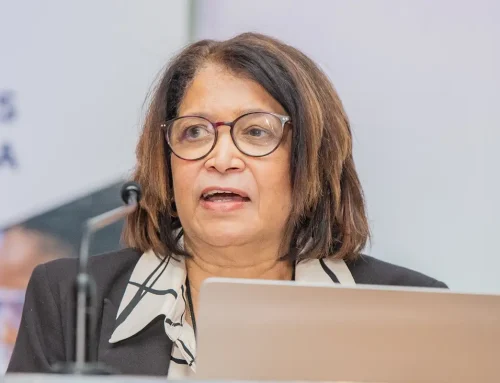
Dr Phethiwe Matutu, Chief Executive Officer of Universities South Africa (USAf), officially opened the event, positioning the publication as a milestone in the evolution of the Entrepreneurship Development in Higher Education (EDHE) programme.

“This is history in our development as the EDHE programme,” she said, noting that the book reflects a growing body of scholarship grounded in the South African context and brings together contributions in entrepreneurial pedagogy from across the higher education sector.
Serving as Programme Director, Mr Mahlubi Mabizela (left), Director of Operations and Sector Support at USAf, reinforced the evening’s tone. “This evening is about more than a book launch,” he told the audience. “It is a celebration of collaboration, imagination, and shared purpose.”
Book relevance acknowledged
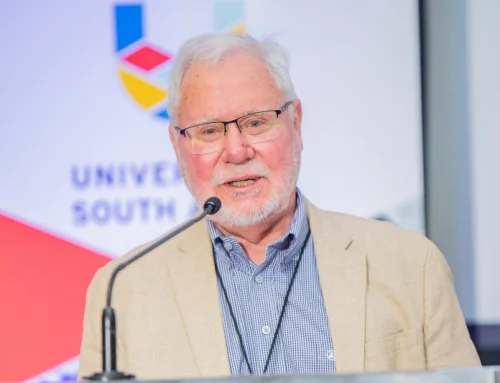
The presence of Mr Philip Tshabalala (right), Chief Director for Teaching and Learning at the Department of Higher Education and Training, underscored the policy relevance of the work. “South Africa’s greatest challenge is unemployment, particularly amongst the youth,” he said. “We must, in equal measure, cultivate job creators.”
He emphasised the need to move beyond theory-driven teaching towards experiential, immersive learning environments, noting that the Department would draw on the book’s models to inform curriculum transformation, staff development and ecosystem strengthening. “This book is a testament to the intellectual rigour and practical commitment of our academics,” Tshabalala said.

A long road to publishing
The book’s origins go back to 2018, when an early iteration of what would become the project began gaining traction within the Community of Practice for the Learning and Teaching of Entrepreneurship.

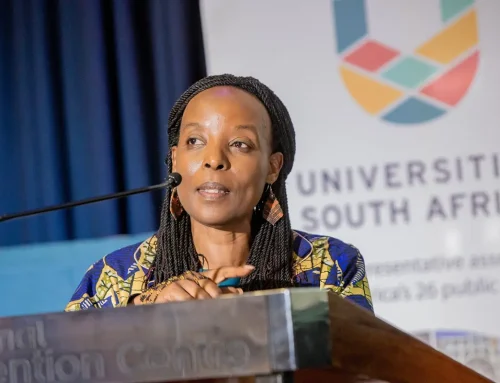
Reflecting on the journey, editor and contributing author, Professor Thea van der Westhuizen (left), traced the book’s origins to an early innovation in entrepreneurship education that did not fit neatly within traditional global frameworks. The work was later presented on an international platform, where it stood apart from submissions by leading international institutions.
“The ultimate goal is to bridge between theoretical ideas and real-world realities, to bridge between universities and the outside world, and to bridge between students’ potential and their achievements,” she said.
From there, the Community of Practice began asking a more fundamental question: how to recognise and document the work of educators who were already doing innovative, practice-based teaching in their classrooms.
This led to the establishment of a national competition, open to all 26 public universities, inviting educators to submit case studies rooted in real teaching practice. In 2022, 21 entries were submitted. By 2025, the competition had received 24 assessable cases, with the strongest forming the foundation of the book.
What the book carries
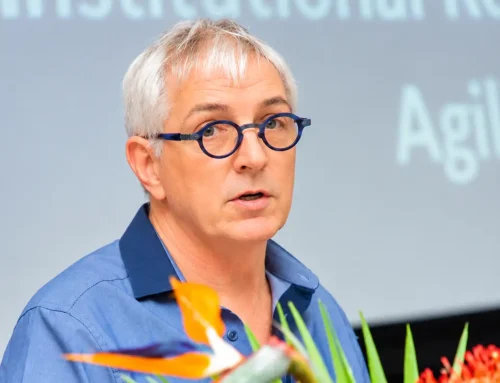
As the evening programme moved into a session focused on the book’s contributing authors, Dr McEdward Murimbika (right), Director of the Wits Centre for Entrepreneurship and New Venture Creation, and Deputy Chairperson of the national EDHE Community of Practice for Entrepreneurship Learning and Teaching, guided the discussion by unpacking one of the central ideas underpinning the publication.
“Pedagogy is simply the art and science of teaching,” he said, noting that entrepreneurship introduces a more complex dynamic within this framing. “You could be a professor of entrepreneurship, but that doesn’t make you an entrepreneur. You could be an entrepreneur, but that doesn’t make you an expert in entrepreneurship. It takes special individuals to combine the two.”

It is precisely this intersection that the book captures: educators who are not only teaching entrepreneurship but actively practising and embedding it within their disciplines and institutional context.
The volume is organised around four thematic areas: Entrepreneurial Ecosystems in Higher Education; Innovative Pedagogies in Entrepreneurship Education; Entrepreneurship for Social and Economic Transformation; and Leadership, Governance and Policy in Entrepreneurial Universities. However, what defines the book is not its structure, but the lived experiences and applied approaches reflected in each chapter.
Professor Thea van der Westhuizen, Associate Professor and Academic Leader for High Impact Community Engagement and Internationalisation at the University of KwaZulu-Natal, who served as the editor and contributing author of the volume, highlighted a key gap the book seeks to address. “There’s a paradox between what is being published from the Global North and what is actually happening in South Africa,” she said.
While much of the global scholarship suggests that entrepreneurship education remains overly theoretical, the contributions in this volume demonstrate the opposite, showcasing practice-based, contextually grounded approaches already taking place across South African universities. In this way, the book serves not only as a collection of case studies but as a corrective to prevailing narratives in the field.
A shift in teaching practice
At the launch event, six of the 23 contributing authors were invited to the stage to describe their respective chapters. This yielded more than just individual reflections. Their cumulative contributions pointed to a broader shift taking place across South African universities, one that is reshaping how entrepreneurship is taught, applied and understood.
Across disciplines, a common thread emerged: a move away from abstract, theory-led instruction towards approaches grounded in real-world engagement, experimentation and application.
For Dr Thulile Promise Mofokeng, lecturer in the Department of Entrepreneurial Studies and Management at the Durban University of Technology (DUT), this meant taking learning beyond the classroom and into communities. “It became a living lab where students could learn while making a tangible difference in the community,” she said, reflecting on a project that brought together multiple disciplines to support rural entrepreneurship

Dr Thulile Promise Mofokeng
Ms Nokukhanya Thembane
In the sciences, Ms Nokukhanya Thembane, who serves as a senior lecturer in the Department of Biomedical Sciences at Mangosuthu University of Technology (MUT), highlighted the urgency of shifting how students are trained. “We are losing brilliant minds that can come up with great products, but we do not capitalise on their potential,” she noted, pointing to the need for stronger integration between technical expertise and innovation.
From the University of Zululand, Ms Nokuthula Seabi, in her role as a lecturer in the Department of Consumer Sciences, emphasised the importance of grounding entrepreneurship in real-world problem-solving. “We encourage them to look beyond the cooking and solve problems within their communities,” she said, describing how students are guided to translate their disciplinary knowledge into practical solutions.
Similarly, Mr Kagiso Mashego (right), from the University of South Africa (UNISA) as a lecturer in their Department of Business Management, described how students are required to engage directly with their environments. “They go into their community, identify a problem, come back and validate that idea,” he explained, outlining an approach that places problem identification and testing at the centre of learning.
This emphasis on problem-led thinking was echoed by Ms Onicah Thandiwe Macheke, Lecturer at the Vaal University of Technology (VUT), who challenged conventional starting points in entrepreneurship education. “How can you start a business without understanding a real need?” she asked, underscoring the importance of empathy and context in developing viable solutions.

At the same time, Ms Vhuhwavho Tshavhungwe reflected on the role she plays as a lecturer at the University of Venda, in enabling these shifts. “We need to challenge ourselves and also challenge our students,” she said, highlighting the importance of adapting teaching approaches within existing institutional constraints.
Although the reflections of only six of the 23 contributing authors are featured here, their combined perspectives reveal a shared direction across the sector. Entrepreneurship education is no longer confined to standalone modules or theoretical frameworks. It is increasingly embedded across disciplines, shaped by local realities, and oriented towards enabling students to engage meaningfully with the challenges and opportunities around them.
Encouraging global response
The book is published open access, meaning it is freely available online. Within its first three months, it had already recorded 25,000 downloads, a clear signal of strong global interest in African-centred approaches to entrepreneurship education.
Delivering the closing remarks, Dr Edwell Gumbo (right), Director: Entrepreneurship at Universities South Africa, reflected on the broader significance of the work. “This is not just a book, it is a special book,” he said. He highlighted the shift taking place across the sector: “Entrepreneurship is no longer just a discipline. It is becoming a way of learning, a way of thinking, and ultimately a way of being.”
The final chapter of the book proposes a coordinated South African model of entrepreneurship education, positioning it not only as locally relevant but as a framework with potential global application.

Echoing this perspective, Professor Thea van der Westhuizen noted: “In many cases, we borrow models from the Global North, as if we do not have our own. This work shows that we do.”
Thoriso Kolobe is a Digital Communication Consultant commissioned by Universities South Africa.