South Africa’s Higher Education sector positions itself for purpose-driven collaboration
South Africa’s higher education sector made a strong case for strategic, purpose-driven collaboration when Universities South Africa (USAf) hosted a delegation from the London School of Economics and Political Science (LSE) on 23 March 2026, for a high-level dialogue with vice-chancellors and sector leaders. LSE is a United Kingdom-based institution specialising in social sciences.
The discussions focused on strengthening academic partnerships and aligning priorities.
Hosted at the USAf office in Hatfield, Pretoria, the LSE delegation was received by the USAf Chairperson, Professor Francis Petersen, who is also Vice-Chancellor and Principal of the University of Pretoria, and the Chief Executive Officer, Dr Phethiwe Matutu. The South African hosts included a high-level delegation of deputy vice-chancellors for research and innovation, and vice-chancellors from several of South Africa’s 26 public universities.
The LSE delegation was led by the institution’s President and Vice-Chancellor, Professor Larry Kramer. He was joined by Mr Firoz Lalji, Co-Chair of the LSE 2030 Campaign; Professor David Luke, Professor in Practice and Strategic Director at the Firoz Lalji Institute for Africa; Mr Benjamin Plummer-Powell, Chief Philanthropy and Global Engagement Officer; Ms Sarah Cook, Director of Leadership Philanthropy; Ms Rebecca Sealy, European Partnerships Coordinator; and Mr Corey Moore, Senior Executive Officer to the Chief Philanthropy and Global Engagement Officer.
South Africa’s approach to Internationalisation
From the outset, Professor Petersen emphasised that South African universities are no longer interested in superficial memoranda of understanding that yield limited outcomes. He argued that the sector is moving towards more intentional and strategic collaborations, noting that “we have many engagements across universities and sectors, but the question we are now asking concerns the quality of those collaborations and what they ultimately produce.”
He explained that South Africa’s 26 public universities operate within a differentiated system comprising traditional universities, comprehensive institutions and universities of technology. While these institutions differ in mandate and capacity, they come together through USAf to “look at the common issues, the issues we can pursue and the challenges that we have as a sector.”
That framing allowed the LSE delegation to engage not with isolated institutions, but with a coordinated national system.

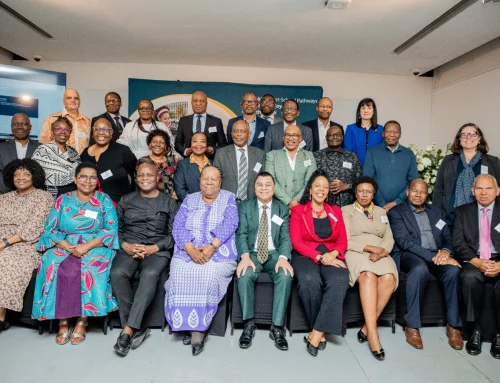
The USAf Chairperson, Professor Francis Petersen (middle, sitting), co-hosted the LSE delegation with the Chief Executive Officer, Dr Phethiwe Matutu (far right, sitting). Professor Larry Kramer (2nd from left, sitting), President and Vice-Chancellor, led the LSE guests.
LSE’s mission
Professor Kramer described LSE as a university grounded in the social sciences, but with a broad intellectual scope that includes economics, politics, sociology, anthropology, history, philosophy and business disciplines. He argued that the current global moment requires renewed attention to these fields.
“The kinds of problems that we need to deal with globally are not going to be solved only by science and technology,” Kramer cautioned. “In fact, they are often created by science and technology.” He argued that solutions require social science insight, combined with the capacity to translate knowledge into policy and societal action.
Kramer outlined six global challenges shaping LSE’s academic agenda. He noted that the first concerns the future of democracy, observing that democratic systems appear to be under strain across multiple regions. The second concerns the future of political economy, where existing models of market-state interaction are no longer adequate. The third is sustainability, which he described as inseparable from economic and political reform. The fourth is inequality, which, he stated, remains deeply embedded in both national and global systems. The fifth challenge is the governance of new technologies, particularly their social and economic consequences. The sixth, which he said had been added recently, is the future of the international order, following the erosion of multilateral systems.
Reflecting on these themes, Kramer stated that “the solutions to all those lie in social science research and thinking, and in the ability to translate that into action in society.” He added that LSE is seeking to build partnerships in regions where these issues are most acute, emphasising that “Africa is very high on that list, because so much of what will determine the future of humanity will happen here.”
SA university system: An overview
Dr Phethiwe Matutu then provided a detailed overview of South Africa’s higher education system, situating the discussion within the realities of scale, performance and inequality. She noted that the country’s 26 public universities enrol just about 1,1 million students and produce approximately 220,000 graduates annually. This output is significant for a system of its size, but challenges of inequality and employment persist. She further observed that women account for 63 per cent of enrolment, compared to 37 per cent for men, a trend consistent with international patterns.
Dr Matutu explained that the system reflects the country’s historical inequalities, with disparities between historically advantaged and historically disadvantaged institutions. She noted that USAf deliberately prioritises support for historically disadvantaged universities, which continue to serve students from lower socio-economic backgrounds and face structural constraints in research capacity and funding.
Turning to research outputs, she highlighted that South African universities perform strongly in areas aligned with the Sustainable Development Goals, particularly good health and well-being and life on land. However, she cautioned that decent work and economic growth remain among the nation’s most pressing struggles, highlighting persistent unemployment and broader economic expansion challenges.
That concern shaped much of the discussion that followed.
Dr Matutu outlined how USAf is responding to these challenges through structured programmes and strategic interventions. She explained that the organisation operates through strategy groups, which address key areas such as higher education funding, research and innovation, teaching and learning, leadership and management, transformation and the world of work.
In addition to the strategy groups, USAf also operates through communities of practice and flagship programmes. Among the latter, she placed particular emphasis on the Entrepreneurship Development in Higher Education programme, designed “to instil an entrepreneurial spirit in our students, to institutionalise entrepreneurship within the curriculum and research, and to transform our universities into entrepreneurial institutions.” This, she argued, is critical in a context where traditional employment pathways are under pressure.
She referred to a recently published Springer booklet which features case studies on the institutionalisation of entrepreneurship in teaching and learning. Though not positioned as a conventional scholarly publication, she described it as an important contribution to knowledge sharing and practical implementation within the sector.
Dr Matutu also highlighted external partnerships that are shaping USAf’s support to the sector, for example, collaboration with IBM to address digital skills gaps within the system, as well as partnerships with the private sector, including Absa Bank, to support student innovation and entrepreneurship. She further described a waste innovation initiative, supported by the Mr Price Foundation, aimed at training approximately 400 entrepreneurs to convert waste into economic value.
“The private sector is increasingly seeing universities as producing the pipeline of entrepreneurs,” she observed, indicating a shift in how universities are positioned within the broader economy.
Regarding international academic exchanges, Dr Matutu emphasised that USAf is pursuing more structured country-to-country collaborations. She cited an existing relationship with Japan, an emerging collaboration with Canada and Hungary, and ongoing facilitation of partnerships with the United Kingdom. These initiatives, she argued, reflect a move towards more inclusive and strategic internationalisation.
Institutional perspectives
Professor Nokuthula Kunene, Vice-Chancellor and Principal of the University of Zululand, noted that her institution has existing collaboration with LSE, particularly in economics and development economics. She indicated a strong interest in expanding and strengthening this relationship.
Professor Kunene mentioned the establishment of an entrepreneurship centre at the University of Zululand and suggested that collaboration with LSE could support its development. She also raised the possibility of joint and dual degrees, noting that while these are attractive options, “we still need to look at how far we are in terms of policy at a national level.”
Her input reflected a broader theme in the discussion: universities are eager to innovate, but they remain attentive to the regulatory and policy frameworks within which they operate.
Dr Mantepu MaseTshaba, Executive Dean of the College of Economic and Management Sciences at the University of South Africa (Unisa), shifted the focus to student access and success. She highlighted the challenge of progression within a large distance education institution, noting that Unisa serves approximately 350,000 students.
Dr MaseTshaba argued that the gap between school education and university expectations remains a major barrier. She drew particular attention to mathematics as a gatekeeping subject for Bachelor of Commerce degrees, observing that “in basic education, learners can study subjects without mathematics, but when they come to university, mathematics becomes a requirement, and that creates a problem not only for access but for success.”
Her remarks underlined the structural nature of many challenges facing the sector, suggesting that solutions require alignment across the education system.
Dr Joe Molefe, Deputy Vice Chancellor for Student Life, Transformation, and People and Culture at North-West University, focused on graduate outcomes and system coherence. Dr Molefe cautioned that “every year we churn out a whole lot of graduates, and it is really a challenge to absorb them into employment.”
He argued that this challenge cannot be addressed solely by universities. He pointed to the fragmentation of the post-school system, observing that “there are a lot of silo practices,” particularly between universities and the Technical and Vocational Education and Training sector. He called for stronger models of collaboration, noting that “we need to look at different models that bring together universities, the workplace and other parts of the system.”
While acknowledging that entrepreneurship is an important component of the response, he argued that it is not a complete solution. The answer, he suggested, lies in building a more integrated system that aligns education, training and employment pathways.
Professor Lynn Morris, Deputy Vice-Chancellor for Research and Innovation at the University of the Witwatersrand (Wits), indicated that while Wits’ collaboration with LSE has been limited to date, there are existing links anchored in research on inequality.
She pointed to the role of the Wits Institute for Social and Economic Research (WISER) in facilitating these exchanges, noting that “there have been some very nascent engagements, but certainly a lot of interest,” and emphasised that “there’s certainly some interest to expand those collaborations.”
Morris explained that recent consultations with Deans across the university had confirmed institutional appetite for deeper cooperation, particularly in economics, development economics and entrepreneurship, while also identifying potential for programme-level collaboration, including joint or dual degrees, subject to national policy frameworks.
She situated these prospects within the broader context of institutional transformation at Wits, observing that the university, which enrols approximately 40,000 students and graduates about 10,000 students annually, has undergone significant demographic change and now reflects a more representative student body, with approximately 85 per cent of students being black South Africans.
The dialogue underscored that collaboration must be purposeful, rooted in social science insight, and responsive to South Africa’s structural challenges. Both USAf and LSE signalled readiness to move beyond symbolic partnerships towards initiatives that generate tangible academic and societal value.
Bhekisisa Mncube is a writer commissioned by Universities South Africa.