The AI challenges facing African languages
While artificial intelligence (AI) tools offer a wealth of opportunities in the integration of indigenous languages, they also raise questions about inaccuracy, ethical concerns and the potential for cultural appropriation.
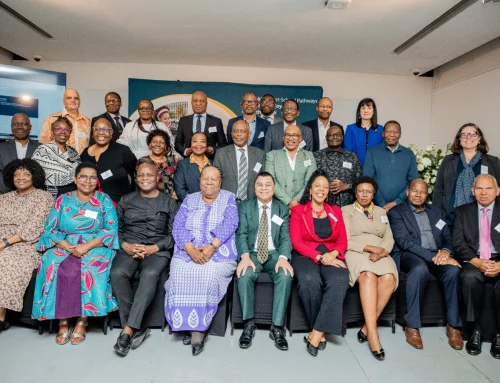
AI was under the spotlight at Universities South Africa’s Education Deans’ Forum (EDF) meeting on 15 August. The EDF Chairperson, Professor Mbulungeni Madiba, who is the Dean of Education at Stellenbosch University, revealed that this will be one of the topics for discussion at the upcoming annual EDF Colloquium, which will take place in November this year.
Concern over the sovereignty of language data

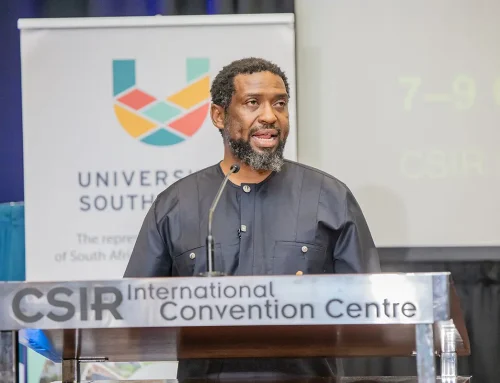
Professor Lindelani Mngun (left), Dean of the Faculty of Education at the University of Pretoria (UP), said AI could lead to a distortion of African languages.
“A colleague who works with AI flagged an important concern about how AI tools are being used, particularly when it comes to the integration of African languages by people who are not specialists in any way, shape or form in these languages. This could lead to a compromised quality of these languages, perhaps even the death of those languages in the long term.”
The Faculties of Education, he said, should take this seriously and find a way to work with the developers of these tools to safeguard the quality of African languages – ensuring they maintain high standards, and that they are not compromised in any way.
“Those of us in teacher education – particularly with a focus on African or indigenous languages – are generally being left out of these vital conversations. For example, ChatGPT does speak some isiZulu, but not any isiZulu that I know. A company in the United States has decided to integrate the language without any proper consultation with the language’s custodians. This is what we need to start addressing in our spaces.”
Professor Madiba agreed that while AI presents many opportunities, there are also many challenges as to how it is used.
“Literacy remains a big challenge with learners who often are not even interested in reading. However, many translated books use a form of the language that is not commonly used in daily conversations. It may be in isiZulu, but it reads like a foreign language. We need to raise our voices when it comes to this.”
Professor Sithabile Ntombela, Dean of Education at the University of Zululand, urged her colleagues to develop, within their own departments, some of the materials needed: “We could begin with Grade One material and build up. Bookshops carry few isiZulu books in KZN. As education faculty, we need to do something about that, and also encourage our students to start writing and developing reading materials.”
Slow progress of CALTs concerning
Professor Madiba (right) went on to address other language issues, including the slow progress of the Centres for African Languages Teaching (CALT) – dedicated to enhancing the teaching and learning of African languages, particularly in the context of teacher education – at universities.
Research shows that education in the mother tongue is a key factor for inclusion and quality learning, which improves learning outcomes and academic performance. This is crucial, especially in primary school, to avoid knowledge gaps and increase the speed of learning and comprehension.

“Although the conceptualisation of CALTs was very good, their establishment has been hampered by a lack of funding and capacity. We need to appeal to the Department of Higher Education and Training (DHET) to make these centres work and send a representative that we can engage with, as a Community of Practice.
“The issue of mother tongue-based bilingual education, which the government is pushing, is central to our work of promoting teacher education. Unfortunately, we don’t have all the required terminologies and registers, and the level of intellectualisation is often low. Government must provide resources for this to work.”
Disparities in students’ support practices during WIL

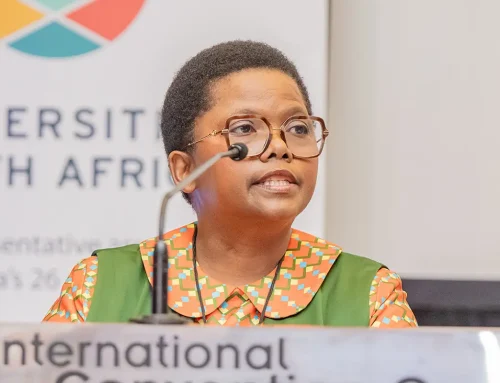
Professor Jacqueline Batchelor (left), Vice Dean: Teaching and Learning at the University of Johannesburg (UJ), raised UJ’s challenges concerning students’ stipends related to Work Integrated Learning (WIL).
The disparities in the system are evident with no consistency in the support of students during teaching practice, she said.
“It is a fraught space. Some of our students are undergoing WIL at schools, alongside peers from other institutions who receive money for travel, clothing or cash payouts for teaching practice. This leads to disgruntlement, which could grow into a sector-wide problem.”
An ensuing discussion revealed non-uniformity among universities concerning student allowances. It emerged that some universities’ staff contribute to benevolent funds and clothing drives to support their students.
Batchelor expressed the need for a uniform sector response to students’ support during teaching practice, and to address some of the hardships that students experience.
EDF Colloquium 2025
On the upcoming annual EDF Colloquium, Professor Madiba said it will take place on 20 November under the theme Digital Transformation and Inclusivity in Initial Teacher Development. The Colloquium would address topics including Assessment and Academic Integrity in the AI Era, Teacher Identity in the Age of AI, Digital Literacy and Resource Access and Pedagogical Innovations.
He said, unlike the broader digital dialogues that USAf convenes on its other platforms, the EDF Colloquium will focus on the transformative role of teacher education in preparing educators for a digital and inclusive future. The event aims to generate actionable outputs, including policy recommendations and a dedicated journal edition, building on the success of the Perspectives in Education (PIE) Journal edition last year.
Janine Greenleaf Walker is a contract writer for Universities South Africa.