Two decades of transformation, resilience and leadership in South African higher education
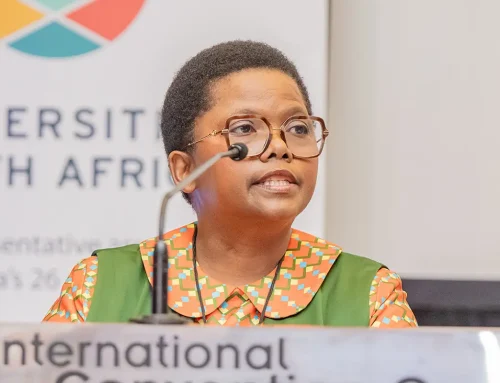
At USAf’s 20th anniversary commemoration on 11 July, Chief Executive Officer, Dr Phethiwe Matutu, underscored why university mergers in the post-apartheid era were vital to the transformation of the higher education sector.
“It was a time of immense pressure on the system,” she said. “Mergers were intended to restructure higher education, address inequalities, and dismantle apartheid’s legacy.”
The CEO said this was a time of heated discussions. At one point, a standoff arose between the then Minister of Education and the University of South Africa over a new name he was proposing for UNISA.
“That is the kind of pressure our vice-chancellors have faced, and nothing has changed in the way they still endure occasional pressure, till today.”
See how far we’ve come

Dr Matutu (left) explained how HESA evolved in 2015 into a broader organisation representing not just university leaders but also the entire constituency of universities and their best interests, also expounding on how the organisation has operated through strategy groups and communities of practice.
“These groups, comprising specialists and professionals from various disciplines pertinent to running a university, became HESA‘s legs on the ground. They were meant to be resources at HESA’s disposal, delivering on its strategies,” she added.
“In my view, that has been USAf’s greatest strength. When someone reaches out to the CEO’s office, the conversation seldom ends there — it is often extended to these structures.” Dr Matutu said USAf had genuinely become a trusted partner in the sector, with other organisations and universities frequently reaching out for guidance towards addressing various higher education issues.
She said one of the greatest challenges that placed universities under immense pressure over the years, especially after the mergers, was the mass expansion of higher education and its net effect on resources. “The massive growth was not matched with appropriate funding. So, USAf’s focus on resource sharing and internationalisation was borne out of a need, and to correct our system.”
The CEO also pointed out the significant impact of the #FeesMustFall protests in 2015, which marked a turning point for SA universities, thus cutting out a crucial role for USAf in lobbying the government for adequate student funding. Years later, the COVID-19 pandemic yet again affirmed USAf’s importance through the organisation’s achievements in keeping universities operational in the face of the national lockdown, and sudden disruption to face-to-face teaching and learning.
While celebrating these achievements, the CEO emphasised the importance of acknowledging those who had laid the foundation and served USAf throughout these years.
Still on USAf’s growth, she drew attention to Higher Education and HIV/AIDS (HEAIDS) —previously a programme under HESA, which outgrew its mother body to become the now independent Higher Health. Another organisation which morphed out of HESA to become an independent entity was the Purchasing Consortium Southern Africa (PURCO SA), which supports universities through collaborative purchasing and professional services.
Growth in sector support programmes
Turning to USAf programmes, Dr Matutu shone a spotlight on the growth of the Higher Education Leadership and Management (HELM) and the Entrepreneurship Development in Higher Education (EDHE) programmes. Both initiatives, funded by the Department of Higher Education and Training’s University Capacity Development Programme (UCDP), continue to operate within USAf. A recent addition to the family was the Advancing Early Career Researchers and Scholars (AECRS) programme, also established within USAf with the support of the Department of Science, Technology, and Innovation. She stressed the critical capacity development needs that these programmes were addressing in the university sector.
Regarding the internationalisation of higher education, Dr Matutu spoke of a significant shift in how universities run the internationalisation agenda, with institutions increasingly involving USAf in their offshore engagements. “Now, universities involve USAf at the very inception of their country-level relationships for greater impact.
“Looking ahead, we will need more of this, especially in the face of new geopolitical developments, which necessitate a bigger focus on Global South-South collaborations. We may need an institution such as USAf to ensure that everything is properly aligned before handing over to universities.”
She went on to mention challenges such as USAf’s now uncertain relationships with Sector Education and Training Authority (SETA) bodies, which partnered with USAf from 2020, in the provision of student bursaries at universities. Another challenge was the stagnation around the Matriculation Board’s relocation to an entity better aligned with its statutory status.
Despite these issues, Dr Matutu emphasised USAf’s ongoing progress, which she credited to the strategy groups for their thought leadership, research studies conducted in response to higher education challenges, and other initiatives that have been steering the system along.
“This is all testament to collective leadership and continuous and fitting response to environmental stimuli.” On that note, she urged staff to celebrate these successes and build upon them in the future.
Staff as the Office backbone

“We cannot talk about USAf without recognising the contribution of employees to what this organisation has become,” the CEO went on to say.
She mentioned especially senior staff movements in the past three years, and considered it a miracle that the organisation was “still standing and going strong,” notwithstanding the changes. Dr Matutu said these changes had given her a bittersweet experience, adding that changing organisational leadership is not something she took lightly.
“However, I think it was the will of God that in our successors we attracted such excellent, experienced, and committed individuals.”
Recognising past leadership for going above and beyond for USAf, the CEO said: “If I were to count USAf’s strengths, its staff would be number one,” she said, to loud applause.
“This kind of staff loyalty to the organisation is something I have never witnessed anywhere else. It is unbelievable, considering that we are a non-profit organisation. Very few people hold permanent positions, and a number of us are on contracts, but we are all here and serving the organisation with our time, energy, and skills.”
She then touched on USAf’s vision and mandate as the voice of South African universities.
“We create an optimal environment for universities to function effectively and efficiently, and we support cohesive but diverse public universities in the service of society,” she said, reiterating the extent to which many sector-related entities looked up to USAf as a voice of reason in many respects.
“We are a vital platform that brings together 26 public universities and other higher education institutions – public or private, local or international.”
As she concluded, Dr Matutu stressed the importance of demonstrating the value of universities, saying USAf needed to showcase its members’ strengths, using concrete evidence.

“Colleagues, I do think that the 20 years of our existence are worthy of this celebration. Most of all, I would like to celebrate you all,” the CEO concluded to a click of glass all over the conference room, as staff toasted to the 20 past years and an even brighter future for USAf.
Nqobile Tembe is a commissioned Communication Consultant.