Universities could respond more effectively to 4IR demands through collaboration between the better-resourced universities and their disadvantaged counterparts
Although the readiness of South African universities to integrate 4IR technologies into their curricula is questionable, leading institutions’ capabilities provide fertile ground for the entire higher education sector to catch up through intentional collaboration, including the sharing of resources.
This emerged at the recent colloquium, which explored the role of higher education in preparing graduates for the evolving world of work, drawing from findings of the USAf Environmental Scan for 4IR Training and the World of Work (2024). The Colloquium brought together key stakeholders to critically engage with the findings of the USAf Environmental Scan, under the theme Navigating the Fourth Industrial Revolution. The event was hosted in Gauteng by the World of Work Strategy Group (WSG) of Universities South Africa (USAf) on 10 July.
According to the Lead Researcher, Professor Rennie Naidoo, who is the Research Director and Professor of Information Systems at the University of the Witwatersrand (Wits) School of Business Sciences, a content analysis of universities’ websites found an 80-20 split between South Africa’s historically advantaged institutions and their historically disadvantaged counterparts in terms of integrating 4IR technologies in their course offerings.

While this disparity was concerning, Professor Naidoo cautioned that the research team might have excluded other institutions’ relevant courses, if their data were not publicly available.
Best practices
Professor Naidoo shared the following best practices that emerged from 12 of South Africa’s 26 public universities.
- University of Johannesburg (UJ):
UJ is among the leading institutions in embedding 4IR principles into its academic programmes and strategic initiatives. This progress is largely attributed to its strong partnerships with the private sector and industry, which enable students and researchers to develop practical, real-world solutions.
The University offers a Computer Science programme with a focus on Artificial Intelligence, a Postgraduate Diploma in Blockchain Technology and Digital Transformation, and a short course on 4IR perspectives tailored for accountants. These offerings demonstrate UJ’s interdisciplinary approach and its reach across various faculties, reinforcing its position as a frontrunner among historically advantaged universities in 4IR adoption.
One notable collaboration is with Schneider Electric, which has resulted in advancements in virtual reality, wireless energy sensors, and real-time monitoring technologies.
- University of Cape Town (UCT)
UCT has integrated 4IR themes into its institutional frameworks and advanced academic programmes. It has established an Environmental Sustainability Directorate that merges digital transformation with a commitment to ecological responsibility. Additionally, the creation of a Design Thinking School underscores UCT’s focus on human-centred innovation—an essential approach to tackling complex technological challenges. Academically, UCT offers a Master of Science in Artificial Intelligence, reinforcing its dedication to developing advanced technical expertise.
- University of Pretoria (UP)
At UP, 4IR is integrated into both its physical infrastructure and academic offerings. The University’s emphasis on Engineering 4.0 and its investment in the Future Africa Campus—a centre for collaborative, transdisciplinary research— stand it in good stead among historically advantaged institutions. It is also recognised for its 3D printing capabilities, supporting both prototyping and large-scale innovation. Additionally, UP offers a Master of Science in Cybersecurity, equipping students to tackle critical threats and vulnerabilities in an increasingly digital world.
- University of the Witwatersrand (Wits)
Wits is a trailblazer in interdisciplinary education within the 4IR landscape, offering programmes such as the Bachelor of Arts in Digital Arts that combine STEM with creative fields, exemplifying STEAM (Science, Technology, Engineering, Arts, and Mathematics) education. Through its data science initiatives, Wits creates cross-disciplinary opportunities for students from non-technical backgrounds, enabling graduates in humanities and arts to transition into technology via postgraduate diplomas. Additionally, the university offers a Master of Urban Studies in Value Creation and a Master of Science in Big Data and Analytics, reflecting its dedication to both practical and theoretical aspects of 4IR.
- University of South Africa (UNISA)
UNISA’s speciality in open and distance learning (ODL) positions it uniquely to model digital transformation for other institutions. Its experience with international collaboration and blended learning serves as a valuable blueprint for technology-enabled education. UNISA also works with other institutions, such as the University of Limpopo, to promote digital literacy in rural communities.
- University of KwaZulu-Natal (UKZN)
UKZN is advancing localised and industry-connected 4IR initiatives. The University collaborates with the Sharks Board and provincial government entities on maritime skills development and local economic development. These initiatives provide real-world relevance to students and focus on strengthening regional innovation ecosystems, combining practical training with economic upliftment.
- University of Limpopo 9UL)
UL has carved out a niche in rural-focused digital empowerment. It runs mobile-based basic digital literacy training programmes, often in collaboration with UNISA. The University has partnered with organisations like Cor to teach community members about artificial intelligence, data science, and web design, promoting inclusive technological literacy beyond traditional academic environments.
- University of Venda (UNIVEN)
At UNIVEN, grassroots innovation is being promoted through initiatives like the Rural Innovation Spring Camp, which includes practical training in IT, robotics, and computer programming. The university also offers cybersecurity awareness programmes, helping prepare students and communities for safe engagement in digital spaces.
- University of Fort Hare (UFH)
UFH stands out for its strong partnership with Telkom, focusing on smart energy grids, renewable energy systems, and Lego robotics projects. These programmes combine educational enrichment with technical problem-solving, contributing to South Africa’s green energy and technological capability.
- North-West University (NWU)
NWU is advancing 4IR education through a specialised Master of Science in Internet of Things (IoT). This reflects a targeted approach to industry demand, particularly in connected devices and automation. Their programmes are highly technical and align with the needs of digitally transformed economies.
- Nelson Mandela University (NMU)
NMU supports the secure deployment of 4IR technologies by offering a Postgraduate Diploma in Cybersecurity. Its curriculum is designed to produce professionals capable of navigating complex ethical, legal, and operational challenges in the cybersecurity landscape.
- Stellenbosch University (SU)
SU offers a Master of Science in Machine Learning and AI, marking its entry into the elite tier of institutions offering deep specialisation in artificial intelligence. The University emphasises rigorous data-driven methodologies and applications relevant to both academia and industry.
Best practices summarised

The above practices, evident at the leading universities, could be emulated across the system to enhance 4IR readiness.
Challenges facing lagging institutions in South Africa

Despite efforts to integrate 4IR in teaching, universities face hurdles such as funding shortages, poor infrastructure, and faculty skills gaps.
Collaboration is the solution
In terms of curriculum innovations, historically advantaged institutions were confirmed to be leading the pack – a fact necessitating collaboration between these universities and their historically disadvantaged (and less resourced) counterparts. “You’ve got some of these different labs available in one institution and not in another,” Professor Naidoo said. “It is time we stopped viewing one another as competition and cooperate and share resources, as some respondents suggested.”
The diagram below provides a taxonomy of multi-level degree programmes linked to 4IR across the sector.

Notwithstanding some institutions’ lag, a sector-wide view suggests an evolving 4IR landscape, nonetheless, if the trends depicted above are any indication.
Improving programme offerings and relevance
Survey respondents opined that programme offerings could improve in quality and relevance if institutions addressed the following areas:
- Expand interdisciplinary programmes: Encourage the development of interdisciplinary programmes that integrate technology with traditional fields such as humanities, social sciences, and business.
- Increase institutional and industry collaboration: Universities should collaborate to leverage combined expertise and resources (e.g. HAI and HDI). To this end, the Colloquium delegates proposed that a national database of 4IR experts (and their speciality areas) be developed and shared across the sector, to inform collaborative initiatives including joint programme design, development and delivery across institutions. Universities should also strengthen partnerships between and with industry to ensure alignment of academic programmes with current technological advancements and market needs.
- Enhance continuous learning and professional development: Increase their short courses and continuous learning opportunities to help professionals update their skills in line with rapid technological changes.
- Invest in digital infrastructure: Improve digital infrastructure to support advanced research and online learning platforms.
- Promote ethical and sustainable technology use: Integrate ethics and sustainability into the curriculum to foster a deeper understanding of the social impact of technology.
Discussion
The study findings sparked a range of reactions from Colloquium attendees, including comments and questions directed at the speakers, including Professor Rennie Naidoo.
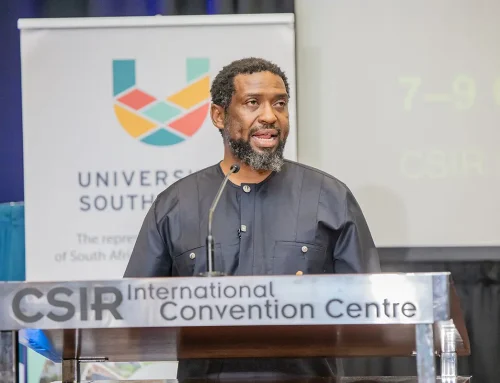
Mr Chief Mabizela (right), Director: Operations and Sector Support at USAf, asked: Given that this is your area of expertise, Prof Naidoo, is your team planning any follow-up work related to this study that might provide deeper insights beyond this preliminary Environmental Scan?
Professor Naidoo responded: I’m experimenting with applying a decolonial lens to the study. I’m concerned that we may be approaching the Fourth Industrial Revolution (4IR) from a predominantly Western perspective. Concepts like ubuntu offer alternative ways of understanding 4IR. Especially in today’s context of geopolitical tensions, it’s time we started interrogating these phenomena using diverse forms of knowledge. While writing the report I found myself framing things in a neocolonial way and thought, ‘How would a decolonial scholar view this?’ That shift can completely reframe concepts like empathy, for instance.

Another focus area for me is digital sovereignty. Most platforms remain Western-centric, but partnerships like BRICS could offer alternative paradigms. Think of how platforms like Facebook and Twitter are influencing elections. So, while this project focused on education, it also served as a launchpad for broader investigations. I thank USAf for the opportunity.
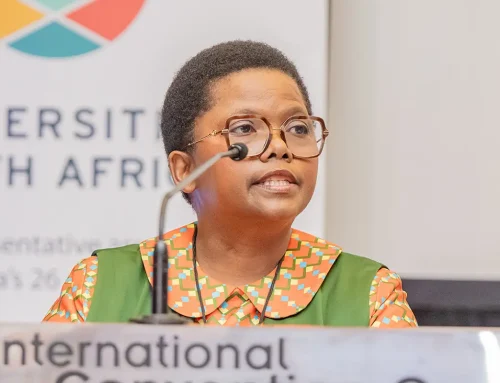
Dr Phethiwe Matutu (left), CEO of USAf, commented: I’d like to thank all the presenters for their contributions. The World of Work Strategy Group is not only concerned with preparing graduates for the workplace but also with enhancing employability. If we fail to prioritise key growth areas — like sustainability and energy, as highlighted by Dr Makhanya [the IBM Researcher in attendance] — we risk falling behind in the very sectors where our economy needs to grow.
The current list of 4IR-related qualifications appears concentrated in engineering, which many historically disadvantaged institutions do not offer. In this context, the introduction of MEng qualifications makes sense. One standout for me was the digital technologies programme for accountants. We need more of these cross-disciplinary qualifications. Broadening our focus beyond Science and Engineering to include national growth areas like energy could lead to a more balanced and inclusive approach.
Ms Elizabeth Masoleng (right), Managing Director: Tekamo Project Management and Consulting Services, and Enterprise Development Associate at the Tshwane University of Technology (TUT), now seconded to TUT’s Information Technology to coordinate and provide mentorship for the Tshwane Varsities Hackathon[1], asked: Professor Naidoo, I noticed that most of the institutions you engaged with, in the sample, were traditional universities. What about the Universities of Technology (UoTs)? They’re doing excellent but often undocumented work, especially in initiatives like the hackathons. TUT’s Faculty of ICT, for example, is a leader among the four Pretoria-based universities participating in the Tshwane Municipality-led hackathons. Were UoTs excluded from the study, or did I perhaps miss their mention?
Professor Naidoo responded: We did have one or two—maybe three—participants from UoTs. However, due to tight ethical clearance timelines (we needed clearance within six months), we were unable to include them in the survey component. That said, they are represented in our website analysis, which captured up to three UoTs in the sample.
Professor Thobeka Ncanywa (left), Director: Research and Innovation at Walter Sisulu University, added: My brief comment is on the integration of technology. The issue of multi-disciplinarity remains unresolved, particularly at the postgraduate level. Supervision tends to remain rigid and siloed, with each discipline limiting itself to its expertise. If we adopted multidisciplinary supervision, we could integrate technological expertise into non-technical disciplines. This would also support decolonisation efforts and encourage practical problem-solving. Multi-disciplinary supervision enhances diversity in research methodologies, considering the sophisticated software usage by some disciplines in data analysis. Infusing those technologies into qualitative data analysis could enrich learning — one way to advance transformation in learning and teaching.
Mr Mabizela concluded by noting that USAf was embarking on a new survey focused on AI-related policies and guidelines under 4IR, in partnership with IBM. He stressed the importance of aligning and tracking all ongoing studies in this area to synthesise emerging insights and generate cohesive, system-wide recommendations.
[1] The Tshwane Varsities Hackathon is a competition led by the City of Tshwane, in which students from the four Tshwane-based universities such as TUT, the Sefako Makgatho University of Health Sciences, the University of South Africa and the University of Pretoria, present tech-based solutions to service-related problems in the Tshwane Municipality, based on real business models.
‘Mateboho Green is Universities South Africa’s Manager: Corporate Communications.