Universities must remove barriers to change without sacrificing academic rigour
Academic leaders challenge rigid disciplines, bureaucratic quality assurance and outdated assessment, arguing that artificial intelligence makes the university’s intellectual purpose more—not less—important.
Universities are expected to prepare graduates for a world of rapid change, yet their own structures frequently resist the innovation they teach. Academic disciplines determine what counts as knowledge, regulations influence what can be taught, and systems intended to assure quality can reward procedural compliance rather than intellectual reflection. The contradiction is becoming harder to defend as artificial intelligence (AI) reshapes how students learn and how knowledge is produced.
That tension ran through a panel discussion on “Reimagining and Challenging the Idea of the University” on Wednesday, 7 October 2026, Day One of the 4th Universities South Africa (USAf) Higher Education Conference, devoted to “Understanding the Present”. The conference, held from 7 to 9 October at the Council for Scientific and Industrial Research (CSIR) International Convention Centre in Pretoria, took place under the overarching theme “Co-Creating a Resilient Future”.
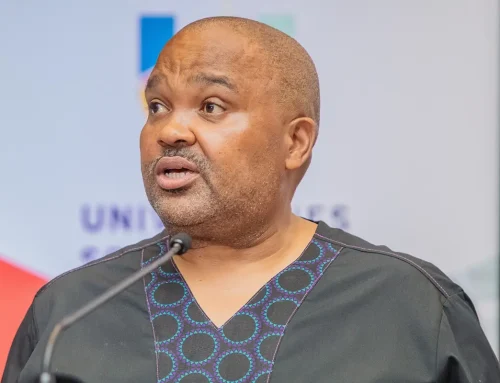
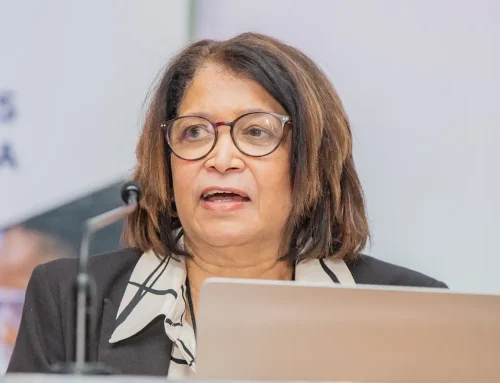
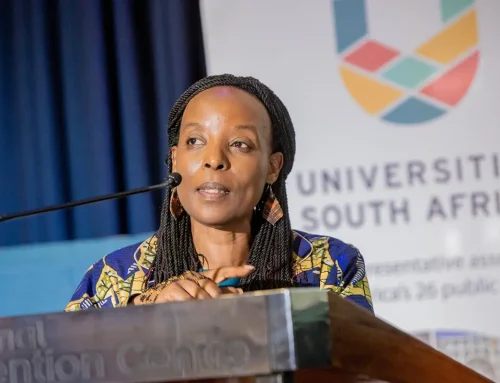
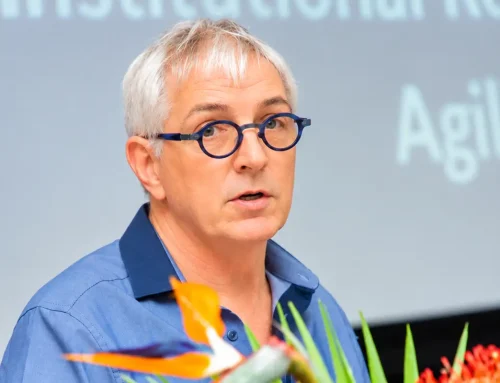
Chaired by Dr Jeffrey Mabelebele, the discussion brought together Professor Sizwe Mabizela, Vice-Chancellor and Principal of Rhodes University; Dr Britta Zawada, former Director of Institutional Audits at the Council on Higher Education (CHE); and Professor Linda du Plessis, Senior Deputy Vice-Chancellor: Teaching and Learning at North-West University. Zawada replaced the scheduled panellist, Dr Amani Saidi.
Rather than predicting the university’s demise, the speakers questioned whether its internal rules, incentives and teaching methods still serve the public purposes that justify its existence. Their interventions converged on an important distinction: renewing the university requires changing its practices, not abandoning the rigorous intellectual work at its core.

From left: Dr Britta Zawada, Professor Linda du Plessis (North-West University) and Professor Sizwe Mabizela (Rhodes University), panellists in “Reimagining and Challenging the Idea of the University”. Fourth Universities South Africa Higher Education Conference, CSIR International Convention Centre, Pretoria, 7 October 2026
The institution that teaches change but resists it
Professor Mabizela began with two questions: “What are universities in a society for?” and, more urgently, what kind of university does society now need? His answer placed the university firmly within the communities from which it derives legitimacy. Institutions must produce knowledge and graduates capable of responding to poverty, inequality and other social challenges, without surrendering their independence to immediate political or economic demands.
He warned that growing distrust of universities coincided with anti-intellectualism, disinformation and the tendency to pass off opinion as fact. His response was not to retreat into academic isolation. Universities, he argued, must defend “the unfettered pursuit of truth”, academic freedom and institutional autonomy while demonstrating the social value of knowledge.
That defence of academic purpose did not amount to defending the status quo. In questions following the presentations, Professor Mabizela identified an uncomfortable institutional irony: “We teach our students that they have to be adaptable, they have to be innovative”, yet universities themselves are “very resistant to change”. He cautioned against explaining this inertia through conspiracy theories; the more revealing explanations lie in the institutions’ established structures and incentives.
For Professor Mabizela, students need more than a qualification suited to an immediate vacancy. Universities should develop reflective, ethical and critical citizens who can reason with evidence, question received wisdom and imagine a better society. Their curricula must also confront whose knowledge is privileged, whose intellectual traditions are neglected and how students’ lived experiences enter the classroom.
Complex problems do not respect disciplinary borders
The sharpest challenge concerned disciplines. Professor Mabizela argued that “the problems that face humanity cannot be solved using one discipline”. Solutions, he said, often lie “at the interface of various disciplines”. Yet universities still organise recognition, reward and promotion around individual academic contributions, even when complex research requires collective effort.
This creates a familiar contradiction: interdisciplinary scholarship is encouraged in principle but may be penalised in practice. The remedy is not the abolition of specialist knowledge. Professor Mabizela urged universities to remove barriers to interdisciplinarity while retaining the disciplines as foundations for rigorous inquiry.
Dr Zawada approached the same problem through the lens of the rules governing curriculum development. She singled out the Classification of Educational Subject Matter (CESM) document, used in the higher education regulatory and funding environment, as a substantial obstacle to programmes that cross established boundaries.
In her assessment, the classification system channels innovation into inherited categories, making it difficult to organise teaching around contemporary South African concerns. Because the categories affect qualification nomenclature and funding, they can pit faculties and departments against one another for resources rather than encouraging collaboration.
Her most arresting illustration was the framework’s treatment of knowledge itself. She contrasted several pages devoted to military science with the absence of the word “gender” and the peripheral treatment of African subjects. For her, the issue is not merely the age of a document but the intellectual priorities embedded within it.
Dr Zawada argued that genuinely new or creative curricula could not emerge easily from such a restrictive framework. The larger question is whether a system presented as an impartial classification of knowledge is preventing academics from developing curricula rooted in African histories, experiences and developmental needs.
Quality assurance is not a tick-box exercise
Dr Zawada’s criticism extended to the way universities respond to quality assurance. The CHE’s evolving Quality Assurance Framework, she explained, seeks a more reflective, developmental approach, requiring academic leaders and lecturers to engage with the substance of their educational practices rather than merely compile records showing compliance.
She described the shift as making quality assurance “a scholarly activity rather than an administrative activity”. That ambition has encountered resistance. After initially welcoming a move away from bureaucratic checklists, some institutions have asked for a return to minimum criteria and tasks that can readily be delegated.
The resistance exposes the difference between producing documentation and testing whether education works. A university cannot establish the quality of its programmes by satisfying procedural requirements alone. It must ask whether learning outcomes are achieved, whether teaching responds to students’ circumstances and whether academic practices improve through critical scrutiny.
Dr Zawada also rejected any opposition between educational excellence and transformation. Recalling the CHE’s foundational approach, she stressed that “quality is linked to transformation, and transformation is linked to quality”. A forthcoming higher education practice standard on curriculum transformation, she said, could help institutions move from declaring transformation an imperative to examining what it requires within individual disciplines.
She acknowledged that she did not possess a ready-made replacement for CESM. Developing one would require the sector to convene expertise, produce proposals and subject them to broad consultation. That admission underscored her wider argument: real reform is a scholarly and collective process, not another administrative instruction.
Artificial intelligence makes expertise more important
Professor du Plessis turned the discussion towards the educational experience itself. The long-standing distinction between contact and distance learning, she suggested, does not adequately describe the varied combinations of classroom, online and blended provision now available to students. Regulatory arrangements should attend to learning outcomes, support and credible assessment rather than allow delivery categories to dictate educational design.
She made a similar case for micro-credentials: shorter, potentially stackable learning opportunities that can help adults return to university as their careers and skills requirements change. But she acknowledged unresolved questions of recognition, portability and national coordination. Degrees and micro-credentials need not be mutually exclusive.
The most consequential challenge is AI. Students can now obtain explanations, summaries and draft arguments in seconds. Professor du Plessis therefore asked universities to move beyond policing the mere use of technology and consider whether students can still demonstrate sound judgement, originality, disciplinary understanding and responsibility.
Her warning was pointed: students cannot effectively interrogate AI-generated answers, identify hallucinations or even ask appropriate questions without a strong grounding in their fields. Rather than making expertise obsolete, the technology raises the stakes for teaching students how knowledge is evaluated.
“Technology is not going to transform education,” she argued. Transformation would depend on academics and students using it purposefully. In South Africa, this also means producing scholarship rooted in African languages, histories and communities, rather than remaining only consumers of technologies and intellectual frameworks developed elsewhere.
Employability is not the same as employment
In the exchange that followed, Professor du Plessis rejected the idea that universities were approaching collapse. “Universities are not in trouble,” she said. “Universities are remarkably resilient.” Their continued relevance, however, depends on remaining critical of their own practices.
She distinguished employment, a job held at a particular moment, from employability, the enduring set of capabilities that allows graduates to develop professionally, change careers and respond to unfamiliar demands. Universities, she argued, do not train students only for employment. This strengthens rather than weakens the case for disciplinary education: transferable judgement requires something substantial to think with.
Assessment, too, needs reconsideration rather than abandonment. Professor du Plessis argued that assessments identify gaps in learning as well as test competence. Universities should therefore examine “how we assess and what we assess”, rather than assume that conventional examinations or the pursuit of marks are the only credible measures of achievement.
She encouraged research organised around societal or industrial problems that draws disciplines together and makes impact a serious criterion of academic success. Otherwise, institutions risk accumulating research outputs with limited public effect.
The question institutions can no longer postpone
Taken together, the interventions placed responsibility on universities, regulators and government. The debate is not simply about whether rules can be relaxed or new technologies purchased. It concerns what institutions reward, how they recognise knowledge, whether they trust academics to lead quality improvement and what they expect graduates to become.
Professor du Plessis called for a national compact through which universities, regulators and government would share responsibility for agility, quality and public value. Professor Mabizela insisted that adaptation must not sacrifice intellectual independence. Dr Zawada argued that regulatory structures must be open to the same critical examination they demand of universities.
The panel ultimately resisted the easy choice between an unchanged university and one stripped of its traditions. Its stronger proposition was that academic freedom, disciplinary depth, transformation and institutional responsiveness need not be rival commitments. The test is whether higher education can redesign the structures surrounding its intellectual mission before those structures make the mission harder to fulfil.
Bhekisisa Mncube is a contract writer for Universities South Africa.