Universities must resist the rush to ‘frictionless’ education, DELT dialogue hears
September DELT CoP dialogue on relational digital education extends August’s call for institutional responsibility, asking universities to protect trust, judgment, and human connection as artificial intelligence reshapes higher education.
Artificial intelligence (AI) is becoming embedded in university life, but the danger extends beyond students using AI to write assignments or academics outsourcing parts of their work. Higher education faces a deeper risk: mistaking speed, convenience and automation for learning.
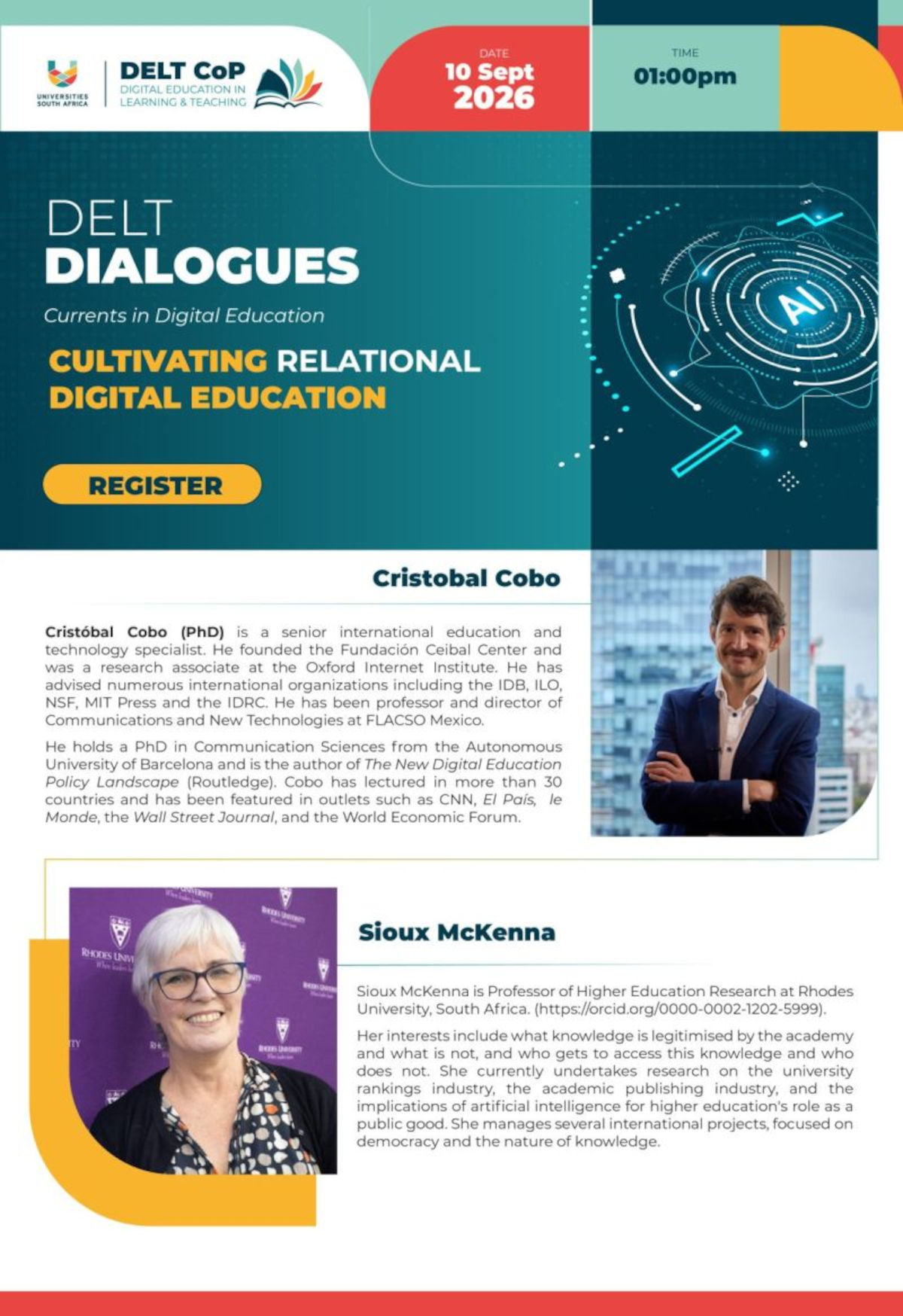
The 10 September 2026 edition of DELT Dialogues: Currents in Digital Education brought the warning into sharp focus. Universities South Africa’s (USAf) Community of Practice on Digital Education in Learning and Teaching (DELT CoP) convened the webinar under the theme Cultivating Relational Digital Education. Dr Cristóbal Cobo and Professor Sioux McKenna examined what universities risk losing when digital efficiency weakens the relationships that sustain meaningful learning.
Cobo is a Senior Education Specialist at the World Bank, while McKenna is Professor of Higher Education Research at Rhodes University. Elizabeth Rakgotho-Booi, President of the Southern African Association for Institutional Research and Head of Business Intelligence and Data Architecture at the University of the Western Cape, facilitated the DELT CoP dialogue.
From institutional responsibility to relationality
The conversation did not reject technology. It rejected technological inevitability. It also extended a question the DELT Dialogues series had put to the sector a month earlier: what do universities owe staff and students as AI reshapes learning and work? On 12 August, Professor Danny Liu and Professor Willie Chinyamurindi argued for better assessment, critical AI literacy and stronger human judgment. The September edition carried that responsibility into relationships: if universities redesign for AI, what human connection must they protect?
Scale without losing relationships
Cobo began with massification, the expansion of higher education from a relatively privileged minority to far broader participation. He described that expansion as a major achievement, but said it had shifted the challenge from “providing entry to ensuring meaningful participation and success.”
Digital models can widen access and reduce barriers, he argued, but scale often depends on standardisation. The policy question is whether institutions can grow without weakening the relationships that make access educationally meaningful. Acceleration creates a similar tension. Shorter courses, micro-credentials and just-in-time learning can offer flexibility, but reflection, intellectual maturity and trust do not necessarily keep pace with technology.
“How can we accelerate the building of trust?” Cobo asked. The question went to the heart of his argument. Fragmentation can make education more portable, while also separating credentials from coherent intellectual formation. Commodification can organise education around price, speed, convenience, completion and employability, making its wider social and intellectual purposes less visible.
Automation can reduce costs and extend provision, Cobo stated, but it can also shift responsibility and risk from institutions to individual learners. That burden may fall hardest on those who are already vulnerable. His warning was not against innovation. It was against the assumption that what is faster, easier to measure or simpler to scale is necessarily educationally better.
Cobo illustrated the point through friendship. He recalled meeting Professor Laura Czerniewicz, Professor Emerita at the University of Cape Town and Chairperson of the DELT CoP, about 14 years ago. They had rarely met in person since, yet had maintained a friendship online. They were, he joked, “living proof that online relationships can work despite social media.”
The distinction mattered. Digital technology can sustain relationships. The harder question is which digital practices strengthen relationships and which remove the human encounters through which knowledge, trust and judgement are built.
Relationality is not ‘being nice’
McKenna pushed the argument into the everyday realities of teaching and assessment. Relationality, she insisted, is not a softer version of education or a matter of pleasant interaction. “It’s not about niceness at all,” she said. Nor, she added, should relationality be confused with the interface design of chatbots and digital companions.
For McKenna, relationality is a structured feature of human learning. Students learn in conversation with people, disciplinary fields, communities and traditions of knowledge-making. That differs from a transactional model in which students submit work, receive marks and accumulate credentials. Large language models can reproduce that pattern: a user gives a prompt and receives a response. The exchange can be useful, she maintained, without becoming equivalent to a human educational relationship.
The distinction becomes especially important in assessment. When every task feels high-stakes, students have little room to experiment, fail, revise and learn. Under those conditions, handing difficult work to a large language model can become a rational way of managing risk. “There’s no space to stuff up,” McKenna observed, arguing that assessment systems often leave students too little room for intellectual trial and error.
That argument echoed the August dialogue. Liu had proposed a shift from “surveillance to stewardship”: secure assessment, where institutions require direct evidence of competence, alongside open assessment, designed for responsible AI use. Chinyamurindi had insisted that universities apply to themselves the scrutiny they demand of students. The September dialogue deepened the point. If institutions want authentic learning, they cannot simply write stricter rules; they must create conditions in which students have reason to think.
McKenna’s prescription was practical. Universities need assessment environments in which students can make mistakes, receive feedback and develop judgment. Academics, she argued, should also make their implicit epistemic reasoning explicit: explain why a discipline values certain forms of evidence, argument, writing and enquiry rather than leaving students to decipher a hidden curriculum.
When efficiency becomes the measure
The discussion repeatedly returned to what universities choose to measure. Trust, dialogue, intellectual care and relationship-building can disappear from institutional priorities because they are difficult to count. Massification without sufficient resourcing, austerity and credentialism can deepen the attraction of technologies that promise efficiency. AI enters this environment of overload precisely.
For students, it offers speed. For academics, it promises relief from repetitive work. For institutions, it can appear to offer scale. None of those benefits is trivial. The problem arises when efficiency becomes the measure of educational value rather than a means of supporting it.
McKenna described an emerging idea from research she is conducting with colleagues as “complicit exhaustion.” Academics can become so overwhelmed by institutional demands that they comply with what is measured and rewarded, even when they disagree with it. Her example was deliberately uncomfortable: “Why am I spending so much time on pastoral care when nobody cares about that?” Calls for relational teaching, she warned, will remain hollow if workloads leave little time for conversation, feedback, experimentation and reflection.
Audience participation sharpened the human stakes. Leon Roets, of the Department of Sociology and Directorate of Curriculum Development and Transformation at the University of South Africa (Unisa), argued in the chat that relational education was critical to “enhance our humanity in teaching and learning” and urged participants to think beyond employability. Another participant noted how social media can accelerate trust through likes, views and apparent popularity, even when AI or bots may shape the interaction.
McKenna responded that universities need deeper conversations about what higher education is for. If education is reduced to information transfer, credentialling and syllabus completion, she argued, automated feedback can look like an obvious improvement. If higher education is also about nurturing critical citizens and contributing to the common good, the answer changes. Technology must then be judged by its effect on human formation, not merely by efficiency.
Cobo extended the concern to what he called increasingly “frictionless” relationships. Human relationships require time, attention, emotion, disagreement and sometimes discomfort. Digital agents, by contrast, can be instantly available, endlessly responsive, and designed to sustain engagement. That makes them attractive, but not equivalent.
He stressed that people, especially young people, need to learn the difference between human agents and algorithmic entities. “These are not humans; these are bots,” Cobo reiterated. The underlying systems may be designed to maximise engagement, he cautioned, which means apparent warmth or attentiveness should not automatically be mistaken for mutual care or accountability.
McKenna added that educators have a responsibility to teach algorithmic bias rather than confine AI literacy to instructions about permitted use. If students are not shown how their disciplines, languages and bodies of knowledge may be represented differently by large language models, she argued, universities are failing at a fundamental part of education.
The South African context makes that obligation sharper. The August edition of DELT Dialogues had already foregrounded inequality, language and employability. Chinyamurindi argued that responsible AI cannot be separated from unequal access, high unemployment, students moving between languages, and uneven educational foundations. The September edition of DELT Dialogues added another layer: relational education cannot be sustained by goodwill alone when staff workloads, resources and institutional metrics work against it.
Slow down enough to learn
Cobo’s closing principle was less about chasing innovation than resisting haste. Education has always moved at a different speed from technology, he stated, and that may be a strength. “Time for friction is going to be essential,” he argued. Difficult conversations, uncertain drafts, disagreement with a lecturer, and the slower process of developing an argument are not automatically defects. They can be part of learning.
McKenna offered an equally direct practical step. Instead of treating large language models as a subject only for rules, declarations and misconduct procedures, “let’s just talk about it in our classrooms,” she urged. That means examining where AI succeeds and fails, exposing academics’ own uncertainty, discussing algorithmic bias and asking what the technology may mean for future professional practice.
The same principle applies to institutional decision-making. A technology that reduces administrative work may give academics more time to focus on students and strengthen relational education. A system that removes meaningful contact may deliver operational efficiency while creating an educational loss. The test is not whether a tool is new or fast. It is what educational purpose it serves, what responsibility it redistributes and what relationship it changes.
Czerniewicz closed by returning to the community. “Keep having these conversations,” she urged. “Extend these networks.” Her call captured the continuity between the August and September dialogues. The first asked institutions to accept responsibility for an AI-driven world; the second asked what that responsibility looks like when translated into everyday relationships, assessment, workload, trust and time.
No policy written today will settle every question raised by generative AI. Universities can build communities that test assumptions, share evidence and keep asking what education is for. They need not choose between technology and relationships. The harder task is to make technology respond to educational relationships rather than allowing efficiency to determine what education becomes.
In an age obsessed with acceleration, higher education may need the confidence to slow down. The conversation that takes longer, the feedback that requires a person, the student who needs another attempt, and the academic who needs time to think are not necessarily inefficiencies waiting to be engineered away. They may be the university doing its work.
Mr Bhekisisa Mncube is a contracted writer for USAf