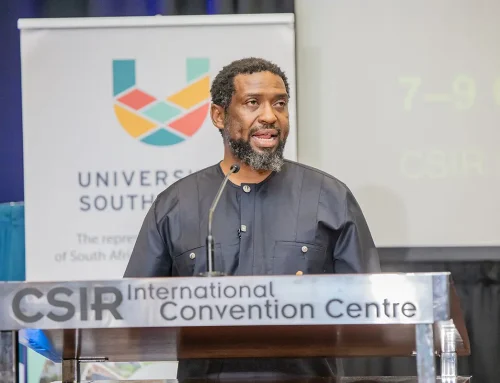
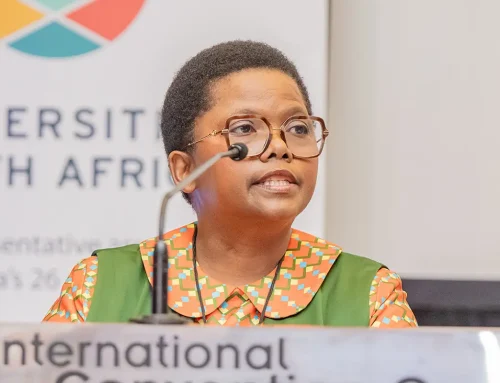
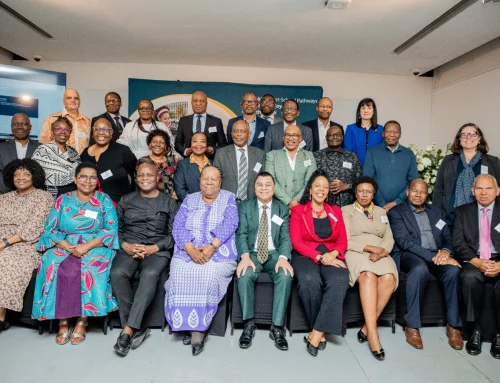
Universities South Africa hosts Open Access (OA) webinars during International Open Access Week, 2025
“The access, use and value derived from research and scholarship ought not to be a privilege that few enjoy, but should become a shared, public resource, to the benefit of many in South Africa, within the continent and beyond”, says the Chief Executive Officer of Universities South Africa (USAf), Dr Phethiwe Matutu.
That is why USAf, aligned with and in support of the global OA2025 movement, invites the higher education community, researchers, and policymakers to two compelling webinars on October 23rd and 24th, 2025. This year, the theme is: “Who Owns Our Knowledge”?
These virtual sessions will bring together thought leaders, researchers, librarians, and policymakers to reflect on how knowledge is created, shared, and controlled and how we might collectively build a more open, just, and sustainable knowledge ecosystem for South Africa, the region, and the world.
The programme features inputs from critical thinkers in the sector, such as the Academy of Science South Africa (ASSAf), the South African National Library & Information Consortium (SANLiC), the National Research Foundation (NRF), the Department of Science, Technology and Innovation (DSTI), the Training Centre in Communications (TCC Africa), the Library & Information Association of South Africa (LIASA), the Committee of Higher Education Libraries of South Africa (CHELSA), the Wits University Press, the University of Venda, the University of Cape Town, the National Library of Sweden and the Association of African Universities, to name a few.
The two webinars, comprising three sessions, will cover the following themes:-
- Policy and Governance for OA
- Sustainable Funding Models for OA, and
- Stakeholder Collaboration in the pursuit of OA
Additionally, the Deputy Director-General from DSTI, Mr Imraan Patel, will present on The South African Open Science Policy, during Session I.
Reclaiming knowledge as a shared public good
Within South Africa’s higher education system where institutions are largely public entities, the scholarship and research being produced hold profound public value. Yet access to this knowledge often remains behind paywalls or are restricted by licensing, funding, and infrastructure barriers. In times of disruption and constant change, it’s time to ask bold questions: Who creates and owns the knowledge we rely on? Who has access to it and who doesn’t? How can we reclaim knowledge as a shared public good?
USAf’s OA2025 webinar sessions will provide a platform to explore these questions, and aims to co-create strategies with relevant stakeholder groups to build a knowledge ecosystem rooted in equity, collaboration, and openness.
Key concerns driving the Open Access movement
While OA is reshaping global scholarship, it brings with it important ethical and practical debates that remain central:
- Equity of participation
The shift to article processing charges (APCs) risks creating new inequalities — where researchers from underfunded institutions or the Global South struggle to afford to publish in open venues. How can we ensure that Open Access does not reproduce old barriers in new forms? - Sustainability of publishing models
As traditional subscription models evolve, universities and libraries face questions about how to sustainably fund Open Access infrastructure, repositories, and journals without compromising quality or long-term viability. - Intellectual property and licensing
Who truly owns publicly funded research? How can open licensing (such as Creative Commons) ensure that knowledge remains free to share and reuse, while protecting the rights and recognition of authors? - Global knowledge inequities
Much of the world’s scholarly publishing infrastructure is still concentrated in the Global North. How can Africa and the Global South build stronger regional systems for open publishing, preservation, and visibility? - Data and digital infrastructure
Open science depends on access not only to publications but also to data, software, and educational resources. Building robust, interoperable systems is crucial to making openness meaningful and sustainable.Given all the above, a call for courageous conversations is essential. Through these webinars, USAf aims to foster robust engagements on the future of open, equitable research and scholarship to inspire collective action toward a truly inclusive and accessible commons.
Dates: 23rd & 24th October 2025
Join the movement. Challenge the status quo.
Let’s reimagine knowledge as a shared public good.
Registrations are still open and can be accessed on the USAf website.