USAf–LSE talks yield clear pathways for institution-to-institution collaboration
South Africa’s higher education sector, represented by Universities South Africa (USAf), and the London School of Economics and Political Science (LSE) have advanced from exploratory dialogue to a clear, purpose‑driven collaboration agenda.
Both entities outlined practical pathways, institutional responsibilities and next steps following high-level deliberations in Pretoria at their meeting on 23rd March 2026.
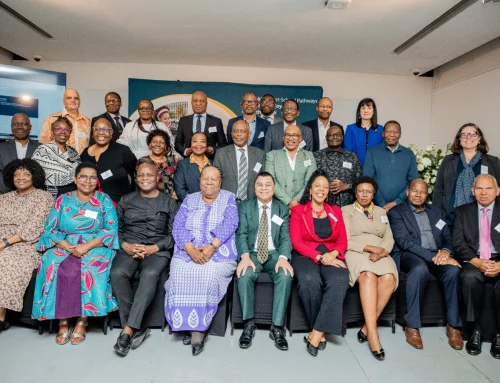
The meeting was hosted by Dr Phethiwe Matutu, Chief Executive Officer of Universities South Africa (USAf), with Professor Francis Petersen, Chairperson of USAf, leading the discussions along with his LSE counterpart, Professor Larry Kramer, President and Vice-Chancellor. The South African delegation comprised vice-chancellors and deputies from several of South Africa’s 26 universities, while the LSE team was mainly made up of officials involved with international partnerships, philanthropy and global engagement.
Beyond reflection on shared challenges, the engagement produced a structured set of potential collaboration opportunities, alongside workable ideas for implementation.

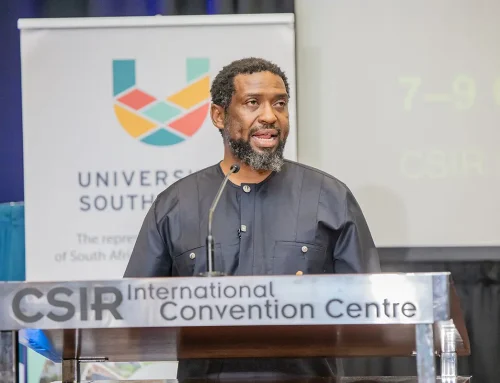
Professor Petersen (left) set the tone by emphasising a shift from breadth to depth in institutional partnerships, arguing that future collaboration must be anchored in shared purpose and measurable outcomes. He noted that “we are moving towards strategic collaborations where the level of strategic dialogue is different and where the discussions are broader than just exchanges or publications.”
He added that such partnerships must ultimately contribute to societal improvement, stressing that “the common purpose is about improving the quality of life of people and contributing to a more stable and secure world.”
That framing shaped the way prospects were identified and discussed.
LSE’s offering
From LSE, Professor Kramer (right) expressed preparedness to engage across multiple levels, emphasising that meaningful partnerships will be selective and built on strong alignment. He explained their approach as facilitating collaboration across teaching, research, and executive education, rather than replicating LSE in other countries. He said their role was to “facilitate the work of students and faculty and create opportunities where there is demand and alignment.”
As possible collaborative forms, he mentioned student exchanges, dual-degree programmes, joint research initiatives, scholarly exchanges, and lifelong learning programmes. However, given the limited resources at their disposal, they select strategic partnerships by alignment of purpose and sustained commitment.

Expanding on how such partnerships are structured in practice, Kramer cited existing models that move beyond traditional exchange frameworks. “We currently have a double degree with Tsinghua University in China, where students undertake part of their studies there and part at LSE, with each institution responsible for its own curriculum and delivery,” he explained.
He added that this approach is being extended to Africa, noting that “we’ve been exploring similar models through our engagements in Nigeria.” He emphasised that “these are not about simply bringing students to London, but about building partnerships that are rooted in local institutions, with real presence and ongoing collaboration.”
USAf’s approach to international partnerships

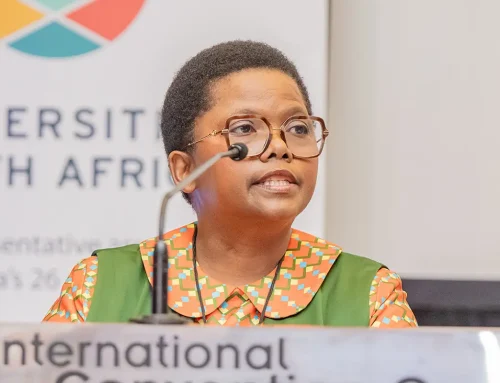
Dr Matutu (left) positioned USAf as the coordinating body to ensure the next phase of bilateral discussions is structured and inclusive. She explained that the organisation operates at a system-wide level and is responsible for aligning collaboration with national priorities across all 26 public universities.
“Everything that we do is at a systemic level,” Matutu emphasised, noting that future collaboration with LSE would be channelled through established structures, including strategy groups, flagship programmes and communities of practice.
She outlined several priority areas for collaboration, including academic collaboration, research partnerships, programme development and capacity building. She also pointed to specific areas where alignment is already strong, including entrepreneurship development, public policy, digital transformation and leadership training.
Matutu further indicated that collaboration with LSE would be situated within USAf’s broader internationalisation strategy. She noted established country-level partnerships with Japan, developing collaboration with Canada, and the initiated and ongoing engagement with Hungary. These partnerships, she explained, are designed to ensure inclusivity and to extend opportunities across the system, including historically disadvantaged institutions. She intimated that a partnership with LSE could be explored along similar lines.
Zooming in on entrepreneurship and innovation, South African universities stressed that entrepreneurship is now central to addressing graduate unemployment and economic constraints. USAf’s Entrepreneurship Development in Higher Education (EDHE) programme was presented as a key platform for collaboration, offering opportunities to integrate teaching, research and practical innovation.
Matutu explained that the programme is designed to operate at multiple levels, stating that “we are focusing on developing entrepreneurial students, institutionalising entrepreneurship within the curriculum and research, and positioning universities themselves as entrepreneurial spaces.”
This approach aligns with LSE’s own interest in innovation ecosystems and enterprise development, creating a natural point of convergence.
SA institutions highlight their priority focus areas for collaboration
Professor Nokuthula Kunene, Vice-Chancellor and Principal of the University of Zululand, echoed entrepreneurship as a key institutional priority. She noted that her university is establishing an entrepreneurship centre and expressed interest in linking this initiative to LSE’s expertise. She also mentioned additional scope to expand existing cooperation in economics and development economics.
Professor Kunene raised the possibility of joint and dual degrees, particularly in economics, entrepreneurship, and political science, while ensuring alignment with national policy.
Dr Mantepu MaseTshaba, Executive Dean of the College of Economic and Management Sciences at the University of South Africa, highlighted the importance of curriculum alignment and student support in shaping future collaboration. Dr MaseTshaba pointed to challenges in entry-level preparedness, graduation rates and progression, particularly in large-scale distance education contexts.
“The gap between entry-level and university education is a real challenge,” she observed, noting that students often struggle to transition from basic schooling to higher education.
She drew attention to the role of mathematics in Bachelor of Commerce degrees, explaining that “in basic education, learners can study subjects without mathematics, but when they come to university, mathematics becomes a gateway.” This, she argued, creates both access and success challenges, suggesting that collaboration could include developing alternative models for entry and support.
Her input broadened the scope of collaboration beyond research and mobility, pointing towards pedagogical innovation and system alignment.
A third major area of focus was employability and the relationship between universities and the broader post-school system.
Dr Joe Molefe, Deputy Vice Chancellor for Student Life, Transformation, and People and Culture at North-West University, emphasised the urgency of addressing graduate unemployment. He cautioned that “every year we churn out a whole lot of graduates, and it is really a challenge to absorb them into employment opportunities.”
Molefe argued that this challenge requires new models of collaboration that extend beyond universities. He pointed to the fragmentation of the post-school system, noting “a lot of silo practices,” particularly between universities and the Technical and Vocational Education and Training (TVET) sector.
He called for “different models that bring together universities, the workplace and other parts of the system,” suggesting that future collaboration with LSE could explore integrated approaches to education, training and employment.
These contributions led to a fourth area of opportunity: research collaboration aligned with real-world challenges.
The LSE response
Professor David Luke, Professor in Practice and Strategic Director at the Firoz Lalji Institute for Africa at LSE, emphasised the importance of contextually grounded research, particularly in areas such as economic governance and development. He suggested that collaboration should focus on producing knowledge that is both academically rigorous and practically relevant.
Luke noted there are areas where we need to rethink how economies function, adding that collaboration could include joint research projects, publications and teaching materials that reflect African realities. This aligns with LSE’s broader focus on global challenges and provides a framework for collaborative research that is both locally grounded and globally relevant.
The discussion also identified capacity building as a cross-cutting priority. This includes support for early-career researchers, leadership development, and institutional strengthening, all of which are central to USAf’s existing programmes.
In addition, there is potential for expanded student and staff mobility, building on existing initiatives such as the Student Women Economic Empowerment Programme (SWEEP) under EDHE, which has already facilitated exchange between South African universities and LSE.
With these prospects identified, the discussion turned to the next steps.
Way forward
Professor Petersen emphasised that universities globally face common challenges, including governance pressures, funding constraints and shifting policy environments. He suggested that these issues should form part of future working relationships, noting that “these are conversations that we need to have at a leadership level because they affect everything else.”
Professor Kramer concurred, indicating that LSE was open to continued bilateral institution-level engagements to explore specific areas of collaboration.
Drawing on ongoing collaboration with North-West University, Professor David Luke pointed to the development of a textbook intended to map critical research gaps in teaching materials on trade and development.
For system-level collaboration, Kramer encouraged USAf, as an umbrella association, to approach its counterpart, Universities UK, to identify system-level strengths and ensure fair distribution of opportunities nationally.
Bhekisisa Mncube is a writer commissioned by Universities South Africa.