Visionary parental stewardship births a lucrative STEM career in a rural, bright mind
She was born to a father who very firmly laid out a rule in his household that all his children would study science, a non-negotiable, in-demand stream, if one were to find their place in the economy. And Dr Phethiwe Matutu, now Chief Executive Officer of Universities South Africa (USAf), bears testimony to the value of that upbringing.
Exceptionally talented in mathematics and following her father’s wishes, Matutu’s career path was one smooth sail from primary school, all the way to exiting as the first black woman to obtain a PhD in Mathematics at the University of Cape Town in 1999.

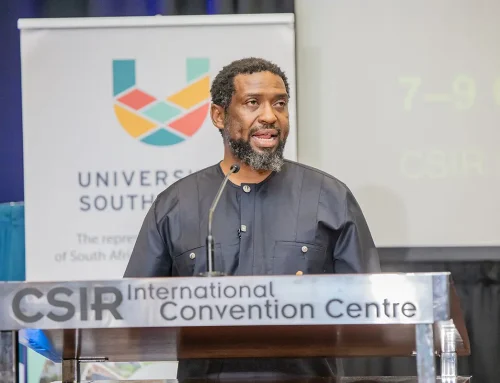
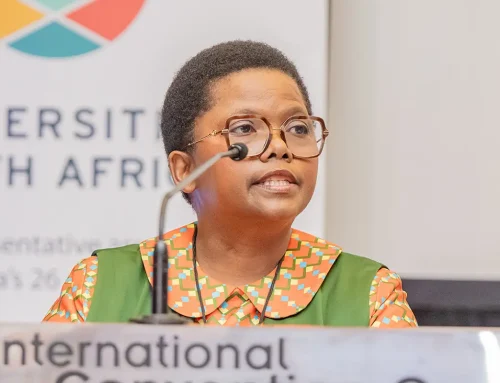
Dr Matutu attending USAf’s biennial Research & Innovation Dialogue outside Durban, in 2023.
The benefit of choosing a high-demand skill
“I navigated my career journey without the hassle of competing with a multitude of people for spaces and opportunities,” she says, reflecting on how it all began in high school.
“I had been accepted into Ndamase High School — a typical rural boarding school in Cumngce, roughly 17 kilometres from Mthatha in the Eastern Cape.
“On the day I arrived, I was asked to produce proof of my Standard 7 examination results — Standard 7 being a basic Transkei Bantustan schooling qualification of that era. I had to travel into Mthatha to retrieve the transcript, and, in my absence, the school administered a mathematics test to the incoming cohort, of which I was a part. I also sat for the test upon my return the following day and scored 38 out of the 40 marks. That result earned me a place in the 3A class, which I shared with the likes of Bongani Mayosi — another brilliant mind who would go on to become a Professor of Cardiology and later Dean of Health Sciences at the University of Cape Town (UCT), until his tragic passing in 2018.
“My transition to university was seamless — applying, gaining admission, and securing a place in a hostel all happened without an issue. My first real challenge came with the shortage of academic staff at the University of the Transkei (UNITRA).

“After completing my undergraduate degree, I had to pursue my Honours part-time while simultaneously studying for a Higher Diploma in Education (HDE), specialising in mathematics teaching. I undertook both qualifications concurrently because the university lacked sufficient lecturers to run a full-time Honours programme. I recall Professor Loyiso Nongxa, who was then teaching at the University of Natal, being flown into Mthatha on weekends to teach us.
“At the end of that year (1988), my exam papers landed in front of an external examiner who happened to be the Head of the Mathematics Department at Rhodes University — Professor Wesley Kotze — who reviewed my marks and asked, ‘Where is this student?’ The coordinating professor, an Applied Mathematician, later introduced us.
In April/May 1988, UNITRA singled out the then Ms PP Matutu (bottom photo) for passing her BSc with distinction in mathematics, further stating the student’s intention to teach mathematics after completing her Higher Diploma in Education.
“That’s how Professor Kotze came to offer me an all-expenses-paid opportunity to study at Rhodes University and complete my Honours full-time.
“We had experienced a few bouts of unrest at UNITRA during my first year of undergraduate study. Tired of studying in an unstable environment, I secured a place at UCT for second-year BSc, an idea my father adamantly opposed.
“Understandably so. He had already lost one son to apartheid-era politics, which had forced him into exile from the University of Natal. Politics had also claimed one of my male cousins, whom my father had raised alongside my brother, teaching them all the essential farm duties — from ploughing to fixing his fleet of vehicles. He was not prepared to lose more of his children to politics and exile.”
So, three years later, “the opportunity to study entirely free of charge was a temptation my father could not resist. Rhodes offered me not only a bursary but also accommodation. I shared an office with four other Honours students. I also tutored while studying full-time.
Adapting in an all-white institution
“At Rhodes, the adjustment was significant, coming from UNITRA — an all-black institution. Suddenly, I found myself immersed in the predominantly white world of Rhodes University. I was tutoring white students and engaging with an academic staff that was entirely white.
“This was also where I enrolled for my Master’s degree, which I completed with distinction in 1991.”
Matutu then secured a teaching post at the University of the North (Turfloop) — Qwaqwa Branch — although her tenure there proved far shorter than anticipated.
“Students were protesting about the standard of mathematics instruction, claiming that the Eastern European lecturer, also a Head of Department, was making them write like secretaries. I remember thinking, ‘What on earth am I doing here?’ Alongside other staff members, I often found myself locked out of campus by protesting students. It was in those moments that the idea of leaving that institution to pursue further studies began to take shape.
Being discovered by UCT
“While considering the possibility of pursuing doctoral studies at the University of the Witwatersrand (WITS), I received a call from the Head of the Mathematics Department at UCT. And guess who it was? Professor Chris Brink, who has spoken at our conferences and partnered with us on some projects. He is now Emeritus Vice-Chancellor at Newcastle University in the United Kingdom.”
She says even back then, there was a concerted effort to identify and support high-performing black academics. “I suspect the media frenzy surrounding my Master’s degree distinction at Rhodes had something to do with it — word travels fast when you break through barriers.”
Family tragedy
“In July 1992, my father was murdered in his garage as he arrived home from playing golf in Umthatha. Contrary to what many might assume today, this was not a robbery. These individuals simply ambushed and shot him in cold blood. This was around the time my family had planned to celebrate my Master’s achievement, and I’ve always believed his killers acted out of jealousy.
“It took me time to come to terms with the loss, but I eventually accepted the offer to pursue doctoral studies. In doing so, I made history once again — becoming the first African woman to earn a PhD in Pure Mathematics in 1999. Around that same period, another black woman, Marcia Moremedi — if memory serves me correctly — was awarded a PhD in Applied Mathematics from WITS.
“For several years thereafter, I lectured at the University of Cape Town (1992-1997), followed by Stellenbosch University (1998-2004), and later at Rhodes University (2004-2008), respectively. During this period I got married, and had children. I then joined the Department of Science and Technology in 2008, eventually rising to the position of Group Executive at one of DST’s agencies — the National Research Foundation. I held that role until I transitioned to Universities South Africa (USAf) in October 2022.
The role of parents in shaping children’s careers
Dr Matutu firmly believes in the power of parental influence when it comes to shaping their children’s career paths.
“As we celebrate Women’s Month this August, I want to highlight the pivotal role mothers can play in guiding their children’s career choices—particularly in light of the prevalence of single-parent households in our society. Parents must first educate themselves about the evolving world of work and familiarise themselves with the skills most in demand. That’s the most effective way to support their children, while also honouring their individual talents and interests.”
She acknowledges that parental influence can have both positive and negative outcomes. “When my father insisted that all his children pursue science, it was driven by a clear understanding of the market demand for those qualifications. He did allow us to deviate from that path—but only after we had completed a BSc.”
Thanks to her father’s influence, one brother became an architect, a sister earned a B.Ed specialising in mathematics, and another brother—who sadly passed away—was preparing to study engineering abroad after starting his BSc at UNITRA. The rest completed their BSc degrees before branching into careers in teaching, commerce, and human resources.
How her mathematical skill was nurtured
As the seventh of nine children, Dr Matutu benefited from the guidance of her older siblings, most of whom studied maths and science. “Some were at university, others still in high school, and they’d mark my self-taught exercises.” When her siblings were not around, she would take her work to her teacher, who was often astonished by how much she had mastered independently. “It thrilled my teacher to know that, should a complex problem that had not been taught in class come out in the externally set paper, someone would get it right. ”
She also credits working in her family store during her primary school years for nurturing her mathematical abilities. “We kept cash in a drawer behind the counter. As customers paid, I had to calculate change mentally. That’s another way I trained my brain in numerals.”
To youngsters still figuring out their career paths
Dr Matutu believes that following one’s parental influence can lead to a solid career. She recalls some of her peers at UNITRA whose father had a deep belief in the value of teaching, convinced that South Africa would never lack teaching jobs.
“His children obtained teaching qualifications before pursuing their own career choices. I remember one of them went on to become a land surveyor. Although she was happy, the route to securing her preferred profession was protracted, as she first had to satisfy her parents.”
However, Dr Matutu notes that there are occasions when one’s aspirations align with their parents’ wishes—and that, she says, is a good thing.
‘Mateboho Green is Universities South Africa’s Manager: Corporate Communications.