‘You are not going to talk to me at gunpoint’ – Prof Mtose on leading a university through competing pressures
The taxi operators came into the vice-chancellor’s office to discuss transport for student teachers. The first thing they did was take out their guns and put them on the table.
“I said: ‘Please put that gun back where it belongs. If you want to talk to me, you are not going to talk to me at gunpoint. This is serious. I am going to leave this meeting and let’s see who is going to shoot me.’”

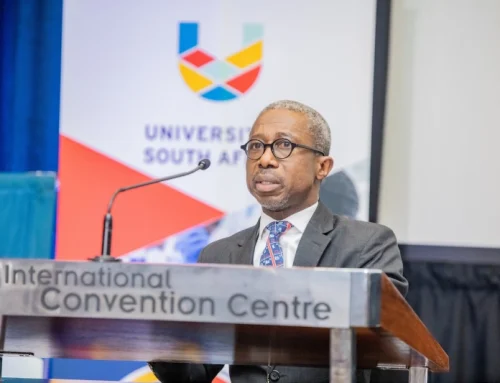
Professor Xoliswa Mtose (left), Emeritus Vice-Chancellor and Principal of the University of Zululand (UNIZULU), told the story to delegates at the 4th Universities South Africa (USAf) Higher Education Conference, in a session titled “Building Institutional Resilience, Strategy and Agility”.
Her story, however, was about more than one tense meeting. At a university with too few resources, she said, the pressures come from every side.
“You are in an institution that doesn’t have resources, you don’t have buildings and yet you have business people coming to demand that the vice-chancellor (VC) gives them 30%,” she said. And with a taxi rank right outside the university, there were times when “you couldn’t drive without going through people carrying guns”.
She soon learnt that as a Vice-Chancellor (she stepped down in March this year after more than a decade in the role) she could walk into a meeting about one thing, only to find it was really about something else. “At times you heard afterwards that this was actually the agenda,” she said. “And there are times when society will use students as weapons to destroy you as the vice-chancellor.”
A memorandum from students might appear to be about fees, curriculum or language. “But when you read it and go through their demands, you realise there is political interference, there are labour relations issues, there is interest in tenders, and on and on,” she said. “I learned to read a crisis systemically rather than episodically.”
She was also frank about the word “resilience”, which gave the session its title: “I don’t think that when you are walking the walk, you are resilient. You are learning to survive in the midst of the conflict that surrounds you.”
As someone who is not Zulu, she had to learn the culture and the politics of the area in which she was working.
“As a vice-chancellor it is important never to think that you are not part of the political agenda. You are right inside it. The best way for me was to listen and to have my ear on the ground.”
She said she believed that female vice-chancellors are attacked more than their male counterparts. “You are a woman in an area that believes a woman can’t talk there or can’t look men right in the eye, which I do. My weapon is just looking you in the eye and saying: ‘Hey, I am not taking this nonsense’.”
“Fortunately, as a woman, even when students are rude, they see a mother in you. And that is what we need to project: a mother who is understanding, but firm at the same time,” she said.
Her students became her best source of information. Through them she learned what the induna and the political parties thought of her.
“Not all of them were correct. So you must not respond or tell them what you think. You must just receive it and go and think about it.”
‘Efficiency for whom?’
In her address, Prof Mtose placed these daily battles inside a bigger picture. Universities, she argued, are pulled in different directions by competing forces, and leaders need to ask whose interests each one serves.
In South Africa she singled out two: decolonisation and digitalisation. “These logics create a central leadership paradox, in which, as a vice-chancellor, you operate within and feel the tensions of,” she said. Digital technology is often said to bring efficiency, “but one may ask: efficiency for whom?”
She described some “game changers” from her time at UNIZULU. The first was what she called epistemic leadership: deciding whose knowledge counts. When professors in the Department of African Languages chose to write their dissertations and citations in isiZulu, there was pressure from within the university to translate them into English.
“And the question we had to ask ourselves was: for whom? Why are we translating what is legitimate, this is our language, this is a Zulu-speaking people, into English? For whom?”
A language policy on its own was not enough. “We thought that once we had the policy, it was done; we were good,” she said. The real question was what the university had to do “to put isiZulu at the centre of knowledge, not just in the language policy”.
On the curriculum, she found that decolonisation meant vastly different things in the natural sciences and in the humanities, and her job was to turn those differences into learning. The best approach was to make it an institutional project, “rather than leaving each pocket to work out how to decolonise its own discipline”.
COVID-19 showed that going digital could deepen inequality at a rural university. When teaching moved online, UNIZULU’s students did not have laptops and they had no connectivity in their rural areas.
“I had the experience of seeing academics getting out of their comfort zones, when they decided that they would go to the post office in each and every rural area to connect with their students and give them the laptops we had bought,” she said. “The game changer for me was that digital transformation became a question of social justice and institutional resilience, rather than simply technology adoption.”
She also rejected the idea that local relevance and academic excellence pull in opposite directions. “All knowledge begins locally,” she said. “It is produced by local actors.”
The dark side of adaptation
Prof Mtose warned against taking the familiar call to “adapt or perish” at face value. “Adaptation can be weaponised by dominant institutional actors to ensure that their mechanisms of control remain intact,” she said.
“I contend that this adaptive ethos, at best, merely tinkers at the margins of fundamental organisational challenges. At worst, it inadvertently reproduces or legitimises the status quo.”
When a crisis hits, she said, several of these pressures arrive at once. What first looked like a student protest about one issue “quickly revealed deeper questions about belonging, language, curriculum, affordability and institutional identity”.
That changed how she saw her own job.
“The most important shift was from seeing myself merely as an administrator of change to understanding myself as a mediator of plural institutional futures,” she said. “The central question for me was how I, as a leader, could continuously negotiate competing pressures while preserving institutional purpose?”
Janine Greenleaf Walker is a contract writer for Universities South Africa.