You cannot reinvent South Africa’s universities for the future without reassessing the curriculum – but there isn’t an easy formula for it
If there is one aspect that is integral to conceptualising universities of the future, it is the question of what is taught and learnt. This is especially true in South Africa where the student protests of 2015/2016 highlighted the drive to decolonise the curriculum.
So it is not surprising that the session titled Curriculum for the Future, at Universities South Africa’s conference on Reinventing South Africa’s Universities for the Future, delved deeply into the complexity of the subject.
Prof Vasudhevan “Vasu” Reddy, Dean of the Faculty of Humanities at the University of Pretoria, struck at the heart of the dilemma when he said: “It’s almost impossible to think about curriculum change without a full recognition of where we locate it and what are the push and pull factors. Curriculum change 20 years ago would have been seen in a very different context.”
He said curriculum change was not a clinical exercise but one that had to uncover very deep questions that are troubling and messy. “Getting down to the nitty gritty of saying: ‘what choices am I making here?’ That’s where the big challenges are,” he said.
Prof Reddy was one of two speakers on the panel. The other was Prof Yiva Rodny-Gumede, Head of the International Office at the University of Johannesburg (UJ). She spoke a lot about innovation.

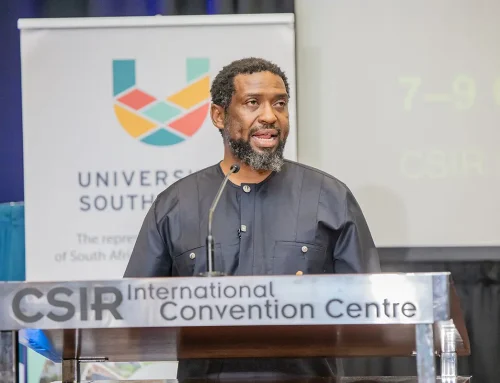
Prof Vasu Reddy, Dean of the Faculty of Humanities at the University of Pretoria.
“How do we facilitate and how do we create an innovative higher education system, how do we create innovative universities, innovative campuses, innovate teaching and learning projects and then innovate their curriculum?” she said.
“What is an innovative curriculum?” she asked. She cited Aalto University in Finland whose focus on creative collaborations, multiculturalism and breaking down boundaries in its curriculum also translates into minimal classrooms and more meeting rooms.

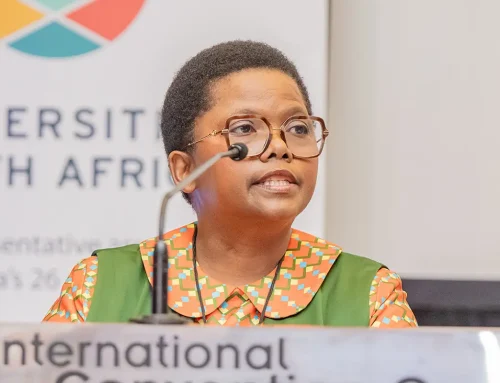
Prof Yiva Rodny-Gumede, Head of the International Office at the University of Johannesburg, offered insights into innovative curriculum.
She said an innovative curriculum is one which also:
- encourages critical thinking;
- encourages entrepreneurship;
- uses innovative assessment methods; and
- includes social consciousness in terms of community orientation and outreach, and engages with the United Nations’ sustainable development goals and with wicked problems (social concerns that are difficult to explain and inherently impossible to solve).
Another possible innovation includes customised study programmes where students complete degrees in the shortest time possible, as well as the low-residency model where students come to campus for short bursts of intensive classes. Prof Rodny-Gumede said this would help those students battling travel costs.
Prof Reddy’s presentation was, on Universities South Africa’s request, about the national project he is heading from the University of Pretoria titled Unsettling Paradigms: The Decolonial Turn in the Humanities Curriculum at Universities in South Africa.
Unsettling Paradigms is a collaborative project involving the universities of Pretoria, the Witwatersrand, Free State, Rhodes, Western Cape, Cape Town, Stellenbosch and KwaZulu-Natal. It started in 2016, after what Prof Reddy referred to as the “watershed year” of student protests, and is funded by the Andrew W Mellon Foundation of New York.
It is an intervention project based on curriculum renewal and transformation. Ultimately it is about “the struggles being articulated around the meaning, not just simply of a university, but also of a transformed university,” said Prof Reddy. And in South Africa that is not merely a buzzword but about “real, tangible, meaningful change that each one of us wants to make”.
He said the very name “Unsettling Paradigms” reflects the heart of the project: moving from a fixed position to one which blurred the boundaries of our assumptions, values and practices.
Then, not knowing she was present at the discussion, he quoted Professor Suellen Shay of the University of Cape Town’s Centre for Higher Education Development, an expert on global curriculum trends: “In South Africa – and other developing countries – addressing the problem of inequality through curriculum reform is not optional”.
He said Unsettling Paradigms is referred to as being about the decolonial term, yet it is also about:
- how we reconstitute society, social relations and our identities;
- identifying local challenges; the plurality of voices;
- being inclusive;
- being democratic;
- the hidden curriculum and institutional cultures; and
- the curriculum itself: what substantive change entails, what should be taught, and how it can be best achieved.
- Re-contextualization — what choices are made and how they’re arranged;
- Reassessment – of canonical figures and themes in syllabi; and
- Repositioning – less about destruction and more about decentring.
“Recovery” is a key term they use in the project. This, he said, refers to our diverse heritage around voices, perspectives, absences and gaps; and recognising that these aspects of the past impact on the present in polyphony (a musical term which refers to two or more simultaneous lines of independent melody).
“What does Latin and Roman history have to teach us about ingrained attitudes to gender, about the legal system?” he asked. It was about how perspectives can be reversed or enhanced through looking at new ways of doing. “If you have recovery, you have reassessed that, you also have repositioned it,” he said.
Aside from the theory, this is what the universities involved in Unsettling Paradigms are actually doing:
Wits: Socially Just Epistemologies – explores transformation of universities through teaching interventions that integrate a sense of moral and ethical purpose to learning;
Rhodes: Decolonial Aesthesis as critical teaching methodology – experimental teaching-in-practice for Arts students from Rhodes, Fort Hare and Walter Sisulu universities. International scholars will be invited to facilitate decolonial creativities based on the work of Prof Walter Mignolo of Duke University in the US whose work explores global coloniality, the geopolitics of knowledge and trans-modernity;
UCT and Stellenbosch: Toppling Visual Regimes – this is exploring a decolonised Visual Culture curriculum. The main aim of this three-year project is to research African Visual Culture and art by scholars on the continent;
KwaZulu-Natal: (Re) Centering rurality and uncovering the hidden agenda – addresses how rural-origin students experience and respond to the hidden curriculum in higher education spaces, and how this might inform transformation and decolonisation curricula;
Western Cape: Languages and literacies in Higher Education – uses activities that require 3rd year literacy students to explore their own multilingual affiliations and subjectivities; and
Free State: Decolonising Anthropology at the margins – looking at the diversity of curricula, as well as student and staff experiences in the Anthropology departments at Free State, Sol Plaatje University, Rhodes and North West universities.
Unsettling Paradigms includes developing an open online archive, which is in place, and launching the Journal of Decolonising Disciplines, edited by 24-year-old University of Pretoria Masters student Siseko Kumalo.
This session’s Chair, Dr Sizwe Mabizela, Vice-Chancellor and Principal of Rhodes University, announced that Prof Shay was present. This is the expert that Prof Reddy had quoted, and whose contribution to teaching and learning was something they all celebrated. He then asked her directly: “What should the curriculum of the future be, Suellen?”
She responded by saying there are three drivers challenging us:
- Redressing inherited inequality;
- The decolonial term and its focus on knowledge; and
- 21st century challenges such as 4IR and changes in the world of work.
How could we pour these three drivers together to move forward, she asked the panellists and others. Prof Rodny-Gumede said she thought the UN’s sustainable development goals were a fourth driver.
Prof Reddy said he didn’t think Prof Shay’s drivers could be pulled cohesively in a systemic way because that might imply there was a formula to be applied, when the reality was far more convoluted.
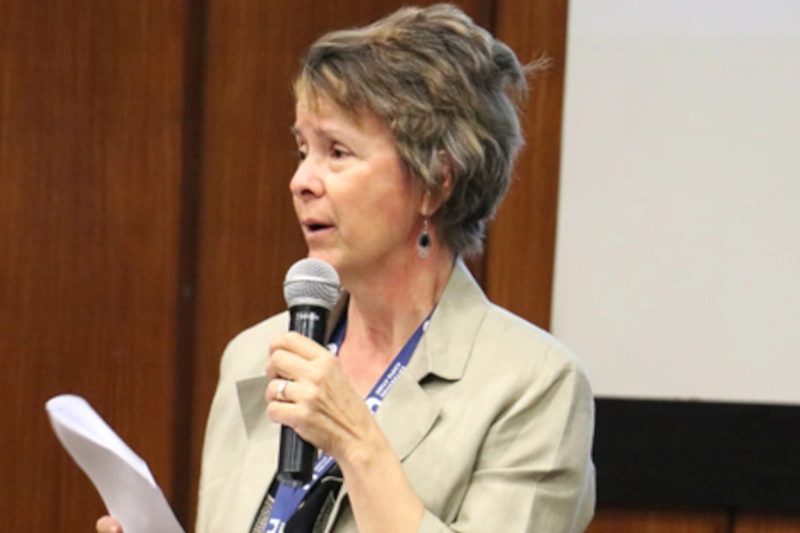
Prof Suellen Shay, a curriculum expert and Dean at the Centre for Higher Education Development at the University of Cape Town.
“There’re choices to be made in your distillation of redress, knowledge and 21st century challenges,” he said. “So it’s not an easy process, Professor Shay, to pull everything equally together but we do know that, at the end of the day, we do need to. Not because we want to be reactive; there’s a value to curriculum change”.
Prof Puleng Lenka-Bula, Vice-Rector for Institutional Change, Student Affairs, and Community Engagement at the University of the Free State, said she was concerned Prof Reddy had explained the decolonial term by referring to re-reading Euro-American canons. “Why would we want to centre empire and its logics?” she asked.

Ms Tsitsi Mpofu-Mketwa, a Teaching Assistant and PhD candidate at the University of Cape Town, shared some of the approaches they use in deconstructing Sociology curriculum.
Almost as if in response, Ms Tsitsi Mpofu-Mketwa, a teaching assistant and PhD candidate at the University of Cape Town, shared some of the ways they used classical text to deconstruct the curriculum in the Sociology Department. For example, first-year students look at texts by 19th century German philosopher Hegel who portrays Africa as a dark continent. However, instead of discarding his writings, they find it useful to look at the legacies Hegelian thinking has left with us: “a part of which is linked to the way Africa gets partitioned in different segments, and linked to xenophobic attacks where some parts of Africa are considered as less relevant”. Mpofu-Mketwa referred to this as how they “engage our classical tricks” to teach students that they don’t have to feel the way Hegel did, but can find alternative ways of viewing their African context.
Prof Rodny-Gumede responded by saying “an old canon” could be used in a different way. She related how she had used both Hegel and the African concept of ubuntu to comment on the Venda movie Elelwani: “I smashed and grabbed everything that I could take out of Hegel’s Aesthetics and I articulated that from an Ubuntu perspective”.
In response to Prof Lenka-Bula’s criticism, Prof Reddy said he had not been propagating a re-centring of the empire but was actually asking for a critique. And that in itself was an act of reading, an intervention, a process which led to “creating new forms of knowledge” which was about “becoming messy, deliberately so”. He said he thought that was what education should be: “it should be messy, it should be troublesome, it should problematise, it should engage the contestations. We’re moving away from binary opposites.”
Mr Simon Trump, Co-CEO of the Ikusasa Student Financial Aid Programme, asked if there were short-term measures to test different curriculum changes. Prof Rodny-Gumede said these measurements should be based on how best the curriculum would benefit the students, often from a financial perspective.
Prof Reddy said the test for curricula were about how they relate to the kind of graduate attributes you wanted to instil. They could also be tested in terms of whether a particular curriculum, combined into a degree, led to employability, a big evaluation marker for universities.

Mr Simon Trump, Co-CEO of the Ikusasa Student Financial Aid Programme.
Ms Faye Taylor, Head of Strategic Partnerships at the Association of Commonwealth Universities, wanted to know to what extent students needed to be convinced of their new role in learning, such as the need to get involved in creating the curriculum.
Prof Reddy responded by saying that students’ core work had changed radically in the last five to 10 years and there was a deep reluctance to even go to classes. “We see that students are interested in their success but they are also not wanting to be burdened with the kind of expectations some of us might have,” he said.
He said a big question they had been asking colleagues in Unsettling Paradigms was if students were extensively engaged in creating the curriculum or if it was just lip service. “Wonderful stuff, student-centred co-creation,” he said, but wondered how one organised students to participate.
Professor Thengani Ngwenya, Director of the Centre for Excellence in Learning and Teaching at Durban University of Technology, asked for more information about Prof Rodny-Gumede’s comment about students completing matric maths while doing first-year university maths.
She said it was not in practice at UJ but she had been involved in one such programme many years ago at Stockholm University.
Written by Gillian Anstey, an independent writer commissioned by Universities SA