A 4IR Environmental Scan highlights an urgent need for universities to adapt to 4IR demands
The urgent need for universities to align with the demands of the Fourth Industrial Revolution (4IR) emerged as a common thread across all speaker contributions at a recent colloquium exploring higher education’s role in preparing graduates for the evolving world of work.
Hosted by the World of Work Strategy Group (WSG) of Universities South Africa (USAf) on 10 July in the East Rand in Gauteng, the colloquium brought together key stakeholders to critically engage with the findings of the USAf Environmental Scan for 4IR Training and the World of Work (2024) report under the theme Navigating the Fourth Industrial Revolution.
Commissioned in 2023, the 4IR Environmental Scan assessed the readiness of South African universities to integrate 4IR technologies into curricula, teaching practices, and workforce development strategies. The scan was conducted in partnership with the University of the Witwatersrand’s School of Business Sciences.

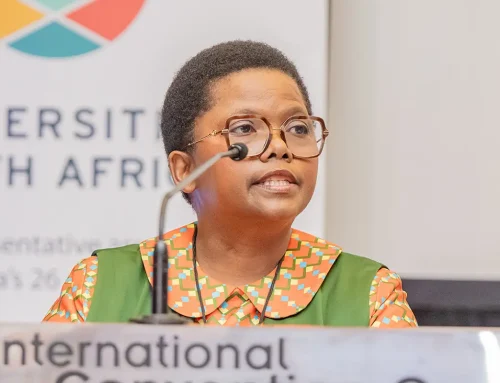
USAf’s CEO, Dr Phethiwe Matutu (left), was the first to sound the alarm in her opening remarks – when she said the whole world was scrambling to respond to the 4IR – a phenomenon that the Ministerial Task Team on 4IR described as “the convergence of new digital, physical, biological technologies such as artificial intelligence, cloud computing, the internet of things, robotics, augmented reality, 3d printing, biotechnology merging with human physical lives, changing the way we interact, live, and work.”
She said the enormity of these innovations, though difficult to quantify, required every student to undergo some form of training, either in robotics, 3D printing or other forms of digital technologies.
“While students in commerce get trained in a particular area, it is clear that robotics will have to play a role in engineering, as will 3D printing, or various other aspects of artificial intelligence.” She said, notwithstanding the different training specialities, all technologies tend to conflate, enabling students to achieve unimaginable possibilities.
“Recently, we heard of a medical team from the United States that completed a medical operation on a patient in Africa while remaining in the US. These are innovations we never imagined. You have to work within an interdisciplinary team to achieve them, and the global challenges require these innovations.”
No longer skills of the future
Dr Matutu argued that these visible innovations “are no longer the skills of the future. They are very current – the whole world is scrambling to come to terms with them,” thus triggering the question: “How do we prepare our students with the necessary skill sets for this unimaginable environment?”
She said it was in gatherings such as the 4IR Colloquium that the higher education sector would determine “what it is that we should be doing as universities, together with the private sector, and policy makers in government, to drive what South Africa must do to align, and to prepare our graduates for the current world of work taking place in industry, and the future world of work that will be driven by these innovations and technologies.”
The urgency to move with speed
She said USAf — recognising that universities would not run at the same pace, with some already being miles ahead of the system in utilising these opportunities — was looking at a systemic approach, of promoting peer learning to support those institutions lacking the capacity to run at the forefront. “Given the inequalities in our system, USAf is looking at enabling them to move with speed, and to catch up.”
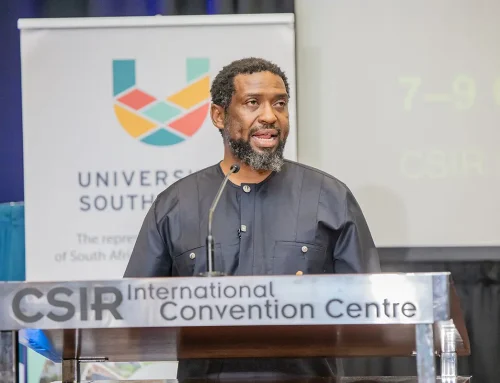
Professor Letlhokwa Mpedi (right), Vice-Chancellor and Principal of the University of Johannesburg, who welcomed delegates in his capacity as the Chairperson of USAf’s World of Work Strategy Group, echoed the CEO’s sentiment on responding with speed.
He referenced the World Economic Forum’s Future of Jobs 2025 report, which highlights three key forces poised to profoundly reshape business and employment: expansion of digital access, projected to be the most transformative trend by 2030, rapid advancements in artificial intelligence, robotics, and evolving energy systems.

Professor Mpedi said that while the WEF Report had published sobering statistics of anticipated job losses, it also offered some hope. “170 million new jobs will be created while 92 million will be lost, resulting in a net growth of 78 million jobs globally. In particular, we will see growth in frontline and care roles as well as tech roles, while clerical and administrative roles will face the steepest declines…
“Far from being alarmist, changes are unfolding at a rapid and unprecedented rate. Against our current context, we are increasingly asked to reflect on our role and whether our relevance can withstand time…What we are concerned about is how we navigate these shifts as universities.”
Changing work forms require innovative teaching methods
In the context of the new forms of work appearing on the horizon, Research Director and Professor of Information Systems at the University of the Witwatersrand’s School of Business Sciences, Professor Rennie Naidoo (left), who was the Lead Researcher in the 4IR Environmental Scan, noted a stark difference between today’s traditional kind or work, where one sticks with one employer all their life, and the new models of work, such as job-sharing, mobile work using ICTs, crowd employment, casual work, voucher-based work, or portfolio work.
“When we train our graduates, do we bear these in mind, knowing that this is the world that they might be entering?”

He also referenced the WEF’s Top 10 priority skills that universities should be concerned with, in the 4IR era.

Professor Naidoo also weighed in on universities’ structural inequalities. Confirming the view shared by the USAf CEO, Professor Naidoo said their literature review had revealed that South Africa’s higher education system was dealing with two trajectories: conventional higher education institutions and their adaptive and tech-savvy counterparts.

He said employers and advantaged learners in the system tended to expect higher performance in innovative teaching methods. The tech-savvy institutions seemed to be responding more rapidly to these demands, compared to their slower-to-adapt, more traditional counterparts.
Professor Naidoo underscored the urgency to adapt, arguing that “the incremental approach to changing our curriculum raises the risk of irrelevance. It’s quite likely that a tech-savvy institution such as Harvard University could emerge on our shores, forcing our universities’ business schools to shut down. I’m not sure that we understand we’ve got to move more quickly than we currently are. We cannot adapt quickly enough.”
We cannot rest on our laurels – Professor Mpedi
Citing a question posed by the scholar Bryan Turner in December 2024: “Does the University have a future?”, Professor Mpedi added that lately, his university Council members often ask whether the university has a future, given all the training programmes now offered online by various companies.
“They argue that the days of universities are numbered, and talk of the uberisation of universities, where, in future, universities will be physical structures open for anyone to come there and offer courses.”
Countering this hypothesis, Professor Mpedi reasoned that universities had existed for 1000s of years, citing an institution in Europe that was approaching its 375th anniversary in 2025. “Clearly, that university has survived wars and all other odds. But we should not fool ourselves into thinking that because universities have survived this long, we can rest on our laurels.”

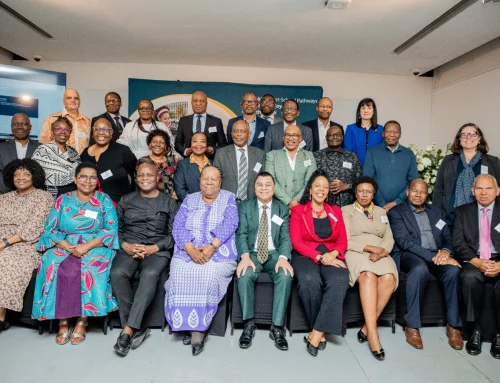
The 55 delegates attending the Colloquium represented vice-chancellors, deputy vice-chancellors, faculty deans and their deputies, heads of schools and deputies, senior lecturers, lecturers and heads of research. Also in attendance were representatives from private higher education institutions, employers’ associations, First National Bank, the South African Breweries and think tank organisations. Up to 20 public universities were represented.
Maintaining SA’s global standing
Dr Matutu went on to describe the South African university sector as “a system renowned internationally for its competitiveness in various areas. We don’t want to lose that reputation when it comes to our graduates.”
It was in this context, she said, that USAf, through its World of Strategy Group (WSG), to drive the university-industry interface to determine “how to skill our graduates.” She said the colloquium was a platform to launch the Environmental Scan Report and to determine how to move forward.
The 10 July Colloquium is a culmination of a decision made by the WSG at its meeting in April 2023 to gather data across the university system to establish what is happening within various professions in response to 4IR imperatives. The initiative was a response to the mind-boggling speed of technological advancement in the 4IR era and the implications for higher education.

The WSG meeting of 13-14 April 2023, which hatched the idea of a nation-wide environmental scan.
The then WSG Chair, Professor Thandwa Mthembu, said “We need to identify the sectors in our country that beg a national response on what South Africa should be doing, whether it is netiquette, online learning, aspects of energy, mining or banking.”
The USAf Environmental Scan for 4IR Training and the World of Work (2024) report, which the sector gathered to dissect on 10 July, marked the completion of the fact-finding phase of this project. Having now identified strengths, weaknesses, opportunities and threats in the South African higher education sector, the WSG will, henceforth, lead the process of mounting a well-informed, sector-wide response.
‘Mateboho Green is Universities South Africa’s Manager: Corporate Communications.