A four-way public-private-international partnership strengthens entrepreneurship education in SA for national advancement
The fruition of the Embedding Entrepreneurship in Curriculum workshop series, notwithstanding the strained political relations between the United States and South Africa, demonstrates the power of science diplomacy.

This was the opening statement of the Universities South Africa (USAf) CEO, Dr Phethiwe Matutu, at the dinner hosted in Pretoria on Wednesday, 6 May, to officially welcome Professor Paul Miesing (above), an Emeritus Professor of Business and a United States Fulbright Scholar, in South Africa. Professor Miesing is facilitating a series of six workshops equipping academics and universities’ leadership in embedding entrepreneurship education in the curricula of all faculties across South Africa’s 26 public universities, and in three other institutions in the Southern African Development Community (SADC) region.
The realisation of this capacity development programme is credited to a four-way partnership between USAf and the Department of Higher Education and Training (DHET), the primary sponsor of the Entrepreneurship Development in Higher Education (EDHE) programme; the United States Embassy in South Africa through its Fulbright Specialist Programme, and ABSA Bank, through a R5 million grant aimed at supporting EDHE’s flagship programmes, including the workshop series that commenced on 9 May. The Fulbright Specialist Programme, which enables countries to leverage international expertise and best practices in numerous disciplines, has deployed a senior academic to lead the six-week training programme as part of its entrepreneurship support to South Africa’s higher education sector.
Another supporter of this capacity development initiative, especially its extension to the Southern African Development Community (SADC), is South Africa’s Department of Science, Technology and Innovation (DSTI). The department contributed R140,000 to enable participants from three universities outside South Africa, but within the SADC region, to also benefit.

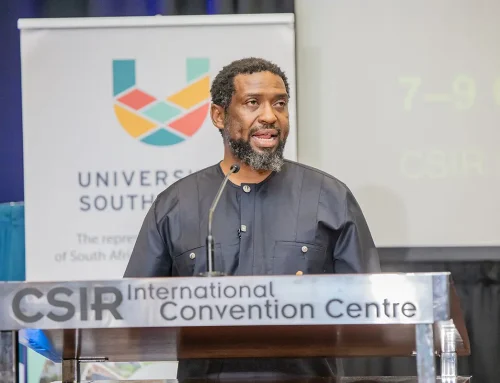
Welcoming representatives of higher education leadership, the United States Embassy in South Africa, the SA government and ABSA Bank partners to the dinner event, Dr Matutu (left) said, “That researchers continue to collaborate and advance their work regardless of political tensions demonstrates that science diplomacy prevails above politics.
“This also highlights the importance of partnerships and the need to keep collaborating, no matter what our political heads think, or the state of their relationships,” Dr Matutu said.
She pointed out that embedding entrepreneurship into universities’ curriculum, and institutionalising it across the higher education sector, has long been a shared goal between USAf and the Department of Science, Technology and Innovation (DSTI).
“At a national level, this is important for several reasons. Our economy has not been growing at the desired pace… so universities must produce talent capable of driving economic growth. One thing we’re not short of, in this country, is talent: creative and numerical. But the question is: what are we doing with it? Looking at South African demographics, young people of university study age make up about 30% of our population. Programmes like this one are key to ensuring that our talent works for us and our country’s advancement.”
The United States’ and ABSA’s contributions mark a significant addition to the DHET core support of the EDHE programme under USAf, while the DSTI has come aboard to support an Africa-wide entrepreneurship development drive.
Why ABSA supports entrepreneurship
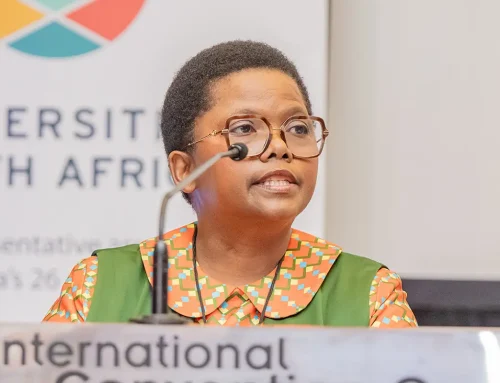
Ms Nonhlanhla Magagula (right), ABSA Bank’s Head of Corporate Citizenship Programmes, said the initiative signals a fundamental shift in how the higher education sector prepares young people for the future.
“This is a shift in how we see higher education. Embedding entrepreneurship in the curriculum is about enabling young people to begin to think and act differently. We need young people who don’t line up asking, ‘Where am I going to get the next job?’ but who instead see themselves as opportunity creators. As ABSA, we’re excited to be part of this shift.”
She noted that the future of work, shaped by rapid technological change and evolving industries, is already here. “It’s no longer something on the distant horizon; it’s already with us. So how do we prepare young people to access future opportunities, and to create those opportunities?”
Magagula pointed out that the fastest-growing jobs today are entrepreneurial ones created by visionaries and young innovators, “people who identify a problem and turn it into a business solution.” That’s why Absa partnered with USAf, she said. “Our support is a deliberate effort to build a real, enabling ecosystem for entrepreneurship in higher education. The EDHE initiative directly addresses systemic challenges like youth unemployment, which currently sits at over 45% in this region. That’s significant.”
She added that ABSA’s partnership with USAf is not only focused on individuals, but also on strengthening institutions. “As much as the end beneficiary, the student, is critical, we also need to ask: how do you strengthen the system within which that beneficiary is located? Institutional capacity development is just as important to us. That’s why we’re so looking forward to the workshops that will be taking place.” She said they would drop in on some of the workshops, not for purposes of auditing them, but to get first-hand experience of this exciting initiative.
Fulbright expertise to broaden to other disciplines
Mr John Jake Goshert (left), the Assistant Cultural Affairs Officer at the United States Embassy in South Africa, described the Fulbright Specialist Programme as one of the Embassy’s flagship initiatives for fostering international collaboration. He emphasised that specialists are selected through a competitive process, not only for their expertise but also for their ability to engage meaningfully across cultures.
He said the Embassy is using the current USAf/EDHE initiative as a model for further engagements, including upcoming placements focused on AI in higher education, civic education and speech therapy, among others. “Ideally, the specialist visits are just the beginning of long-term partnerships and collaborations that continue to provide ripples of growth and development for both sides,” Goshert said.

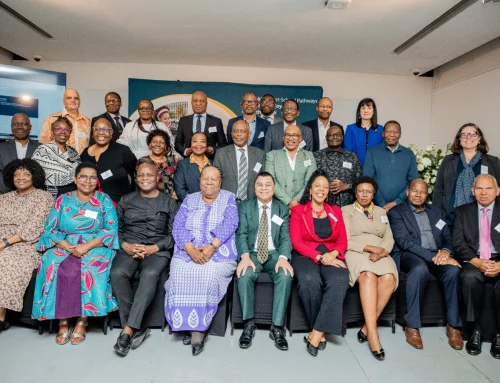
The close-knit community that officially welcomed Professor Paul Miesing to South African shores on Wednesday, 6 May.
South Africa to lead an entrepreneurship drive across Africa
Representing the Department of Science, Technology and Innovation, Ms Lindiwe Gama (right), Director for Africa Bilateral Cooperation, said this occasion was heralding “a very exciting time for us. When we began engaging with entrepreneurship in higher education across the African continent, there was a prevailing narrative that Africa was not entrepreneurial enough.”
Ms Gama was referring to a UNECA (United Nations Economic Commission for Africa) multinational study that assessed the nature and extent of entrepreneurial universities across Africa in 2021.
Carried out at numerous universities in Algeria, Ethiopia, Ghana, Kenya, Rwanda and South Africa, the UNECA study found weak links between universities, government and industry.
Other problem areas it identified were:
- The absence of strategic alliances and joint Research & Development (R&D) centres.
- Little or no investment by the universities.
- Unclear government policies on entrepreneurial universities.
- Limited to no links between R&D, innovation and entrepreneurship.
She explained that through UNECA, a decision was taken to initiate continent-wide discussions on fostering entrepreneurship in universities. “For us, this is not just about ensuring our own [SA] national growth; it’s about developing together with the rest of the continent.” To that end, the DSTI would facilitate sharing with other universities in the rest of the continent, entrepreneurship expertise, and best practices now established in South Africa’s higher education. She said this was an excellent opportunity for SA universities to share tried, tested and proven practices for mutual and extended growth.
Acknowledging the ABSA Bank’s presence elsewhere on the continent, Gama implored the Group to also consider extending their support to this continent-wide entrepreneurship drive.
Nontobeko Mtshali is a writer commissioned by Universities South Africa.