Beyond banking: how corporate citizenship is reshaping SA’s entrepreneurial landscape
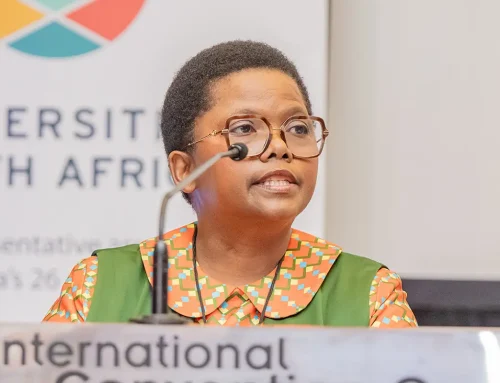
In a keynote address that challenged traditional notions of corporate support, Ms. Nonhlanhla Magagula, Head of Absa’s Corporate Citizenship Programmes, outlined a transformative vision where her institution has become a catalyst for systemic change rather than a mere funding source.
At the EDHE-Absa Innovation Challenge launch hosted at the Mangosuthu University of Technology (MUT) on Wednesday, 25 June 2025, Magagula (right) demonstrated how the banking sector is reshaping its role in supporting youth entrepreneurship across South Africa. The event also marked the formalisation of a Universities South Africa (USAf) partnership with Absa in support of developing an entrepreneurial ecosystem across South Africa’s 26 public universities. This partnership is being implemented through USAf’s Entrepreneurship Development in Higher Education (EDHE) programme.

“At Absa, we don’t just want to be a bank that provides funding. We want to be a catalyst, a partner, a platform,” Magagula declared to an audience of student entrepreneurs and university leaders attending the event. “Our goal is to walk with entrepreneurs from their first spark of an idea to their first employee, and beyond.”
Financial inclusion through entrepreneurship
Magagula’s address was anchored on Absa’s Corporate Citizenship strategy, which positions “Financial Inclusion Through Entrepreneurship” as the pathway to meaningful economic transformation. This approach recognises that unlocking South Africa’s entrepreneurial potential, particularly among our youth, is a key lever in helping to address unemployment – this requires a deep commitment from stakeholders across the spectrum.
“We genuinely believe that young people are the heartbeat of South Africa’s entrepreneurial future,” Magagula explained. “That’s why our support goes beyond sponsorship – it’s about building pathways into economic participation, into ownership, and lasting impact.”
Geographic and institutional intentionality
She went on to explain the choice of MUT for the launch of the relationship with USAf, at an institution located in Umlazi township rather than in traditional business centres.
“It’s not a coincidence that this national initiative launches here. MUT represents the hope of historically disadvantaged institutions and the possibility of innovation emerging from the townships,” she explained.
“Innovation doesn’t always look like Sandton, the richest square mile in Africa. Sometimes it looks like Umlazi. Sometimes it looks like an idea on a piece of paper. Sometimes it looks like a student building an app in a residence room,” Magagula observed, referencing Facebook’s origins as an example to emphasise that transformative innovation can emerge from any environment.
Redefining economic participation
Magagula’s keynote challenged narrow definitions of financial inclusion, arguing for a more comprehensive approach that addresses multiple barriers facing young entrepreneurs. “We believe in economic participation that goes beyond just access to money. We believe in access to opportunity, access to markets, access to mentors, and most importantly, access to self-belief.”
“Our country doesn’t lack ideas. It lacks platforms. This Challenge is one such platform,” Magagula noted, identifying a critical infrastructure gap in South Africa’s entrepreneurship ecosystem.
Building on proven track record
She positioned the EDHE-Absa Innovation Challenge within Absa’s broader entrepreneurship support portfolio, referencing successful partnerships with organisations like the Young African Entrepreneurs Institute (YAEI) and Junior Achievement South Africa.
Although she mentioned that the Absa Bank was named South Africa’s best bank for SMEs in 2024 by Euromoney, Magagula quickly explained that “it is not the award that drives us. It’s the success stories, the young woman in a rural town who turns a local problem into a scalable business, the graduate who refuses to wait for employment and instead becomes an employer.”

The audience at this event comprised student entrepreneurs and staff involved in entrepreneurship development.
Championing transformative enterprises
She said they were looking to support ventures that “break the mould, challenge the status quo, and demonstrate transformative thinking.”
Magagula clarified: “We don’t want you to start ‘just another business.’ We want you to build something transformative. We want you to start something that answers the call of your community, your country, and even the world.”
She thus implored student entrepreneurs to “dream out loud, pitch with pride, and execute with excellence.”
In conclusion, she impressed upon the young audience at MUT that “The future is not something that arrives. The future is something we build, and I believe with all my heart that South Africa’s most important builders are not in boardrooms; they’re right here. On campus. In townships. In you. It is YOU.”
Tersia Gouws is a commissioned writer for Universities South Africa.