Can SA universities realise genuine transformation and endure, long-term?
How to achieve transformation without risking sustainability; what defines a university; whether blackness is synonymous with dysfunctionality, and whether black elites are enforcing an educational system that does not work for South Africa, were questions raised during a spirited debate in the Transformation Strategy Group (TSG) session of the recent 3rd Higher Education Conference, on 9 October.
Titled The Future of Transformation in South African Higher Education: Looking Back, Going Forward, this session was exploring transformation imperatives within the broader Conference theme of ‘The Future of the University’.

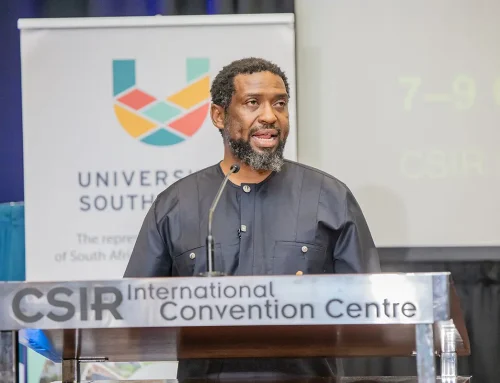
When the floor was opened for a discussion, following the presentations of Professor Lis Lange and Professor Nomalanga Mkhize, Mr Mandla-Onke Notyawa (above), an Honours in Statistical Sciences student and a former Student Representative Council President from the University of the Western Cape, fired the first salvo.
“When protests arise at institutions of higher learning, it is often Student Affairs divisions who are thrown under the bus and given these issues to deal with – these can be anything from academic issues to safety challenges. This leads to blackness being made synonymous with dysfunctionality because the problem is passed on to black people to resolve — because it is black students who are protesting and causing problems.
“Who is responsible — in the main– for Student Services? It is black people. They are given the problems to deal with, so black people are perceived as incompetent when it comes to institutions of higher learning. A while back, I raised a controversial view [at my institution] that a white deputy vice chancellor for development and support should be appointed because [previously], a black person was always in charge of that portfolio.”
Dr Maditsane Nkonoane (right), Dean of Students at the Durban University of Technology (DUT) said it was vital that the transformational system is overhauled. “We find ourselves where we are today because of how we perceived the White Paper on transformation. The massification in higher learning has led us to where we are and has bred a sense of entitlement in our student community.
“The concept of cooperative governance – as contemplated in the White Paper, and later percolated in the Act itself – is problematic. You just have to look at alumni associations which are basically retirement homes for student leaders. This is what also corrupts us.”

Mr Tumiso Mfisa, Stream Coordinator: Gender Equality, Diversity & Inclusivity at the Cape Peninsula University of Technology, agreed that transformation needs a radical approach: “We can’t dwell on the past as it has happened and every university has its own vision and own mandate. We need, as young people, to ensure that we have both academic and administrative competencies and skills. Community engagement has to form part of transformation. Many universities get scared when you raise topics around decolonisation or the renaming of buildings. We have to challenge the status quo but in a way that unites us and does not create further division.”
Mr Sibusiso Mnxuma (left), Senior Lecturer in Industrial Psychology at North-West University, said the one big failure of the Department of Higher Education was not maximising and harnessing the learnings from educational and vocational training (TVET) colleges when tackling the issues of unemployment: “I had an opportunity to visit universities in Rwanda and was impressed with their digital transformation. We also need to realise the transformative power of universities in terms of solving real life societal and community problems. We cannot have municipalities, in which universities are situated, fail. We are supposed to be the highest structure in terms of intellectual knowledge contribution.”
Mrs Elinor Sisulu (right), founder and Executive Director of Puku Children’s Literature Foundation and a former member of the Nelson Mandela University Council, urged university leaders to consider the demographics of students: “There are large numbers of materially deprived students, who encounter significant social change when they come to university. Just how far are universities student-centric and working towards helping them? One of the biggest threats to universities comes from the outside. If, for example, the University of Pretoria was taken out of the Tshwane metropole, the municipal economy would collapse; but what voice do universities have? Political power of universities should form part of the transformation discussion.”
Speaking on the Siyaphumelela student initiative, Mr Ashton Maherry from the non-profit South African Institute for Distance Education (SAIDE), said they had seen huge strides in student access; but this was not adequately translated into student success. “There are still huge inequalities in performance gaps between race, gender and socio economic status and in some cases the gap is widening. There is still a lot of work to do when we examine throughput. We discovered at one university that due to CoViD restrictions on the cohort that graduated last year, throughput went from 65 percent to 30 percent.”
Dr Sianne Alves (left), Director: Office for Inclusivity & Change at the University of Cape Town, who chairs USAf’s Transformation Managers’ Forun and is a member of the Transformation Strategy Group, believes that higher education now has ‘quantity and forms of quality’ throughout the sector, and that 30 years on it has succeeded in its mandate.
“Now we are at a confluence. We are at a point of opportunity where we have to think about AI as a part of our solution, and reconfiguring and redesigning what higher education means, even relooking the physical infrastructure of the university and whether a building defines a university or whether it is defined by virtual accessibility and access to education. We need to continue to upscale education, not only in South Africa but with our partners on the African continent, and possibly beyond. Alongside that ideal vision, we need to comprehend how transformation is understood and what is a newer and more responsive version.”
Professor André Keet (right), Research Chair for Critical Studies in Higher Education Transformation and Deputy Vice-Chancellor for Engagement and Transformation at Nelson Mandela University and is also a member of the USAf Transformation Strategy Group, also suggested a way forward:
“We need new concepts, mechanisms and tools like the transformation barometer of 2015 which now is outdated. There are so many developments within the sector that a new instrument is required. The TSG needs to reconsider the question of how we rethink social justice transformation within the university and the capitalist juggernaut.
“Why is it that the university, as a knowledge space, finds it so difficult to traverse different genres of epistemic tradition? We create a culture of competition and individualisation within the university sector but we also need to encourage people to work together. We need to tackle the discourse where transformation is more or less juxtaposed with sustainability. Sustainability is always thought of as financial sustainability and transformation as drawing on resources that are required for the university’s financial sustainability.”
Professor Lis Lange, one of the two key speakers in this session, said that instability comes mostly from a financial point of view and from the social development perspective.
“AI and digital transformation have to be examined critically – we must not make the same mistake twice by using something when we don’t understand how it works. It cannot be used as an excuse to make money in a market where there are no regulations.”
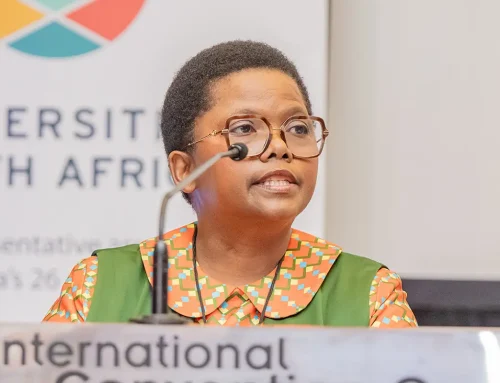
Professor Mkhize (left), the second lead speaker, addressed both post colonialism and “blackface instability”.
“The African elites opened the door to neoliberalism and failure, and the black elites are going to be the ones who are going to enforce a system that doesn’t work for their own people. They possess the political and internal, individual and intellectual power to say no but they don’t. In South Africa, there are multiple political forces that have constrained the power of student formations and trade unions. The fist of power is your black politician. This class defends its own gains at the expense of the rest of society.
“However, we are encaptured in contradictions as South African society. The South African university is less neoliberal than it could be because it is taking care of many people through a social justice mandate. However, the black face of the university cannot be the solver of the problems that it is not really causing.” she said.
“We have to tackle sustainability versus transformation – this is a terrible discourse but it is also a reality. Capital flight in its various forms is making universities unstable. When I talk about transforming transformation, all these questions have to be discussed. We have our work cut out for us.”
Janine Greenleaf Walker is a contract writer for Universities South Africa.