Enhancing teacher education through PrimTEd
Interventions aimed at improving teacher education and development in South Africa – particularly concerning the teaching of languages and mathematics – are beginning to pay dividends.
This message emerged from an entity involved in teacher education at Universities South Africa’s Education Deans’ Forum (EDF) meeting on 15 August.
The Primary Teacher Education (PrimTEd) project began as an initiative of the Department of Higher Education and Training (DHET). It is part of the Teaching and Learning Development Capacity Improvement Programme (TLDCIP) that covers areas of primary teacher education.
Since 2016, PrimTEd has assessed standards for measuring Initial Teacher Education (ITE) programmes for primary school teachers’ English and mathematics levels and abilities. It also tracked their development by testing both first-year and fourth-year students. It has now been expanded to measure student teachers’ knowledge in foundation phase literacy in IsiXhosa, Sepedi and English as a First Additional Language (EFAL).
The project also facilitates communities of practice (CoP) among lecturers from the 20 public and private universities involved in PrimTEd, to garner their support and inputs in the design and uptake of these assessments. Lecturers engage in research, standard setting, item writing, and collaborative dialogue based on research outputs produced by colleagues across all participating universities.

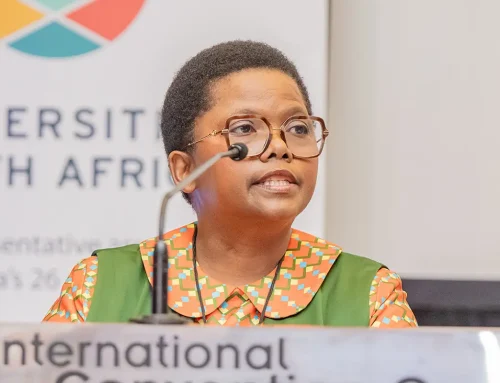
Professor Maureen Robinson (left), who currently works for the educational consultancy, Kellelo, was previously a Dean of Education at Stellenbosch University for five years, and for 10 other years served the Cape Peninsula University of Technology (CPUT) in a similar capacity. She reported to the EDF on the progress that PrimTEd has made to date.
isiXhosa and Sepedi glossaries
She said PrimTed had developed isiXhosa and Sepedi glossaries to standardise the languages, and to enable quality assurance and testing. “Extensive piloting of the (updated) maths and English test and pre-piloting of isiXhosa and Sepedi has been done. If you are going to create a benchmark test across universities, you want to be very confident that the testing is valid and that the resulting information is useful. It’s been an intense and long process developing and checking these tests, which included Rasch analysis,” she said.
Professor Robinson dealt with the nuances between Home Language (HL) Knowledge and HL Practice: “It’s not just about what English, Sepedi, isiXhosa or maths content student teachers know; it’s also about what they know about the teaching of these subjects. This takes into consideration the pedagogy, the theory and practice of teaching that subject. That’s really what these tests are aimed at.”
She urged deans to encourage their maths and language staff to join the CoP meetings and administer PrimTEd testing at their universities.
Maths pilot testing
Her colleague, Dr Qetelo Moloi, a Quantitative Analysis Expert at Kelello, shared some of the findings of the PrimTEd maths pilot testing that has taken place.
He said that between 2016 and 2022 they used what they now refer to as PrimTEd 2.0, which has now been changed to PrimTEd 3.0.
“We have developed a standard that can be used across the institutions of higher learning, and this is not only about content. The process is now at the stage where we have piloted more than 500 items of maths with standards attached to them”


“We have tested more than 3000 first-year students and more than 1000 in year four. It is worth noting that there is good progress from first to fourth year – evidence that students improve their performance as they progress through their degree. We also have fewer students functioning at the basic level and more functioning at a higher level of competency– evidence that the interventions in place are bearing fruit.”
Key changes to ISPFTED
Mr Haroon Mahomed, Executive Manager: Teacher Education and Development (TED) Policy and Planning, updated the EDF members on the status of the Integrated Strategic Planning Framework for Teacher Education and Development (ISPFTED), currently being revised. He also updated them on the National Policy Framework for Teacher Education and Development (NPTED).
According to Mahomed, TED policy in South Africa is guided by ISPFTED. It aims to improve the quality of teaching and learning in schools by enhancing teacher education and development opportunities. It focuses on improving access to quality education and development for both current and prospective teachers.
The first TED summit took place in 2009, and ISPFTED was launched in 2011. The second TED summit, held at the end of 2021, developed resolutions in six key areas, namely, teacher standards and professionalism, teacher recruitment and retention, teacher education, system deployment, career paths and accountability.
The 2011 ISPFTED framework, Mahomed said, laid the groundwork by outlining strategies for teacher development, recruitment and professionalisation. It has been undergoing revision since the 2021 TED Summit, and this 2025 framework builds upon this foundation, focusing on further improving teacher quality and ensuring a well-rounded education system for all learners.
Key changes include:
- Context and content updating – Including the impact of Covid, rapid technological advances between 2011 and 2025 and inclusive education including mother-tongue based bilingual education.
- Governance and coordination – Proposal to strengthen governance through the establishment of a National Council for Teacher Education and Development (NCTED).
- Alignment – Process to align the ISPFTED with the NPFTED, previously not aligned, resulting in many challenges with mandates.
- Adjustment of outputs and activities – Outputs increased from four to eight, and activities were adjusted, based on SMART (Specific, Measurable, Achievable, Relevant and Time-bound) principles for ease of planning and implementation; planning was streamlined, and goals were made more achievable.
- Budget – Current budget information was updated with an increase to around R2 billion and how these funds can be used more effectively and efficiently. A 70% skills levy can be used for TED.
- Collaboration: The roles of various role players including higher education institutions, Sector Education and Training Authorities, the South African Council for Educators, the Education Labour Relations Council and unions to be clarified.
Mahomed asked the EDF to provide feedback, adding that in-depth dedicated workshops could be arranged at universities in collaboration with the Education, Training and Development Practices Sector Education and Training Authority (ETDP SETA).
The updated ISPFTED policy document will be tabled at the Heads of Education Departments Committee (HEDCOM) meeting later this year and later taken to the Council of Education Ministers (CEM).
“In terms of current projection, we could complete this work by the end of this year with HEDCOM and CEM to advise on the further rollout of this process in 2026.”
Changes to Grade R qualifications
Ms Nombulelo Sesi Nxesi, CEO of ETDP SETA, said there had been a change to Grade R teaching: “A decision has been taken that all Grade R teachers must have a Bachelor of Education (BEd) in Foundation Phase Teaching. We are no longer going to be funding a Grade R diploma for employment purposes.”
For the unqualified or underqualified Grade R teachers, transitional measures are currently being developed in consultation with the Education Labour Relations Council (ELRC) and HEDCOM. This framework will ensure that teachers are appropriately qualified for the specific developmental and pedagogical needs of learners at this critical early stage of education.
Janine Greenleaf Walker is a contract writer for Universities South Africa.