Every university says it benefits society but where is the evidence?
Every one of South Africa’s 26 public universities says it benefits society but very few provide evidence of actually doing so, Professor Chris Brink told delegates at the 4th Universities South Africa (USAf) Higher Education Conference.
“Go and look at the websites of these 26 universities,” he said. Their mission statements promise to “tackle practical challenges”, to find “solutions for the world’s most pressing issues” or to “make a positive impact on society”. Ask for examples, though, and the picture changes.
“The funny thing is, most university websites provide no case studies of how they have already done what their mission statements say they aim to do. You will have to dig really deep into a university website to find any evidence of already having delivered on these kinds of claims.”
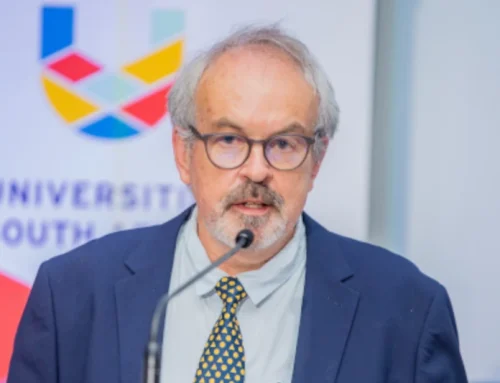
Professor Brink (right), Emeritus Vice-Chancellor of Newcastle University in the UK and a former Rector and Vice-Chancellor of Stellenbosch University, chairs USAf’s Societal Impact Case Studies Assessment Panel. It is the gap between what universities claim and what they can show that led to the formation of the USAf initiative.
“Janet and I decided that we could begin building a national repository of societal impact case studies because we both believed, and still believe, that such examples can be found,” Professor Brink said, referring to Ms Janet van Rhyn, Project Manager: Sector Support at USAf. “Universities are just not very good at finding and presenting them.”

Each year, every vice-chancellor in the country receives an open call to submit no more than three case studies of societal impact. An assessment panel then chooses those that, according to Professor Brink, “will speak to the public, speak to politicians, speak to donors, speak to journalists and speak to civil society generally”.
The initiative began in 2024, when 19 case studies were selected, followed by 23 in 2025 and 14 in 2026. (The case studies can be found on the USAf website, under the Societal Impact tab).
What universities should do, he said, is ask themselves what is different now in the world, outside of academia, as a result of the academic work done in the university.
A case study also has to pass four tests. The first, and most important, is that the impact must already have happened.
“We are not asking for potential impact and a guess about what might happen in the future,” he said. We are asking about track record. Secondly, the impact must be a result of academic work. Charitable work, such as for example a soup kitchen for homeless people, however worthwhile, does not qualify. Thirdly, the impact must be manifested in society, outside of academia. And fourthly, there must be a clear line of development from the academic work to the societal change.”
The third test is the one academics find the hardest, he said.
“When you ask academics about anything they do, their comfort zone is to tell you about how many publications they have written, how many conferences they’ve been to, how many PhD students they’ve produced,” he said. “What we are asking is, in addition to all of that, is anybody out there in the world, any community, any group of people, better off as a result of your academic work?”
Submissions that pass are judged on reach and significance. ‘Reach’ is essentially a question about how widely the impact has spread, and ‘significance’ is a question about how much of a change has been effected. For example, if a school of education says it has changed the secondary school curriculum in the Western Cape, he explained, the panel wants to know how many schools it reached in the Western Cape. “One, five, 125?” Then it asks how deep the change went. Was it a small adjustment in one grade or something fundamental?
Engagement work trips up many submissions. “For example, a mathematics department might make a submission and say: for the past five years, we have offered extra classes every Saturday morning to secondary school pupils, and here is a photograph and a video of these activities,” Professor Brink said.
“That is just evidence that the activities happened. What we’re looking for is evidence that the activities made a difference.” Are the pupils doing better at mathematics? Do they attain better matric results? Are more of them going to university?
He urged anyone writing a case study to read USAf’s guidance note and use the template, and to remember who the readers are: journalists, funders, politicians, NGOs and government officials. “This isn’t a PR exercise, so don’t use flowery language. Just be factual.”
Professor Brink introduced three projects selected for USAf’s Impact Initiative in 2025.
- Tangible Africa – Nelson Mandela University
Using puzzle-piece coding tokens and a smartphone, it has taught coding and problem-solving to more than 350 000 learners and introduced 50 000 teachers to it, all without computers, electricity or the internet. It now operates on five continents. - Changing Faces, Changing Lives – Central University of Technology
Its Centre for Rapid Prototyping and Manufacturing, the first in Africa certified to make medical devices by 3D printing, has given more than 5 000 patients custom titanium implants and devices. Many of them had lost parts of their faces to cancer, trauma or infection, and about 300 were treated free of charge. - Transforming Waste into Hope – University of the Western Cape
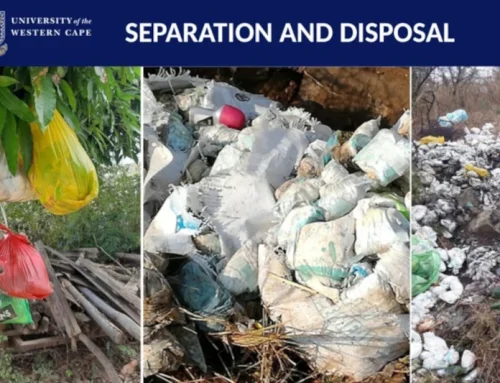
In three villages in the Kruger to Canyons Biosphere Reserve, with no waste collection, mothers had been throwing used disposable nappies into the river. Local seamstresses now make reusable cloth nappies, paid for through community savings groups, and the project’s work has fed into South Africa’s national strategy on disposable hygiene products.
“There might be a great collection of impact case studies at your university but you are possibly not aware of them because that’s not the question we ask. We need to learn to ask a different kind of question, so that the researchers, the academics, the teachers and the students are aware that this is valued, that this kind of work will be appreciated, it will be incentivised and it will be put on the national stage.”
He encouraged university managements to “start looking” as the next open call for submissions will be in 2027.
Janine Greenleaf Walker is a contract writer for Universities South Africa.