From Fees Must Fall to AI: Dr Price’s lessons for leading a university through crisis
One only has to look at current headlines to realise that South African institutions of higher learning are not unique when it comes to the challenges facing them.
Universities worldwide are in a state of flux as student-led movements challenge institutional governance and systemic inequities. University students in France have joined high-school students in ongoing student protests in Paris and across France. Meanwhile, Cornell University in the US is facing severe public backlash and legal action over its handling of an alleged 2024 gang rape of a student at an on-campus fraternity. And all of this plays out in real time on social media.

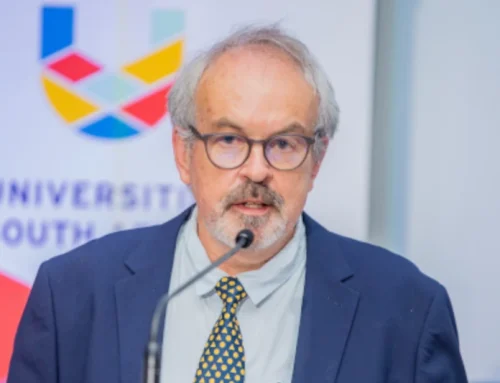
Dr Max Price (left) knows better than most the pressures facing university leaders as he was Vice-Chancellor of the University of Cape Town (UCT) through the Rhodes Must Fall and Fees Must Fall protests between 2015 and 2017.
He shared his experiences and lessons learnt at the recent 4th Universities South Africa (USAf) Higher Education Conference.
Dr Price, started with risks that rarely happen but do huge damage, and and we try prepare for them through the risk register process.
“Your electrical power goes in the middle of registration. Your IT systems are hacked and shut down – these are not bad luck. Those are risks you should lose your job over if you didn’t foresee and plan for them,” he said.
“Do you all have a complete duplicate of your IT systems and your data storage off-site, at least 200 kilometres away, with their own power supplies? And can you switch over from one to the other, from one minute to the next?” he asked. “There is nothing earth-shattering about that, but I think we don’t give it the credit and position it needs.”
He questioned why every university pays consultants to draw up the same risk register.
“There is a 90% overlap in the risk registers of all universities. It is ridiculous that we pay consultants over and over again to do it for us.” USAf, he suggested, could provide a shared template.
Rehearse the crisis before it happens
The second kind of risk is the one universities know is coming but seldom plan for. He gave the example of a student who alleges she was raped by another student in her residence, who denies it. She demands that he be suspended and removed from their shared class. Students protest at the vice-chancellor’s door.
Most universities have a sexual harassment policy, he said. That is not enough.
“My experience is that we tend to deal with these complex issues on the run, without having thought them through beforehand. But actually, they are predictable; we know what is going to happen.”
Universities should work through specific scenarios in advance, he argued, take legal advice on questions such as suspension before a case arises, and let communications staff rehearse what they can say. Each crisis also needs one experienced person with authority to be identified to coordinate the many departments that will be part of the institutional response.
The 11pm press release
The protests at UCT showed him how quickly a university can lose control of its own story.
“We did not understand how social media had changed the communications landscape in managing crises,” he said. “I suspect we are always behind the curve because the students are right at the curve; they are very good at it.”
Students, parents and staff now get their news from social media, he said, so a university that waits to respond has already lost the narrative.
“If you don’t have a really competent social media team, you are fighting with both hands tied behind your back. You have no hope.”
Most universities do not need a permanent in-house crisis team so he advised finding an outside team now and agreeing a price. “Let me tell you, those social media teams put their prices up very high once the crisis has started. They know you need them more than they need you.”
Getting ahead of the story also takes speed. Whoever runs a university’s social media in a crisis must be “joined at the hip” to the vice-chancellor, he said, “in every meeting, in every crisis, in every aspect of what you are doing, so that they can be tweeting and posting all the time”.
He described the practice that prevailed while he was VC: “The press team writes a press release, the vice-chancellor gets to review it at 11 o’clock at night, and by then no one is interested any more. I can’t emphasise enough how much resilience in this day and age depends on understanding and managing social media.”
Messages alone do not reassure people, though. When lecture theatres are invaded or students are chased out of a dining hall, senior leaders have to be there in person.
“People need to see that you feel their anxiety and their pain,” he said. “And they also need to see that you are a rock, that you are strong, that there is someone in charge who knows where we are going.”
From 23 people to five
Dr Price admitted that his own leadership style failed in the first year of the protests. He had always been collegial and consultative, and the full leadership team of 23 deans, executive directors and deputy vice-chancellors sat in every crisis meeting.
A review during the December 2015 recess showed this had been “a serious mistake”.
“You would never expect a general in a war to convene long meetings of everyone, from the cleaners to the generals, to make decisions,” he said.
So, in 2016, a team of five led by the deputy vice-chancellor, Professor Francis Petersen, met every day and handled negotiations, so that the rest of the university could keep working. “You still have to get the financial audit done on time. You still have to recruit students for next year.”
Leaders also need people who will tell them the truth, he said, and that rarely comes from the people whose performance appraisals they write. He advised building a circle of five or six respected colleagues across the university, well before a crisis.
“It doesn’t help at all to have a whole lot of yes-men and yes-women around you who are afraid to offend you.”
Asked whether he regretted being so vocal during Rhodes Must Fall, he said he did not. At first he was in a minority on campus that agreed with the students, and even government ministers opposed removing the statue. Academics, alumni and donors “needed to hear that from the leader”, he said. “I don’t have any regrets about doing that.”
Graduates for jobs that no longer exist
Looking ahead, Dr Price warned that artificial intelligence would be more disruptive than anything higher education had faced in a century, both for teaching and for the jobs graduates go into.
“We really do our students a disservice if we educate them and, by the time they have their master’s or postgraduate diplomas, there are no jobs for them in that sector. That is really unethical.”
He urged newly appointed vice-chancellors to spend three to six months visiting leading universities abroad before taking office. As dean of health sciences at the University of the Witwatersrand, he did exactly that and found that most medical schools had stopped teaching dissection, while his students still spent around 700 hours dissecting bodies. He brought in respected outsiders, including the dean of Harvard Medical School, to make the case for change.
Some colleagues will never come along, he said.
“There comes a point when you can’t take everyone with you, and you have to make some hard choices. But that is what leadership requires.”
Every new vice-chancellor should also have an executive coach, he said in answer to a question from the floor, and should learn to read a balance sheet.
“If you can’t read the finances and the budget, your colleagues will run rings around you.”
Janine Greenleaf Walker is a contract writer for Universities South Africa.