From one university honours project to five continents: Tangible Africa’s unplugged coding revolution
A project developed at a South African university has changed the lives of more than 350 000 learners across the globe – including nine African countries as well as reaching Ireland, South Korea, Cyprus, Germany and Indonesia.
Little wonder then that Tangible Africa – a groundbreaking initiative that is revolutionising education and empowering students to become problem solvers and critical thinkers even if they have no access to computers – has won several major international and national awards and accolades including the 2024 Information Technology Professionals South Africa (IITPSA) President’s Award.
It was also chosen in 2025 as one of the top national societal impact cases by Universities South Africa (USAf) which looks to illustrate the profound positive influence that South African universities can have on addressing societal challenges.
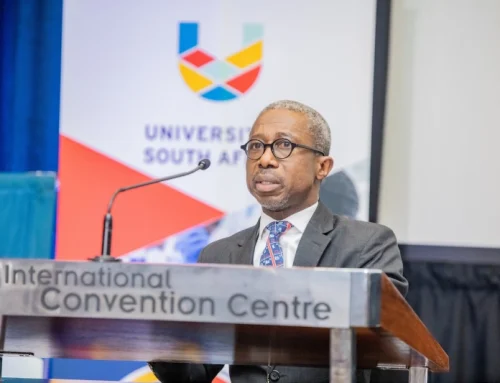
Recently its founder Professor Jean Greyling, Head of the Department of Computing Sciences at Nelson Mandela University, addressed delegates at the 4th USAf Higher Education Conference.
Talking into a vacuum
Professor Greyling recounted how for more than 25 years he had travelled through the Eastern Cape’s rural, township and urban schools trying to interest learners in computing.

More often than not he found himself talking to children who had never seen a computer in schools that also frequently had no electricity.
“I had this sinking feeling that I was talking into a vacuum and I was not having any real impact,” he said.
All this changed in 2017 when one of his honours’ students, Mr. Byron Batteson, walked into his office with an innovative idea to introduce coding to learners who did not have access to computers. Batteson had developed TANKS, a mobile application that uses tangible/unplugged coding tokens and smartphone image recognition. This allowed students to learn coding principles without requiring computers, electricity or internet access.
Professor Greyling credited Batteson with “the best honours project I’ve supervised in 30 years” and with laying the foundation for everything that followed. Batteson is now a senior software engineer with Amazon.
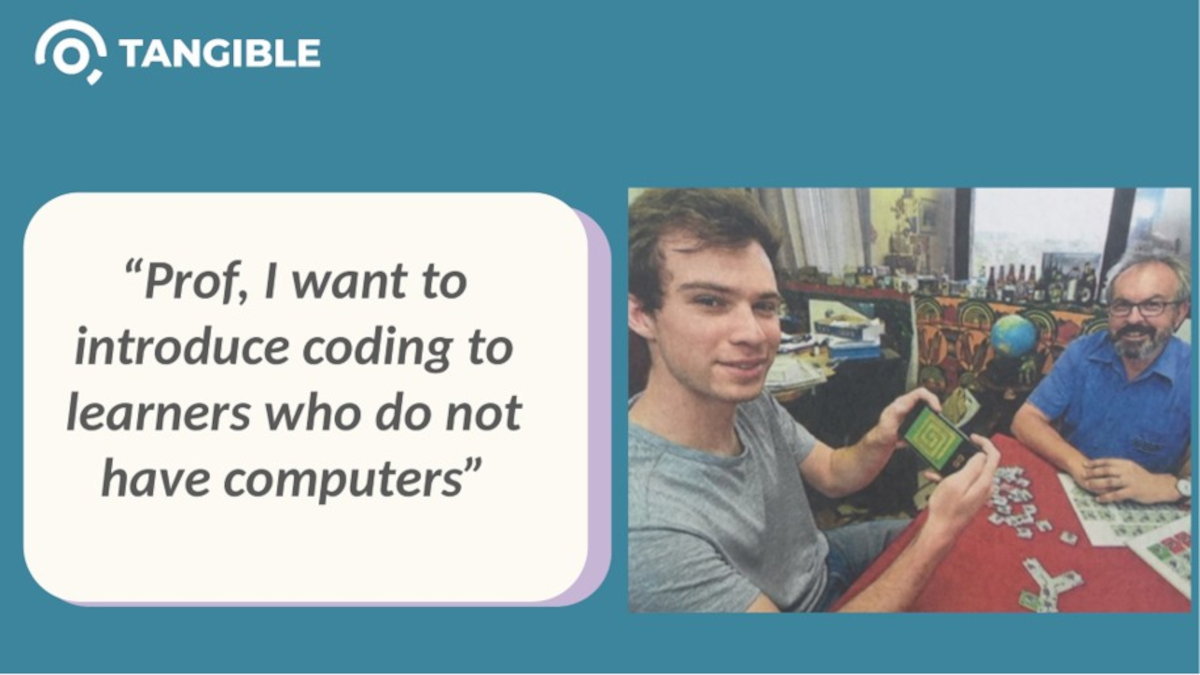
Prof Greyling’s slide: Byron Batteson’s pitch that started Tangible Africa.
Tangible Africa uses small physical tokens, like puzzle pieces, represent the coding constructs that Professor Greyling teaches to first-year university students. Learners receive a challenge on a phone, work in a group to lay out their code with the pieces, take a photograph, and watch the programme run.
Professor Greyling explained that while Tangible Africa is an engagement project of his department, it is now implemented by a non-profit, the Leva Foundation, whose staff drive it day to day.
No computers, no electricity, no internet
From the first day, the Tangible Africa project set out to address what Professor Greyling called “the elephant in the room” in South African schooling: 16 000 of the country’s roughly 24 000 schools do not have computers, which is why Tangible is designed to work with or without technology, without being limited by either.
He also added his own estimate, which he stressed was not scientific and possibly conservative, that 90% of teachers have not been qualified to teach coding, even though coding and robotics now feature in the curriculum from Grade R to Grade 9 at South African schools.
Teachers can be trained in three hours, leave the session feeling empowered and go back to school to use the tools. And, especially in primary school, it has to be fun. “If you take the fun aspect away, you are going to lose them,” Professor Greyling said.

Prof Greyling’s slide: the design rules set in 2017
“Tangible starts by making learning fun and accessible for both teachers and learners, while teaching the fundamentals of computational thinking and problem-solving. Through the process, many learners gain the confidence to pursue mathematics, which is essential for STEM careers.”
The tools have since been adapted for learners who are blind, using braille and 3D printing, and a young blind man who has followed the project is due to join as an intern next year to train other blind learners.
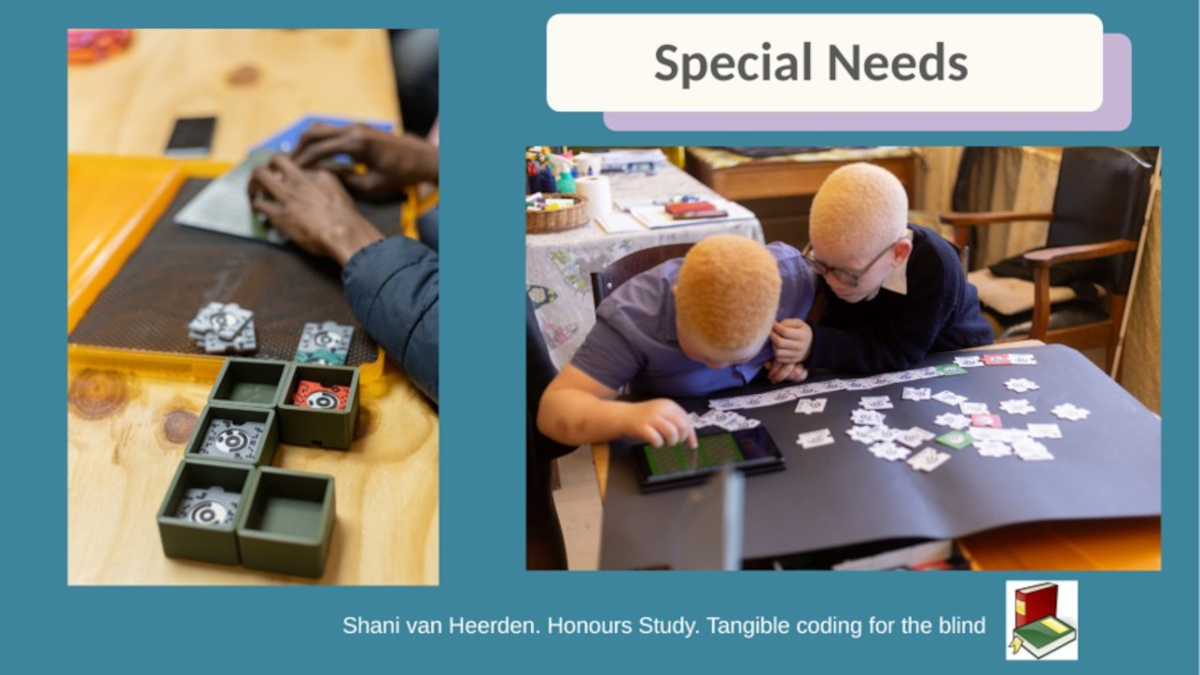
Prof Greyling’s slide: Tangible coding tools adapted for learners who are blind.
Cost is part of inclusion too. The project’s principle is low budget and, wherever possible, no budget. By Professor Greyling’s estimate, about 90% of the schools that benefit pay nothing, which is why the team works hard on corporate partnerships.
Today there are inter-school tournaments and leagues, and coding has become something of a spectator sport. The biggest tournament, which started with 30 learners in 2018 and runs during Mandela Month in July, this year drew 50 000 learners from 500 schools, who engaged with the project’s products 220 000 times in a single month.
In 2025, Tangible hosted a global coding World Cup with 340 teams from 30 countries participating online across five continents. In many of these countries, Amazon Think Big Spaces have been the anchor partnership that has launched Tangible into a global movement.
South African schools placed first and second, with strong competition from Indonesia, the previous year’s winner and demonstrated that it is possible to close the digital divide.
Built on problem solving
But engagement means little without quality, Professor Greyling said. The foundation of everything the project does is computational thinking, “or in an easier word, problem solving”: decomposition, abstraction, pattern recognition and algorithms, skills he argued are relevant not only to coding but to life.
Professor Greyling said he doubts the national coding and robotics curriculum will be well implemented, given the state of school infrastructure, so the project tries to help teachers bridge the gap. A chatbot offers lessons aligned with CAPS from Grade R to Grade 7, one a week for each grade, and all a teacher needs is a phone and a printer.
Coding clubs then take Grade 9 learners through coding, design thinking, entrepreneurship and STEM careers, with the aim of showing them why mathematics matters when they choose subjects for Grade 10.
He shared what he called “a scary statistic” – only 24% of Western Cape matriculants take mathematics, while 76% take mathematical literacy.
The project has been through two global evaluations, including the UNICEF-led Learning Cabinet, and now operates on five continents.
Professor Greyling said the work has made unplugged coding acceptable across the country, to the point where the Foundation Phase curriculum is now fully unplugged.
He then introduced one of the initiative’s many success stories. Mr. Katlego Nyambi, now a second-year student at the University of Pretoria, told delegates he had been “directionless” in Grade 11. A Tangible Africa workshop changed that.
“One of the most important things Tangible gave me was a clear direction, something to work towards,” he said. He became fascinated by programming, started looking at computer science courses at universities across the country and, for the first time, could set real goals for his marks.
“Because I do it more, I enjoy it, and because I enjoy it, I do it more,” he said. He still does not know why his school chose him for the workshop, “but they did”, and he is now “so in love with programming and everything computers, all because of that one point in time”.
Professor Greyling filled in the rest. After that first workshop he had written to Nyambi to tell him he could not study computer science with the marks he had. Six months later, Katlego sent him his new results: his average had risen by 20%. Today he is a computer science student with a bursary from Amazon.
Getting the message out
Professor Greyling said that the team now has a dedicated communication specialist and urged other academics to do the same as this was an important field in which they had little expertise.
“We have to reach people. Academic papers are read by a few academics and annual reports by fewer still. So with our project, we put a lot of effort into LinkedIn, Facebook, Instagram and WhatsApp. The modern generation has a shorter attention span and they don’t look at more than a screen. It is imperative that we bring our information to the new generation, on new platforms, and that includes serious research. And so we put real effort into social media platforms.”
Janine Greenleaf Walker is a contract writer for Universities South Africa.