From rivers of nappies to national policy
In three rural villages in Limpopo and Mpumalanga provinces, mothers were hanging shopping bags of used disposable nappies from the trees. When they were full, the bags were carried to the river and thrown in, so that the next rains would wash them away.
This was not carelessness, delegates at the 4th Universities South Africa (USAf) Higher Education Conference were told. The women knew the nappies were harming their families, their livestock and their water, but with no waste collection service, and for cultural reasons, it was the best option available to them.
Six years later, that discovery has led to improved collection networks, reusable cloth nappy programmes and localised incineration systems to combat illegal dumping and dangerous open burning. The research findings have directly informed South Africa’s Disposable Absorbent Hygienic Product (AHP) Strategy through the Department of Forestry, Fisheries and Environment.
Societal impact does not happen in isolation. It requires time, collaborative partnerships and a deep commitment to addressing real-world challenges. A long-term research portfolio led by Professor Catherina Schenck (right), Principal Investigator and South African Research Chairs Initiative (SARChI) Chair in Waste and Society at the University of the Western Cape (UWC), demonstrates how higher education institutions can move beyond academic outputs to deliver tangible, transformative societal change.
It began with a study between 2020 and 2022 into understanding why illegal dumping and littering happens in underserviced communities. In rural areas, the researchers found piles of used nappies and sanitary products dumped in the open, where households have no regular waste collection.

Professor Schenck and her colleague Dr Antoinette van der Merwe partnered with Kruger-to-Canyons (K2C), a non-profit organisation who brought more than 20 years of experience and a deep understanding of the region and local communities. They knew that sustainable solutions emerge from the ground up through co-creation with the community.
The team members, which included Ms Resoketswe “Shoki” Mafogo and Ms Mpho Mativandlela, began to look at what alternatives the communities, and the mothers, actually had. With the aid of local field workers, who knew the villagers, they were able to complete 1 575 questionnaires with caregivers and run 18 focus groups to better understand the challenges facing these communities.
The team mapped where the nappies were being dumped and found they were clustered along the rivers. Mothers wanted the nappies to be washed away by the next rains and kept far from the home, so that, according to their beliefs, no harm would come to their babies.
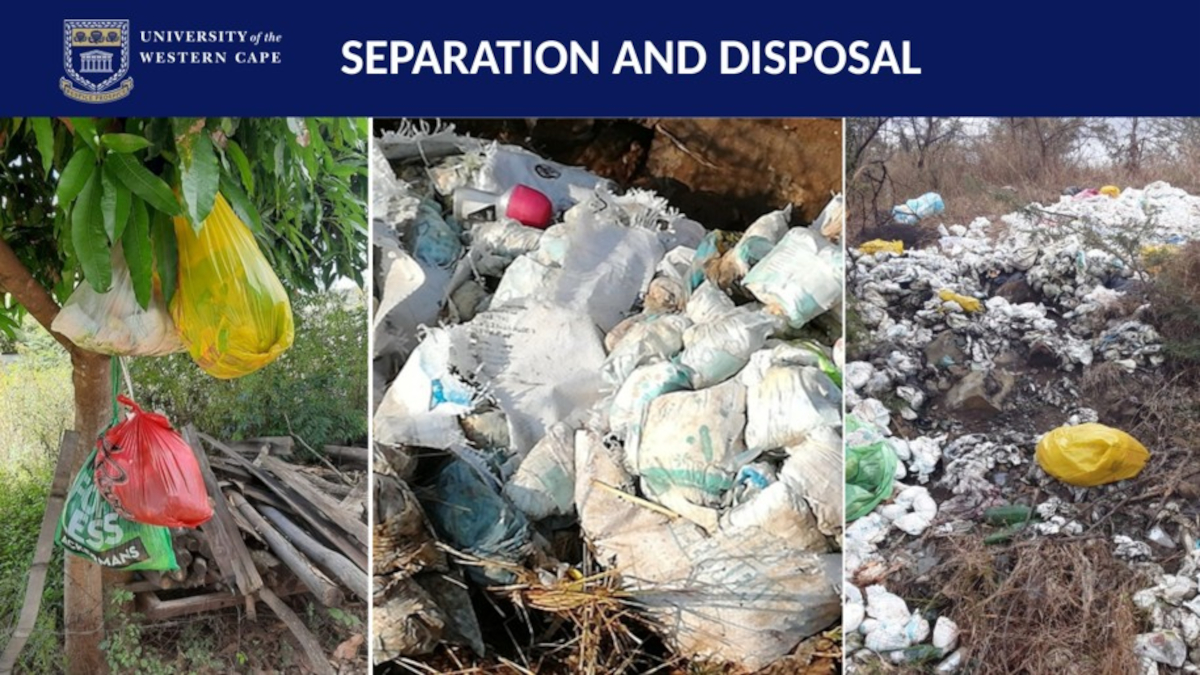
Prof Schenck’s slide: used nappies separated from household waste, hung in trees and dumped in the open.
A grant spent on nappies
The numbers of nappies generated per day were truly staggering: 37 000 a day in Maruleng and 172 000 a day in Bushbuckridge. Some 97% of caregivers used disposable nappies, and 90% received the child support grant.
That created a second problem. Disposable nappies cost R385 a month, against a child support grant of R500.
This meant that a significant percentage of the grant, which was meant for the well-being and livelihood of the child, was going into the purchase of single-use nappies that were ending up in rivers. Dumping of the nappies in open spaces often resulted in them being eaten by livestock causing illness and in cases, death, resulting in economic loss for families. Burning the nappies was difficult because they were wet, so they were buried or dumped.
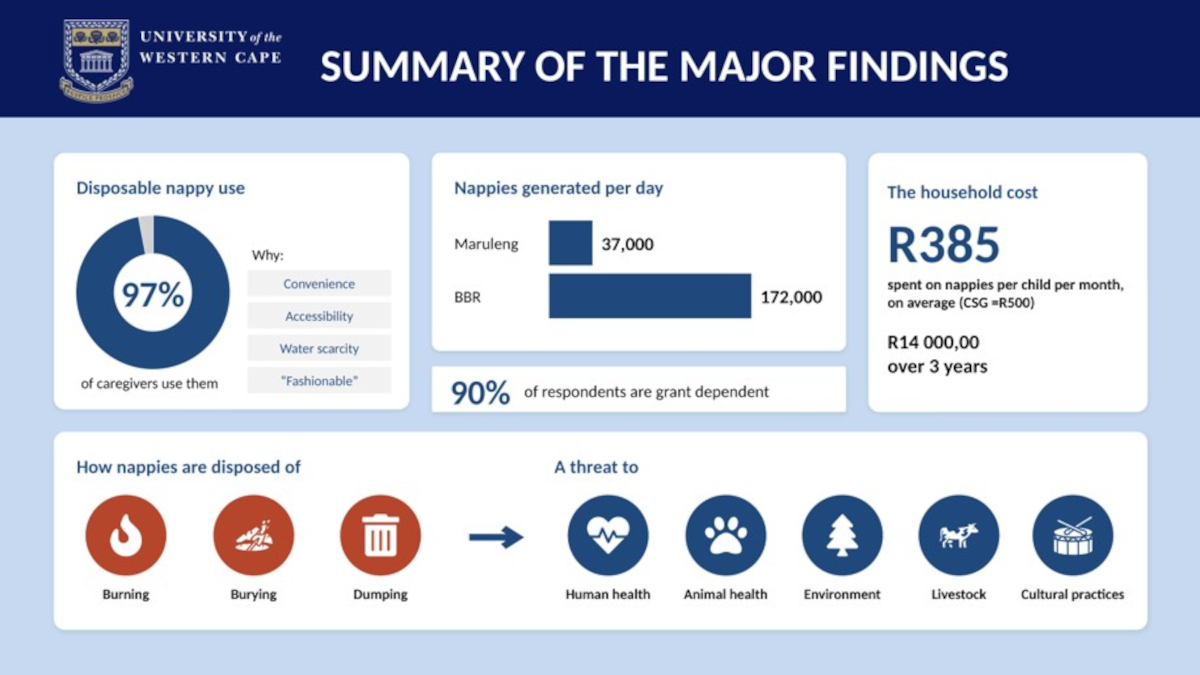
Prof Schenck’s slide: the baseline findings, from 97% of caregivers using disposable nappies to R385 a month per child
Three villages, three answers
Each village (Enable, Phiring and Malaeneng) chose its own solution. Two had no reliable clean water, which made washing cloth nappies risky. One is testing a small incinerator fuelled by alien invasive plants. The other set up drums for used nappies, which a local resident collects with a bakkie and takes to a municipal skip. The third chose reusable cloth nappies, and that is where the team is now working.
The model is built around an eco-savings group, essentially a stokvel, which the community already knew well. It brings together parents with babies, women and teenage girls who need sanitary products, and local seamstresses.
Neither the community nor K2C wanted the nappies to be a handout. They wanted a sense of ownership and participation. The savings group pays for a mother’s first set of reusable nappies. She signs an agreement to pay the money back, and that money buys locally produced, reusable nappies for the next mother.
Disposable nappies cost a family about R14 000 over a child’s first three years. A reusable starter pack, which grows with the child, purchased directly from a supplier, costs just over R1 600.
Local seamstresses were trained to make reusable sanitary pads, which they sell in the community and at a local farmers’ market. They produced and sold 344 pads, more than the target.
So far 45 households in the village use cloth nappies. Of the mothers, 96% are satisfied with them, all are still using them, and all would recommend them to other mothers.
Into national policy
More than 184 rural families now belong to the eco-savings groups and fewer nappies are being dumped. Community leaders, and officials up to provincial level, now know about the problem.
The research has also informed South Africa’s draft national strategy on disposable absorbent hygiene products and the setting up of a waste forum on these products.
The project has produced academic results too: master’s research by K2C staff member Mpho Mativandlela, who enrolled at UWC, and a PhD thesis by Charlotte Nell just submitted at Stellenbosch University.
Talks are under way with other communities and provincial government about repeating the model elsewhere. The project, the team says, shows that biosphere reserves can be laboratories for addressing global challenges at local scales.
Janine Greenleaf Walker is a contract writer for Universities South Africa.