‘They lie about serving people’: Prof Kieswetter says leaders must take their work, not themselves, seriously
“Our country is where it is because leaders take themselves too seriously instead of taking their work seriously,” former South African Revenue Service (SARS) Commissioner Professor Edward Kieswetter told delegates at the 4th USAf Higher Education Conference. “They (also) lie about serving people and instead serve themselves. And it is a reality that we must face up to.”
In his address that ranged from artificial intelligence to Formula One, and from the rescue of Alexander Forbes to the rebuilding of SARS, Prof Kieswetter argued that universities will only be able to move at the speed the future demands if they are built on honesty, integrity and trust.

Prof Kieswetter, CEO of vEKtor Solutions Laboratory, President of the Da Vinci Institute of Technology and Innovation Management and Commissioner of SARS from 2019 until April 2026 was delivering a keynote address titled “Governance, Accountability and Renewal”.
He made it clear from the start that he was not speaking as an outsider.
I am pretty much an insider and emotionally, psychologically and financially invested in education. I am not speaking to you as a taxman today.”
A labour market that does not yet exist
“A student who enrols with us this year will graduate into a labour market that none of us can fully describe,” Prof Kieswetter said of today’s higher education landscape, “and in many respects a labour market that does not even exist, with designations that we haven’t even thought of. We are not living through just automation anymore. We are living through the early years of artificial general intelligence.”
Within three to five years, he predicted, all cognitive tasks would be better done by AI agents, which would be self-learning, self-correcting and self-creating, and “will leave us all trailing behind.”
For him, that raises an uncomfortable question.
“What is a university actually for, in a world where a machine can out-argue your best law student, and in fact all the best law students combined, and will out-diagnose your medical registrar?”
“The honest answer,” he argued, “has to be something closer to saying that a university exists to prepare young people to navigate what does not yet exist. The future cannot be about degrees and qualifications as much as it must be about proven credentials that improve social impact. That is a different mandate and it demands a different kind of institution.”
That institution cannot be an ivory tower, he said, nor “a place that changes its curriculum once a decade and then, when it applies for it, waits another decade for it to be approved. Agility is not an optional extra anymore.”
To show how badly people grasp exponential change, he asked delegates how far 30 linear steps would take him. Just beyond the water fountain outside, he said. Thirty exponential steps? “We would have circumnavigated the globe 27 times.”
Institutional resilience
“In a world where we need to be agile, how do we ensure that we don’t lose our way?” Prof Kieswetter asked. “Agility without the proper anchoring is in fact just reckless drifting. We cannot mistake constant change for progress when what we are actually doing is improvising without a foundation. The anchor is institutional resilience.”
He defined it as the capacity of an institution “to absorb shocks (and we are going to get many more), correct its own mistakes, and own up to them, and keep every promise it has made, without ever losing its purpose”.
“That is not a defensive capacity. It is the precondition for courage.”
A self-confessed Formula One fan, he compared resilience to a racing car’s chassis.
“We don’t see that because we focus on the nice colours, the flags, the insignia and all of the fun around it. Resilience is the chassis that allows (the car) to fly at super speed but is not a brake on agility. Rather it is what makes daring survivable and repeatable, rather than a one-off gamble that either pays off or ends a vice-chancellor’s career,” he explained.
Eight factors, none of them optional
Drawing on his experience at SARS and Alexander Forbes, the two institutions he said he had “the privilege, and the scars, of helping to rebuild”, Prof Kieswetter set out what be believes are eight key principles.
He called the first four – honest diagnosis, governance that works under pressure, integrity by design and accountable leaders – “the factors that allow one to see and steer honestly”.
The remaining four help an institution “deliver and endure the course”. That starts with a culture where truth travels upwards and the capability to keep promises “day after day, boringly consistent”. Trust, he said, is “the reward for doing so”. The last factor is renewal, “so that the institution can outlive you as the leader”.
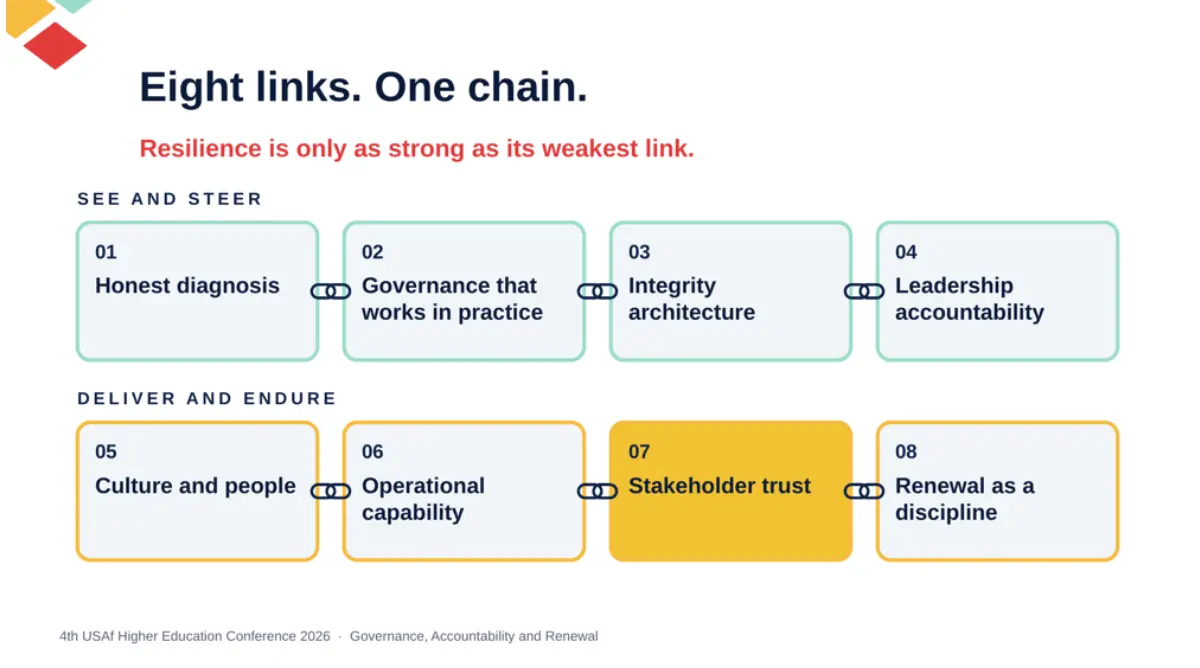
Prof Kieswetter’s slide: the eight links that make up institutional resilience.
He urged leaders not to become complicit in dishonesty, “including when the dishonesty comes from your bosses”. The real state of affairs is “not the state that is presented in the glossy report or the annual report, but the state that the people on the front line actually experience and will share with you if only you care to listen”.
“Governance is not the organisational chart,” he said. “It is what happens the day the organisational chart is under strain – when a council chair and a VC disagree, when an unpopular decision has to be taken, when the person implicated is someone senior or a friend.
“Culture is shaped by the worst behaviour a leader is willing to tolerate. And universities should have an advantage. Academic freedom is, at its best, an institutional form of psychological safety.”
The question, he said, is whether that safety reaches beyond the lecture hall to the administrator, the support service manager and the student.
The basics are also important.
“The student who waits three weeks for funding to clear does not experience your strategic plan for an AI-ready curriculum. She experiences whether you can deliver, full stop. Agility that cannot execute the fundamentals is not agility. It is simply noise.”
Without trust, Prof Kieswetter said, “even with good intent, everything we do will remain sub-optimal”. It is “your most valuable asset, even though it is nowhere on your balance sheet”, and it is not won by a better press statement. “It is won by consistent delivery, transparency and fairness, repeated until people believe it. For a university, that trust is what lets you take the risk of reinventing a curriculum.”
Renewal, the final link, means asking “not what happens while I am here, but what happens when I leave. We build too many institutions around individuals.”
Changing the DNA of an institution
Prof Kieswetter said that when he walked into Alexander Forbes as Group CEO in 2010, the company faced a billion-rand civil claim, 21 potential criminal charges and a R3.5 billion tax risk and was barely making its financial covenants. Financial journalist Bruce Cameron, he recalled, wrote in effect: “Kieswetter, are you stupid?”
In his first briefing, he listened to the CFO and legal counsel for about 10 minutes, then asked why the company was defending itself. Because it was being attacked, they said. “And I said: well, if we are defending ourselves, who is defending the pensioners who suffered as a result of this inexcusable scheme? And they did not answer. This question did not just change our legal strategy; it changed the DNA of the institution”.
The company pleaded guilty and R730 million went back to pensioners. In July 2014, a company “that we could not sell in 2010” listed on the stock exchange, three and a half times oversubscribed.
“What changed the organisation was not a better strategy or a clearer vision. It was building trust, one moral act at a time.”
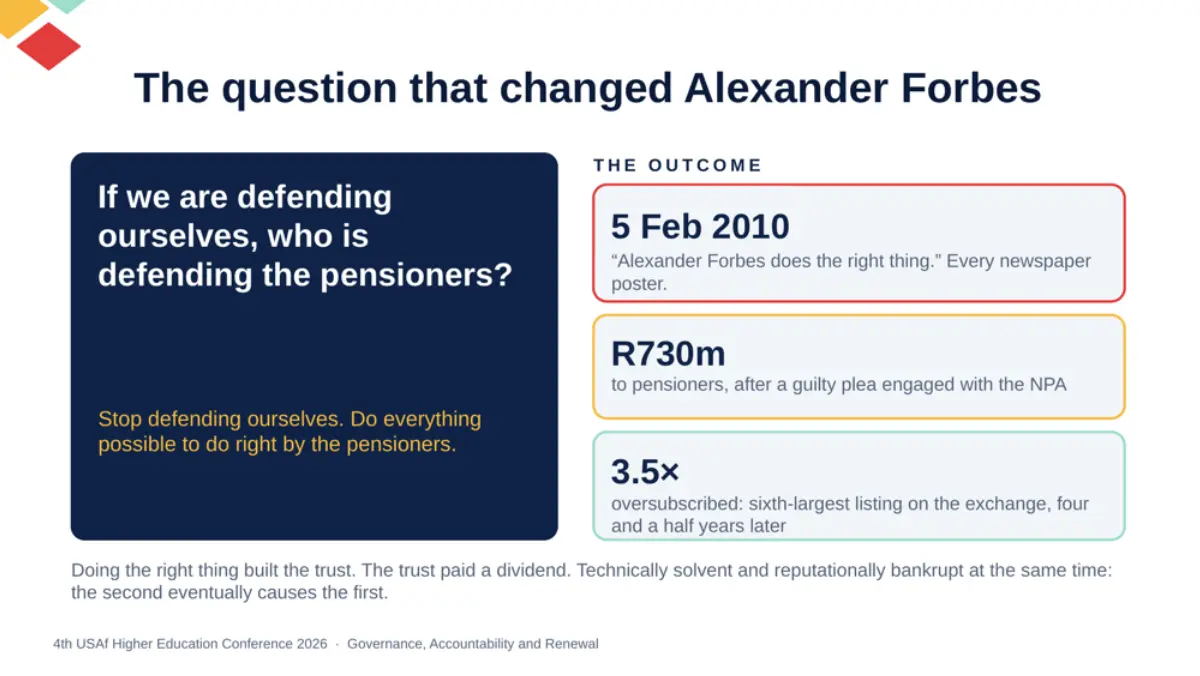
Prof Kieswetter’s slide: the question that changed Alexander Forbes.
At SARS, he said, the game plan was equally clear. “Nowhere in this playbook will you see the words, as part of our strategic intent, ‘We must collect more taxes’. Instead, it promised clarity and certainty, better service and fair enforcement. Over seven years, independently measured public trust rose from 48% to 75%, satisfaction with service rose from 54% to over 90%, and SARS achieved record revenue.”
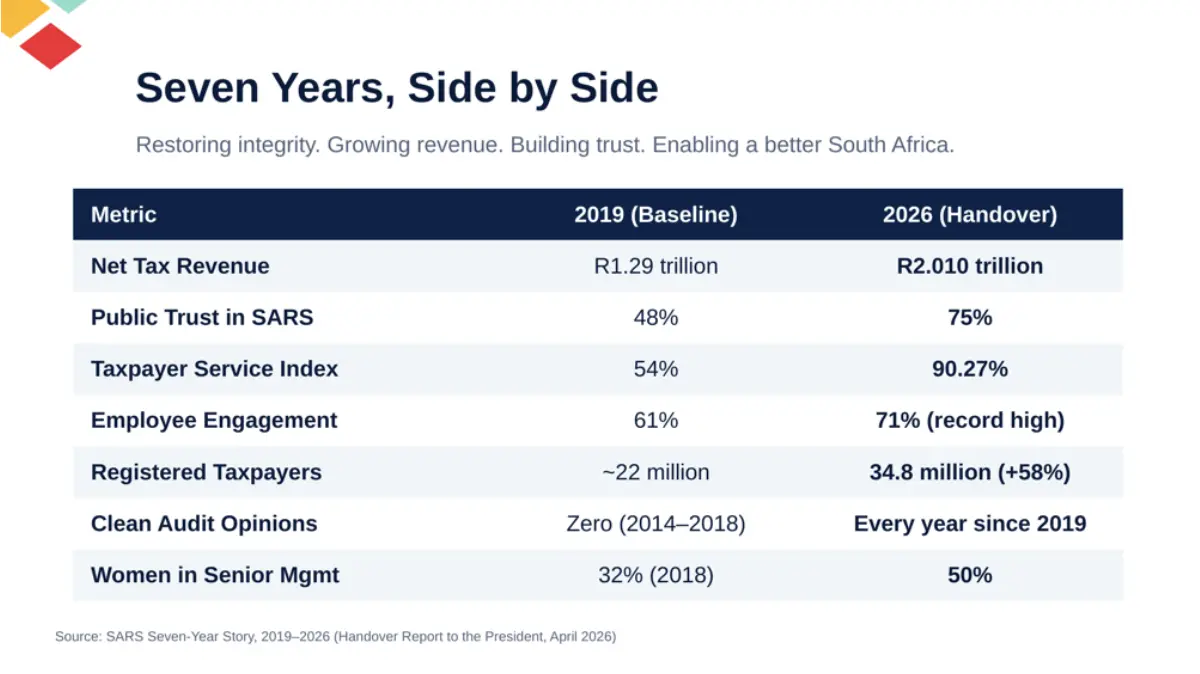
Prof Kieswetter’s slide: SARS over seven years, 2019 to 2026.
Five tests for appointing a leader
He was blunt when it came to leadership: “Most leaders overestimate their own ability and underestimate the size of the job. Leaders do not have to be perfect. However, we have set the leadership bar too low and we have almost always favoured people like us over people who are fit for the job.”
He set out his five prerequisites for appointing leaders.
“The first is good character which you can’t teach. When you appoint a leader who has poor character, you have not appointed a leader; you have appointed a problem.”
The second is the competence requirements suited for the job – without it the likelihood of failure is real. The third is a track record of past performance. It’s very unlikely that someone without a track record of perfromance will perform in the future. The best predictor of leadership is leadership. Citing Jack Welch, he said a would-be leader should first be given a popcorn stand, then the corner café, the provincial store and finally the company.
The fourth is work ethic. “If leaders are not the hardest workers in their organisations, the organisation will fail. Leaders set the example” And the fifth is to be incorruptible – the ability to do the right thing under all circumstances.
He left delegates with two questions. “What do you, as a leader, truly stand for? And is it a goal so worthy that you are prepared to die for it?” Then came what he called a provocative statement: “Leaders, in my opinion, must take their work seriously, instead of taking themselves seriously.”
Janine Greenleaf Walker is a contract writer for Universities South Africa.