How universities can make globalisation achieve better results and longevity — Adam Habib’s perspective
The incentive structure on research subsidies and the ranking systems have pushed South African universities to try and be like each other. This undermines the necessary differentiation that would allow higher education institutions to produce the diverse human capital base required for economic and social development.

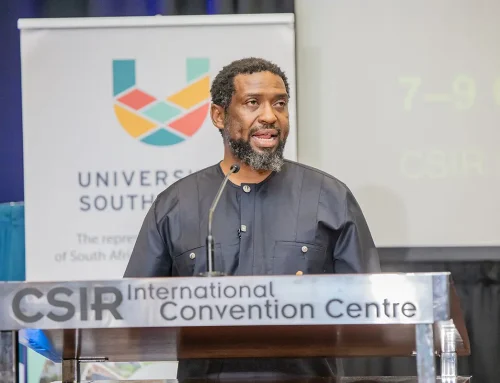
This was what Professor Adam Habib (left), Vice-Chancellor of African and Oriental Studies (SOAS) of the University of London, and former Vice-Chancellor of the University of the Witwatersrand (2013 – 2020) told a roomful of senior university leadership at the 3rd Higher Education Conference (9-11 October) in Pretoria. The three day Conference was themed “The Future of the University”.
He was delivering a keynote address on Reflections on Post-Apartheid Higher Education: “Looking Back, Going Forward” at this premium conference of Universities South Africa (USAf) that sought to chart universities’ way forward.
He began: “I address this conference as a former Vice-Chancellor of a South African University and as a former academic of multiple South African universities for over three decades — 30 formative years in the reimagining and reorganisation of South Africa’s higher education landscape.
“But I also engage you as a Vice-Chancellor of a university in the United Kingdom that has committed itself to disrupting the model of higher education in the UK and to serving as an institutional bridge between universities in the North and those of the majoritarian world.
“I engage you today as an African, born and raised on this continent but one who now temporarily resides elsewhere. Through these multiple reconcilable identities – African and human, former South African VC and now a VC in the UK system – I have become aware and want to highlight our global challenges and our collective responsibility as higher education leaders, in different parts of our world, to build the knowledge base and professional cohorts needed to manage both our national development needs and contemporary transnational historical burdens.
“The university system has not achieved the programmatic differentiation that was envisaged at the turn of the century, instead degenerating into homogenisation and vertical stratification based on reputation,” Professor Habib stated.
He next outlined the successes recorded in the last 30 years, highlighting the failures and reflecting on the managerial challenges confronted in South African Universities, the lessons learnt and what needs to be done.
The good
“At the outset, I should also say that South African higher education today is a far better place than it used to be 30 years ago.”
Statistics:
- 1994: 36 universities hosted 425-thousand students
- 2024: 26 Universities host about 1.1 million students
- 2024: 620-thousand students in TVET colleges; 380-thousand in community colleges
- 1994: Student racial breakdown: 46.7% black African, 41.4% white, 6.9% Indian/Asian, and 5.1% Coloured.
- 2024: Student racial breakdown: 76.4% black African, 11,4% white, 5.7% Indian/Asian, 6.5% Coloured
- Women participation up from 18% in 1994 to 24% in 2024
- Female share of universities spaces up from 58.5% to 60%.
- Postgraduate student enrolment up from 115 000 (15.7%) in 2005 to 173 000 (16.7%) in 2017
- Black academic staff grew by 97.2% – 14 995 to 29 570
- White academic staff decreased by 6.5%
- Female academic staff increased by 50.4%
- Male staff increased by 16.3%
- Research output grew by 169% between 2005 and 2017 (7 230 to 18 881 units) with all university types contributing
- Research intensive universities dominance diminished from 62.7% of publications to 51.3% of publications.
He then concluded: “The growth in student numbers and the increasing proportions of Black, Asian and Coloured students has enabled significant social mobility within the society. Without doubt, South Africa’s higher education system is larger, more efficient and inclusive than it was in 1994. It is a great success story.”
The bad
However, this positive picture hid significant structural fault lines in South African higher education, he said, adding: “There have been serious questions raised about the quality of learning across our institutional higher education landscape.”
The need for global thinking
He said that the national politics and the political economy in which higher education institutions (HEIs) are embedded prioritises short term survival rather than take medium term responsibility to build institutions that address “the challenges of our historical moment”. He said addressing transnational challenges – pandemics, climate change, inequality, migration, social and political polarisation – is dependent on acting as a collective human community.
“We must learn to swim together, or we will collectively sink. We need to bring knowledge systems from all parts of the world into conversation with one another.
“How we address inequality in Kenya will be fundamentally different to how we address it in the UK. We could not have stemmed the Ebola outbreak in West Africa with a purely clinical approach – we needed a multidisciplinary lens to understand Muslim burial practices and how to adapt them to prevent the spread of the virus.”
Adapting solutions to local contexts
Global solutions depend on local knowledge, rooting intervention in the cultural, social and political realities of the local context. This, the professor said, requires academics, scientists, professionals and other stakeholders to continuously engage and innovate across national and disciplinary boundaries, and, in the process, adapt global solutions to local contexts.
“This is what it means to suggest that science should have no boundaries; it should be a continuous process of engagement between theory and application, between the universal and the local. To join and be a part of the global discourse, more inventors, scientists, technologists, social actors, academics and students (innovators) were needed to develop and adapt technologies.
“For this to happen we need universities and vocational colleges that train, research and innovate; companies that are entrepreneurial; incubators that can nurture new technologies; and venture capital networks that can sponsor these initiatives.”
He said that while policies speak of the importance of inclusive, equitable, quality education, institutionally “we behave in a manner the deepens inequalities and institutional divides”.
Rising brain drain
Professor Habib said globalisation, with more global partnerships, more scholarships and more mobility across the world had seen an escalation in the brain drain.
This, he ascribed to a significant number of countries in the Global North explicitly recruiting international students from the Global South, charging them a premium fee – subsidising the costs of their higher education system. “We take in money from the Global South and sponsor middle class people in the Global North and we do it in the name of development.
“Sometimes we even enable this shift of resources from the Global South to the North in the name of development. This is also accompanied by a scholarship regime directed to talented individuals in the developing world, who then come to Europe and North America to acquire tertiary education.
“The assumption, of course, is that these students will return home. But the evidence of the last three decades is that this is not the case. When these students go North, in their 20s and 30s, life happens. They fall in love, they have families, they get jobs and stay. This is understandable. These students are moving in a moment of the human life cycle where partners are found and families are built.”
The evidence
He said Carleton University in Ottawa, Canada, which investigates student mobility and graduate employment across the globe, has found that large majorities of students do not return. He cited over 80% of students from the Indian sub-continent do not return home to pursue their careers, adding that a paucity of national statistics hampers research on African student mobility.
“However, at a conference on the diaspora I attended at the African Union in Addis Ababa in 2019, it was suggested that more than 80% of our students do not return. Student mobility trends work to the disadvantage of the countries of the majoritarian world and institutions are weakened; human resources capabilities are weakening and not being developed.
He argued that although some people prefer to speak of brain circulation rather than brain drain, and the importance of remittances to the majoritarian world, “if we were honest, we would recognise that these are weak countertrends that do not fundamentally change the negative institutional and structural dynamics that accompany the brain drain and compromise inclusive development.”
New form of global partnership encouraged
It is possible to be both local and global, the professor said, giving an example of loving one’s family and community networks while still practising human solidarity outside familial networks. “This is essential if we are meant to survive as a human species. I am advocating a new form of global partnership – one that is more rooted in institutions than in individuals.”
Among universities, this would involve:
- Co-curriculation
- Co-teaching
- Co-credentialing
- Collaboration structured on an alternative business model and fee structure that opens up access for new groups of students to joint academic degree programmes
- Ensuring the programmes are not entirely dependent on scholarships, and so do not terminate when donor money dries up. A self-sustaining logic to the operational or business architecture of the programmes themselves is necessary.
“The argument is not to stop the mobility of students but to complement it with institutional partnerships that enable training in the countries of the Global South,” Professor Habib told delegates. “This transnational training must be undertaken not to compete with the universities in these countries, but in collaboration with them. The strategic purpose is to enable a continuous cycle of institutional development and learning across the universities of our world, and in particular across institutions in the Global North and South.
“The central purpose is to bring higher education and postgraduate training to wider and wider social groups in the Global South, and thereby create the basis and foundation for a more comprehensive universally responsive knowledge production system. Only then will we be able to address both the national and global challenges of our time.”
Disrupt existing business models, or perish
Professor Habib said he wondered why the higher education policy framework, and the Internationalisation agenda of the Department of Higher Education and Training did not speak of any of this.
South African policy at national and institutional levels, and “behaviour,” was “no different from that of many of our peers in universities in the UK, North America and Western Europe.
“I see the same focus on business as usual – on differential fees on partnerships driven by donor money, on short-term income gain as opposed to long-term structural change, and on timid engagements with peers that are largely consistent with the status quo.
“Where is the African spirit, colleagues? Your relationships with universities in the rest of the African continent is no different than that of universities in the Global North with yourselves.
Business as usual will not allow us, either as universities in the Global North or those in the majoritarian world, to survive the transnational and local challenges of our historical moment.
“If we do not reimagine higher education, if we do not disrupt its existing business models, we will not be able to fulfil our institutional mandates and build the collective human resource capabilities that enable us to address the multiple transnational challenges we confront. And if we do not do this, we will not survive the next two centuries as a human species.”
Charmain Naidoo is a contract writer for Universities South Africa.