Intersectionality principles must guide universities’ initiatives aimed at closing the gender gap in STEM fields
The CEO of Universities South Africa (USAf), Dr Phethiwe Matutu, has called on public institutions of higher learning to critically examine programmes aimed at advancing women, citing findings from transformation research undertaken at public universities in recent years. She spoke during the “Closing the Gender Gap in STEM” panel discussion at the University of Pretoria’s 7th Women in Science event on 8 August 2025.
Her topic was Shaping the Future We Want: The Power of Inclusion and Diversity at the event themed Unpacking STEM Careers: Her Voice in Science. STEM careers refer to those in science, technology, engineering and mathematics.

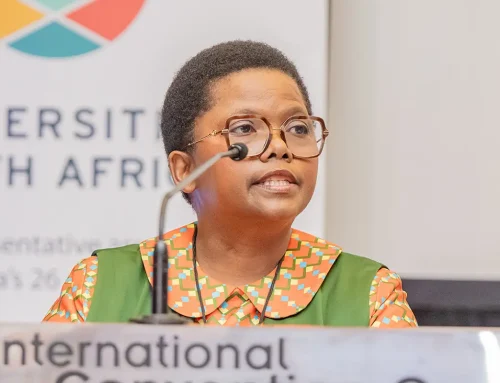
Referencing the State of Transformation in South Africa’s Public Universities Report (2023) by the Ministerial Oversight Committee on Transformation in the South African Public Universities, Dr Matutu (left) highlighted divergent approaches to transformation across the country’s 26 public universities. Half of the institutions embraced a culture of improvement, while the other half resisted, resulting in superficial compliance and “change without change.”
She also mentioned findings from a report titled There has been progress in gender equality but female university professors still face obstacles published in The Conversation. Although based on a research study conducted on the professoriate in Canada, the article mirrors a situation reported in several studies undertaken in South Africa in recent years.
The report revealed the following gender disparities:
- Women earn less than men and face inconsistent promotion practices.
- They hold 40% of professorships—primarily in Humanities and Social Sciences, Life Sciences and not in STEM fields like physics, mathematics and engineering.
- Female Professors carry heavier teaching loads and are more than likely to be assigned administrative and community engagement roles.
- Women struggle to access research funding and are frequently excluded from international academic networks.
“There’s nothing wrong with assigning heavier teaching loads, committee work, or community engagement—as long as these contributions count equally toward promotion,” said Dr Phethiwe Matutu. “Research and innovation often unlock international networking opportunities. As academics climb the ladder toward professorship, teaching loads decrease while access to research funding—and global networks—increase.”
She emphasised that regressive institutional cultures demand greater awareness creation among leadership. “A head of department who fails to recognise the impact of patriarchy, or a male dean blind to entrenched discrimination in his institution, is likely to perpetuate barriers to career advancement, especially in the women burdened with disproportionate workloads.”
Bizarre PhD examination requirements
Dr Matutu criticised the excessive demands placed on PhD supervisors at some universities, citing a requirement for up to six examiners per student. “If you’re submitting theses for four PhD students, you must submit 24 names of potential examiners. Where are you meant to find suitable examiners when you are not sufficiently networked? This requirement actively hinders career progression—particularly for women, who are already systemically disadvantaged.
Discriminatory promotion practices
Promotion procedures, she said, are another area rife with discriminatory practices. Managers often fail to clarify which performance metrics count the most, leaving staff subject to inconsistent and arbitrary criteria. “This leads to different supervisors applying different standards—depending on which side of the bed they woke up on.”
In this context, she shared a personal example where a supervisor once gave her a score of 3 out of 5 in a performance appraisal, without reviewing her achievements against her performance agreement. She escalated the issue and fought for her rightful bonus—illustrating the lengths women must go to secure fair recognition.

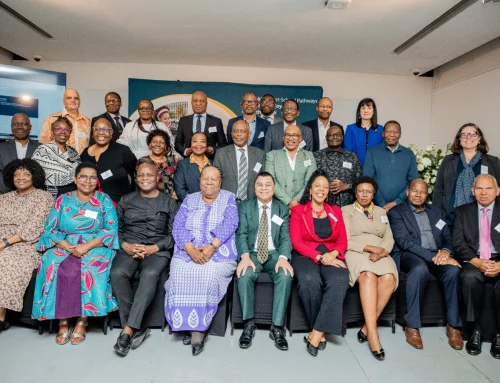
The audience was a combination of Women in Science as spread across UP’s science faculties; scholars and researchers from other universities; senior officials from government departments of Higher Education and Training, and Science, Technology and Innovation; the Academy of Science of South Africa (ASSAf); the German Development Agency in South Africa (GIZ); USAf and private sector companies such as Loreal South Africa, and Greenhill Laboratories.
Intersectionality and diversity: mutually complementary forces
To close the gender gap in STEM and cultivate future generations of professors, Dr Matutu implored universities to adopt the intersectionality in diversity approach. “This means recognising the experiences of black women not solely through the lens of race,” she explained, “but also through gender and disability/class/age. You cannot address one aspect in isolation and expect to transform the status quo.”
USAf’s role in advancing women in Higher Education
The USAf CEO highlighted several initiatives that Universities South Africa has implemented to support the advancement of women in academia.
The first is the Advancing Early Career Researchers and Scholars (AECRS) programme—an initiative supported by the Department of Science, Technology and Innovation (DSTI). While designed to uplift early-career researchers broadly, it places a strong emphasis on supporting women. “Under AECRS, we operate a virtual platform called Thuso Resources, which aids the development of early-career researchers by providing supervision, access to networks, and funding opportunities. We also run Thuso Connect, a platform that links early-career researchers with mentors both within South Africa and internationally.”
She noted that AECRS helps channel resources to early-career researchers—resources they might otherwise struggle to access, as evidenced by the research referenced earlier.
Another key initiative is the Women in Leadership (WiL) programme, delivered under USAf’s Higher Education Leadership and Management (HELM) programme, and funded by the Department of Higher Education and Training (DHET). WiL emboldens women to embrace leadership roles, advocate for themselves and others, and lead diverse teams through the complex changes shaping higher education.
“WiL’s goal is to help build a more equitable, diverse, and representative higher education landscape—one that welcomes multiple perspectives and ways of thinking, enabling all who work and live in the sector to thrive. The programme fosters self-awareness and leadership development, encourages peer engagement, and facilitates connections with experienced leaders, while also creating opportunities to build professional networks.”
This programme, accredited at the Nelson Mandela University, enables women to envision environments in which creativity and diversity are encouraged and thrive, Dr Matutu said. It is targeted at both academic and administrative staff.
UP’s Women in Science event aligns with the SDGs
Regarding the objective of the Women in Science event, of advancing the transformation agenda, Dr Matutu commended the University of Pretoria (UP) for its outstanding efforts in empowering and developing women in STEM, and for its commitment to advancing gender equity within South Africa’s higher education sector. She said this initiative aligns closely with one of USAf’s strategic priorities of fostering transformative universities.
Dr Matutu further highlighted that the Women in Science event is in harmony with the United Nations’ Sustainable Development Goals—specifically Goal 5 (Gender Equality) and Goal 10 (Reduced Inequalities).
“As we celebrate women in STEM, we celebrate the innovators among us. We also celebrate the top researchers, students, postgraduate scholars, and early-career researchers,” she said.
During the Closing the Gender Gap in STEM panel discussion, Dr Matutu shared the stage with Dr Hafsa Essop, UP’s Senior Lecturer in the Department of Radiography and Founder of PregiDose—a mobile application that monitors and records, in real time, the extent of foetal exposure to radiation in pregnant radiographers. Dr Essop, who spoke about her journey in developing the app, was the session moderator.
The third panellist was Ms Thato Semono, Head Girl at TuksSport High School, who addressed the topic Imagine a World with More Women and Girls in Science.
The Women in Science commemoration seeks to honour the achievements of exceptional women in STEM and to explore pathways for strengthening the pipeline of the next generation of women and girls in science, as South Africa moves towards a more inclusive and gender-equal future. The 2025 event was hosted at UP’s Future Africa campus on the eve of National Women’s Day.
‘Mateboho Green is Universities South Africa’s Manager: Corporate Communications.