Mathematics as a key determinant of university entry sparks a fierce debate
Professor Martin Gustafsson sparked intense debate when he asked an audience of 130 education practitioners whether all learners should be permitted to study Pure Mathematics in basic schooling, or whether access should be reserved for those with a demonstrably solid foundation to ensure stronger performance in the subject.
The context
This took place at the inaugural thought leadership event of Universities South Africa (USAf), which explored the theme Rethinking Post-School Education and Training for Youth Employment in South Africa on 2 October 2025.

A long-time Advisor to the Department of Basic Education and an Economics Professor at Stellenbosch University, Professor Gustafsson (left) was addressing senior university executives, senior academics, and senior administrators. Private higher education institutions and TVET colleges were also represented, as were professional bodies, career development organisations, corporate foundations, and education-focused NGOs.
His suggestion to review universal participation in Mathematics in basic schooling, regardless of the learner’s talent, sparked fierce debates among the delegates, with some taking umbrage over this proposition, while others were in support. The professor’s talk was titled School Completion Advancing More Rapidly than University Growth: Implications for Youth and National Development.
USAf had convened this dialogue to examine the issue of high demand for university education versus available absorption capacity, and its implications for young people’s future employability in a country beset by high youth unemployment. The aim was to foster public understanding ahead of the 2026 academic year and to identify potential solutions, even if these took years to materialise.
Audience responses
A delegate calling himself Wonderboy asked: “So basically, Professor, are you saying that teachers should restrict struggling learners who still want to take Mathematics but are held back by poor teaching quality? Surely the purpose of education is to help learners improve, to transform them into doing better and understanding more deeply?”
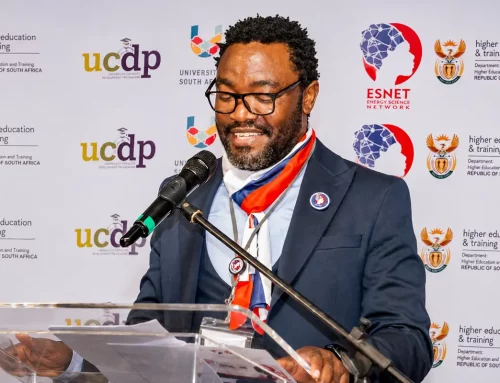
Mr Odwa Mntonintshi (right), Director: Quality Assurance and Information Management at the University of the Western Cape, added: “It is concerning that so many qualifications require Mathematics as an admission criterion, yet there is little clarity on how it actually aligns with the curriculum,” he said.
“Is the government implying that Mathematics is the main attribute for success, even in fields like History or Law? This raises serious questions about fairness, access, and how such qualifications are accredited.”

The rationale behind Mathematics
In response, Professor Gustafsson explained that a Mathematics requirement at university level is not about over-glorifying Mathematics, but about recognising its foundational role in developing analytical and problem-solving skills across disciplines.
Acknowledging that the debate around whether the education system is over-prioritising STEM (Science, Technology, Engineering and Mathematics) fields at the expense of the Arts and Humanities is as old as higher education itself, he said the most pressing issue is the lack of accessible information for young people when making subject choices that determine their eligibility for university study.
To address this, he proposed the creation of a centralised information platform that outlines subject and admission requirements across universities. He said such a resource would help learners and parents make more informed decisions about their educational pathways.
Limiting maths participation for higher-quality results
He further reflected on the pressure placed on learners to take Mathematics, even though performance in the subject remains poor. Noting a widely held belief that hard work can compensate for weak foundations, he argued that Mathematics is an accumulative subject, one that builds over time. “If learners have not mastered the fundamentals by Grade 10,” he said, “they stand very little chance of catching up later.”
Professor Gustafsson added that although many learners take Mathematics, relatively few achieve university-qualifying results. “Nearly 30% of learners fail Mathematics, even though participation remains high,” he said, questioning whether the pressure to push every learner into Pure Mathematics may, in fact, be causing more harm than good, especially without adequate foundational support or differentiated pathways.
More debate around Mathematics and Science
From the University of the Witwatersrand, Mr Tsibane Nhlanhla reflected on his observations from the Engineering Faculty Advisory Board of the University of Pretoria, noting the very low number of students entering university with a background in Mathematics.
He emphasised the importance of recognising Mathematics as the language of Science and Technology that should remain a prerequisite across schools. “Its foundational role in logic, analysis, and innovation extends far beyond the classroom,” he said.
Online participants echoed this sentiment, contributing a flurry of perspectives.

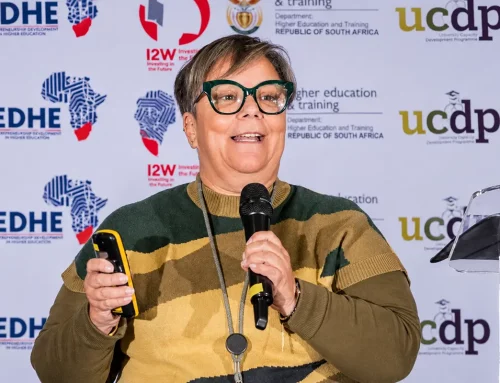
Ms Nuraan Davids-Latief, Information Systems Lecturer at the University of the Western Cape.

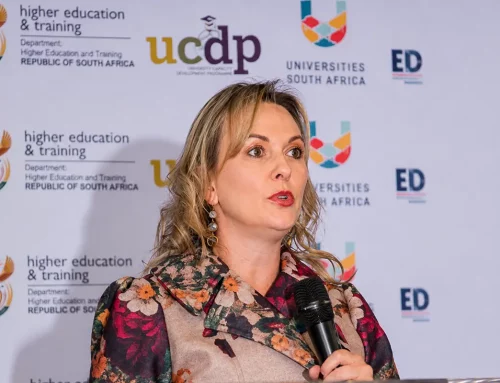
Professor Stephanie Allais, Professor of Education in the School of Education at the University of the Witwatersrand.
Ms Nuraan Davids-Latief, Information Systems Lecturer at the University of the Western Cape, cautioned that if learners are to be given the option not to take Mathematics, then much greater emphasis must be placed on early-career guidance. “There needs to be much more support to help young people start planning their career paths from Grade 8,” she said. “By the time they begin applying to university, it’s often too late for them to realise they either need Mathematics, or don’t.”
Professor Stephanie Allais, Professor of Education at the Centre for Researching Education and Labour, in the School of Education at the University of the Witwatersrand, voiced her disagreement with Gustafsson’s suggestion on limiting learners’ participation in Mathematics.
“We interview employers every week who look for maths passes when hiring machine operators,” she said. “TVET colleges need students with maths for engineering programmes, and both are struggling because most of them go to university. It’s a cop-out to say we should let fewer learners take maths because they do badly. We need to help more [learners] master the subject from the early years.”
Davids-Latief agreed, adding that South Africa’s global competitiveness ranking has declined to 64th out of 69 countries. She added that considering global development, technological innovation, etc, “we should be aiming to raise the bar, not lower it,” she said. “We often undermine our students by lowering the bar so that the data looks prettier. STEM is crucial for the future of our youth. It should not be compromised.”
Dr Ruth Andrews (right), Manager: Experiential Learning at Stellenbosch University’s Centre for Student Life and Learning, added another dimension to demonstrate why Mathematics is essential in everyday life.
Why Maths Matters (5 Key Reasons)
- Everyday Skills: Maths helps solve real-life problems, from managing money to understanding data in the news.
- Future Opportunities: Maths opens doors to jobs, further study, and careers in science, technology, business, health, and more.
- Clear Thinking: Maths trains your brain to think logically, spot patterns, and solve problems step by step.
- Understanding the World: Maths explains how things work, from measuring distances to predicting weather or even understanding sports statistics.
- Confidence and Creativity: Maths builds persistence, curiosity, and confidence, helping you approach challenges in any area of life.

“Maths isn’t just about numbers, it’s about thinking, opportunity, and making sense of the world, especially in our current tech-driven era.”
To this, Mr Mntonintshi retorted: “Does this mean that students who did not do Mathematics cannot think properly or make sense of the world? I think this myth should not be promoted in higher education, as it is discriminatory.”
Dr Andrews clarified: “I completely agree that it is not appropriate to suggest or even imply that students who have not studied Mathematics are somehow incapable of thinking well or contributing meaningfully to society,” she said. “Higher education must remain vigilant against deficit framings that risk marginalising learners.”
Citing scholarly works by Golding (2018), Young & Muller (2013), Niss (2015) and Boaler (2016), Andrews said these scholars do not claim that Mathematics is the only or even the most important form of thinking, but rather that it enables a distinctive mode of reasoning and representation. When accessible to all students, it empowers them to engage with aspects of modern life that are increasingly data-driven and technologically complex.
She continued, “Access to such knowledge is a matter of equity, not hierarchy. It is about expanding opportunities, not restricting them.” She noted that mathematical competencies provide flexible ways of thinking that support—rather than replace—other forms of reasoning, including narrative, ethical, and artistic. “Excluding students from Mathematics or framing it narrowly can itself be discriminatory,” she concluded.

At this point, one of the panellists—waiting for his turn to address the audience remotely—added his voice in support of Dr Ruth’s advocacy for Mathematics. Professor André Roux (left), Associate Professor (Emeritus) and Principal Lecturer in Economics at the Stellenbosch Business School, where he also serves as Programme Head for the Postgraduate Diploma in Futures Studies, posed a question in the Zoom chat:
“Ruth, if I’m not mistaken, there’s a well‑documented link between mathematics and musical creativity?”
Dr Andrews responded: “Yes, that is correct. The connection extends to other areas of the Arts as well.”
Thus, the advocacy for pure Mathematics continued as the discussion drew to its conclusion.
Reflections on the system
Mr Sakhile Phiri (right), Development Studies Lecturer from Nelson Mandela University, asked: “How would a reduction in Mathematics learners align with university qualification requirements? At our university, for instance, most BCom programmes don’t accept students with Mathematical Literacy, regardless of the mark. Learners take [Pure] Mathematics to expand their study options, especially as university positions are already oversubscribed.”
In support of Phiri’s point, Mr Lucky Sibanda, a scholar from GraceLitRev, the AI-powered research platform, said high schools’ struggles to maintain high pass rates had contributed to their channelling students into Mathematical Literacy when they experience difficulties with Mathematics. “While this strategy may be viewed as an ideal solution, it simultaneously presents challenges. It limits students’ future career pathways, as those without Mathematics are often excluded from disciplines that require quantitative competence, as highlighted by Martin.
“This reflects a trade-off between short-term academic gains and long-term career opportunities,” Sibanda said.
Some solutions

Ms Kate Poen (left), Academic and Career Advisor at the University of the Free State’s Centre of Teaching and Learning, cautioned: “It must be noted that degree requirements (i.e. AP scores) are also increasing and extended programmes are being phased out. This means access is becoming limited. So, how do we then ensure that our learners meet the university requirements for access? Is it Basic Education’s responsibility to perhaps revisit their pass mark requirements and quality to ensure there is better alignment?”
Sibanda noted that despite the limited absorption capacity of public universities, only 30% of students manage to graduate within the minimum prescribed period of three years. “This underscores the necessity for substantial preparation before students transition from high school to higher education,” he said, especially noting that universities provide only limited support aimed at enhancing throughput and improving retention rates.
He emphasised the importance of parental involvement, saying that “Although not all learners may naturally excel in Mathematics, increased effort coupled with sustained support from parents and educators could improve mathematics performance across the board.
Towards yet another solution, Davids-Latief suggested that South Africa look at the competence and passion of Mathematics teachers and the techniques used to teach Mathematics in schools.
In conclusion, Professor Gustafsson’s input, supported by the audience’s contributions, highlighted that a Bachelor’s pass does not imply success in isolation from the learner’s quality, and eligibility for post-school education and training.
Thoriso Kolobe is a Communication Consultant commissioned by Universities South Africa.