Mentorship models must evolve to support academic success
Senior academics and research programme leads have urged South Africa’s universities to rethink mentorship structures and prioritise models that recognise the social, psychological and professional needs of emerging researchers.
The message emerged from engagements during the Advancing Early Career Researchers and Scholars (AECRS) Workshop and associated sessions on November 28, during which participants discussed challenges in building a strong academic pipeline. The workshop was hosted by Universities South Africa at an OR Tambo International Airport venue on the East Rand.
Participants highlighted that the mentorship challenge in universities goes beyond technical or supervisory expertise. They argued that personality fit, communication, trust and psychological comfort often influence whether early-career researchers progress. They said traditional mentorship models do not always address the realities of postgraduate life.

Several speakers noted that pairing academics requires a more deliberate matching approach rather than simple allocation based on availability or seniority. One participant commented that mentors should be matched with early-career researchers in the same way a social or professional partnership is formed. Speakers explained that this approach builds confidence and supports research quality.
Calls grow for global collaboration and outreach
The workshop also included discussions on strengthening international collaboration. Participants believed that global partnerships and research networks are increasingly important in developing emerging scholars in specialised and technical fields. They pointed to international engineering networks and research hubs as examples of platforms that could support postgraduate development, but also emphasised challenges such as funding, language barriers, and differing institutional policies that need to be addressed.
Speakers remarked that early-career researchers are becoming more impact-driven and focused on relevance. They recommended that AECRS and related programmes link South African academics with global platforms and international training opportunities.
AECRS is linked to broader national priorities
Discussions referenced the broader national value of AECRS. During the Africa Collaboration Celebration sessions, speakers noted that the programme contributes to national and institutional priorities, including the Sustainable Development Goals and gender equity goals. The involvement of representatives from the National Research Foundation and government officials was viewed as an acknowledgement that emerging researchers contribute to national development.

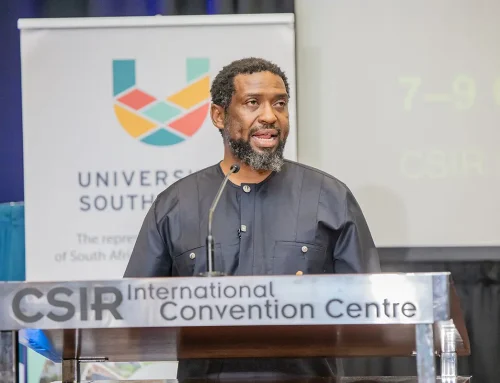
Mr Bheki Hadebe (left), Director for High-End Skills at the Department of Science, Technology and Innovation, reflected on the financial and infrastructural pressures shaping postgraduate development.
He highlighted the need for targeted investment in digital tools and shared research platforms to improve access for researchers across institutions.
Hadebe acknowledged that resource constraints continue to limit the pace at which such initiatives can be scaled, emphasising that strategic prioritisation remains essential.
Shared concerns and recommendations
A series of practical recommendations emerged from the workshop. These included:
- Using digital platforms to reduce isolation among postgraduate students.
- Building institutional support systems for postgraduate supervision.
- Developing structured mentorship models based on compatibility and professional alignment.
- Integrating international collaboration and institutional partnerships.
- Creating case studies to support institutional learning.
Speakers stressed that postgraduate research development requires shared ownership across universities and government. Discussions highlighted that institutional alignment, mentorship reform and international collaboration are central to building a future-ready academic workforce.
Bhekisisa Mncube is a contract writer for Universities South Africa.