Nine vice-chancellors gone in three years: Prof Mthembu calls on universities to stop surviving and start conquering
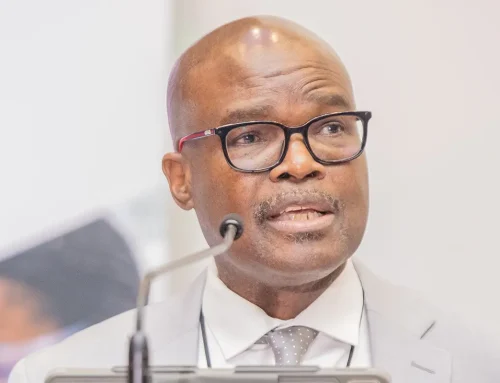
Nine vice-chancellors have left South Africa’s universities prematurely in the past three years or so, and some of the bodies meant to protect universities are among those doing the damage, Professor Thandwa Mthembu told delegates at the 4th USAf Higher Education Conference, held under the theme “Co-creating a Resilient Future”.
“We have seen colleagues who fought gallant battles against injustice and institutional capture suspended, removed or forced out of office,” said Prof Mthembu, Vice-Chancellor and Principal of the Durban University of Technology (DUT). “I speak from experience.”

On October 1 this year Prof Mthembu began his 21st year as a vice-chancellor. He told the conference he may well have retired by the time USAf next meets in 2028. “So this is my last chance,” he said, and he used it to deliver one of the most outspoken addresses of the three days.
He took aim at a parliamentary portfolio committee he described as “performative”, at what he called a quiet slide from state supervision to state control or interference, at the questioning of foreign academics, and at the pressure on universities to take sides in global conflicts.
Resilience is not enough
“I want us to be very careful about the word ‘resilience’, even as it graces the theme of this conference,” he said. “Resilience is the capacity to absorb shocks and bounce back. It is a necessary virtue. But when turbulence or adversity arises and we bounce back to where we had been, or to lower levels than where we had been, then there is a problem.”
South Africans, he argued, tend to land lower each time. “On its own, therefore, resilience is only as good a virtue as the virtue of the survivor.”
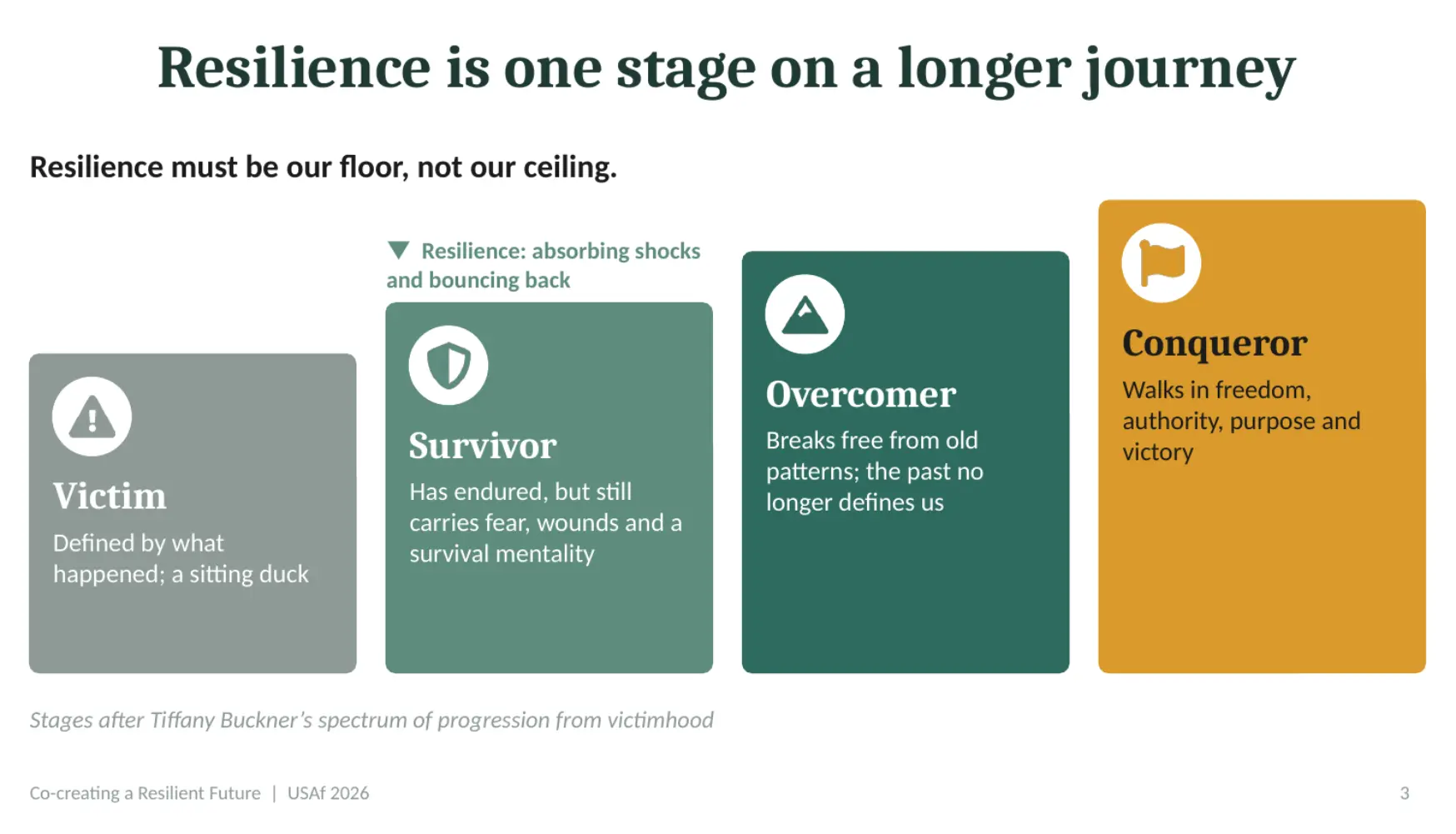
Paraphrasing Tiffany Buckner, he set out four positions a person, institution or system can occupy in the face of adversity. The victim “waits, like a sitting duck, for rescue or for someone to blame”. The survivor has endured but still carries the fear and the wounds. The overcomer breaks free and no longer allows the past to define the present. And the conqueror “walks in the freedom, the authority, the purpose and the victory that have been won”.
“Resilience must therefore be the base of the mountain we must climb, and not the summit,” he said. “That journey from victim to conqueror is the golden thread of this address.”
To demonstrate the cost of what he called “yesterday’s logic”, he turned to the economy. In 1996, South Africa’s nominal GDP was larger than that of Saudi Arabia, Ireland, Israel, Singapore, the UAE, Colombia, Vietnam, Malaysia, the Philippines, Bangladesh and Romania.
“But 30 years later, in 2026, sadly, the nominal GDP of each of these countries I mentioned has surpassed South Africa’s.”
He used Vietnam to make his point. In 1996 South Africa’s economy was 6.5 times larger than Vietnam’s. Today, he said, Vietnam’s is close to 10% bigger.
Vietnam and China had pursued their people’s economic interests pragmatically, he said. Yet there were South Africans “who hanker after economic models that China and Vietnam long abandoned” and who “are quick, of course, to put the interests of their families and friends first, as the Zondo and Madlanga commissions have laid bare”.
Speak in your own name
Prof Mthembu recalled that at the last USAf conference, in 2024, “some of us were castigated for refusing to be captivated by and swallowed up in the Gaza-Israel conflict”.
Universities, Prof Mthembu said, should not take sides as institutions. He quoted Professor Yunus Ballim, the founding Vice-Chancellor of Sol Plaatje University: “We should rather aim for the university to be a microcosm of what society could be like.”
Vanderbilt University chancellor Daniel Diermeier, he said, goes further. Academics must remain free to speak and protest, but “if you want to be vocal about an issue, do it in your own name, not in the university’s name”.
The cost of taking sides, he suggested, shows in research funding. Gross expenditure on research and development has fallen back to about 0.6% of GDP, where it was 15 years ago, against a modest target of 1.5%. “We are resilient, we tell the world; we are proud survivors, we tell the world; but we have very little to show for it,” he said.
“It is estimated that universities lost about R2.5 billion in research funding in one such episode alone, and there have been many other episodes. Meanwhile, HIV and TB research suffers.”
‘Heavy breathing over our shoulders’
Oversight of universities is legitimate, Prof Mthembu acknowledged.
“We receive public resources and must account for them.” But the conduct of the parliamentary portfolio committee had “too often seemed performative, aimed less at building and supporting the university subsystem than at demeaning and embarrassing vice-chancellors and the universities they lead”.
During committee visits, he said, “there is heavy breathing over our shoulders about our tenders”, and colleagues fear the university “is being weakened so that it can be more easily exploited”. Meanwhile, dysfunction at NSFAS, which directly affects students, “does not seem to attract the same urgency”.
He asked when policy had shifted from the state supervision model of the 1997 White Paper on Higher Education. “When did we agree on state control and state interference? So why are we mute about this?”
On the questioning of foreign academics, he took issue with the figure of about 12% of permanent academic staff being foreign nationals, noting that the data does not separate permanent residents from those on visas, so the true share must be lower. International academics make up roughly a third of staff in the UK, he said. “Universities have always been institutions through which knowledge and scholars move across borders. Now we have to be convinced by some people that there is something wrong with having foreign academics.”
‘Where would I be today?’
The most personal part of the address concerned councils, which, he said, should be “the primary defenders of the university”. He recounted facing a purge at the former University of Durban-Westville in 2001–2002, and court victories against the minister of the day in 2012 and against the DUT council in 2024. “Where would I be today?” he asked. “I would have gone back to what I used to do, herding the family stock.”
By his count, nine vice-chancellors had left the sector prematurely through suspension or “controversial settlements”, and some who led through such storms have since died. He asked how many leaders pick up the phone when a colleague is under attack, “not because you support what they might have done, but just at that human level”, and how many universities would offer such a person a soft landing.
“Let us descend from the high horse of institutional autonomy and abandon the timidity that makes us sitting ducks,” he said. “Let us act collaboratively, support one another, overcome and conquer together.”
Two-year SRCs and an end to the protest season
“Our young people are as good as we once were,” Prof Mthembu said. “But too often we leave them in the hands of politicians, through politically affiliated student movements on our campuses, and at the mercy of unscrupulous accommodation providers, to learn about corruption from that young age.”
In June 2023, despite resistance from convocation representatives on council, DUT tightened eligibility for SRC office in favour of excellence and extended SRC terms from one year to two. Online voting has since increased student participation dramatically. Since the change, DUT “is no longer regarded as the protest capital of South African universities”.
Entrepreneurs before graduation
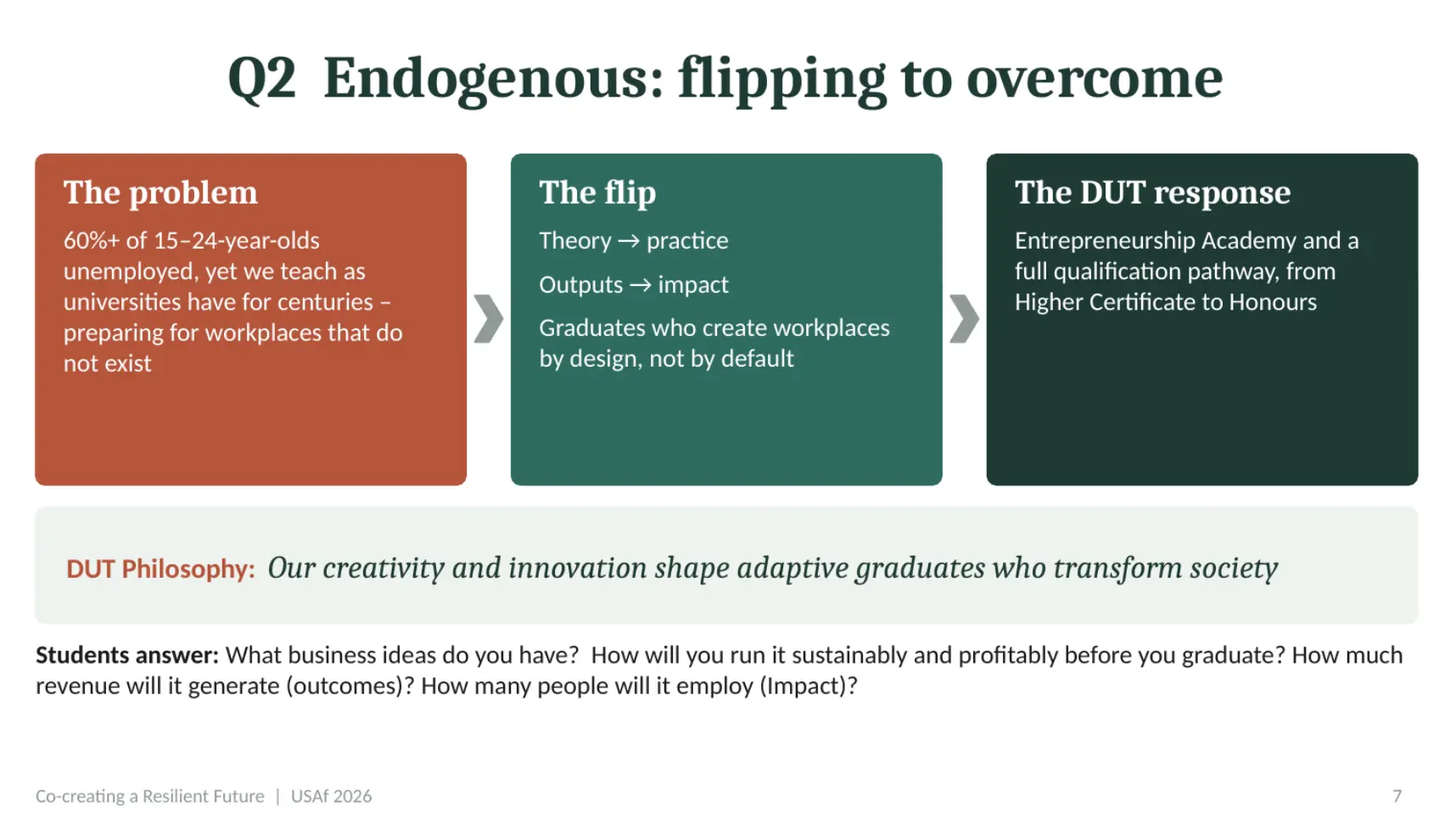
Turning the mirror on universities themselves, he said DUT was moving away from “educating and training for the workplace”, because that workplace does not exist for many of our young people”. Guided by a 10-word philosophy, “Our creativity and innovation shape adaptive graduates who transform society”, it is flipping its teaching from theory to practice.
Through its new Entrepreneurship Academy, students enrolled in full entrepreneurship qualifications DUT hopes the CHE will allow it to offer soon must answer a few simple questions. What business do you want to have? How will you design, run and manage it sustainably and profitably “before you graduate”? Not after graduating: before you graduate”. How much revenue will it generate, and how many people will it employ?
Asked by Mr Shaun Abrahams of the University of Cape Town when resilience becomes adaptation to conditions that should be changed, Prof Mthembu was blunt. “I am not for resilience, because, as I said, resilience is really just about surviving. It is about just continuing to be there, even though you are lower than you were before the onslaught came your way.”
Prof Mthembu ended where he began, with the theme of the conference. If South Africa’s universities are resilient survivors, he said, it is time they “grow and graduate into overcomers, and overcomers who will ultimately become conquerors”.
Janine Greenleaf Walker is a contract writer for Universities South Africa.