Professor Tyobeka demands a year of action as USAf conference closes
Closing the three-day higher education conference, the North-West University Vice-Chancellor challenged institutions to turn Dr Phethiwe Matutu’s opening call for collective renewal into measurable commitments.
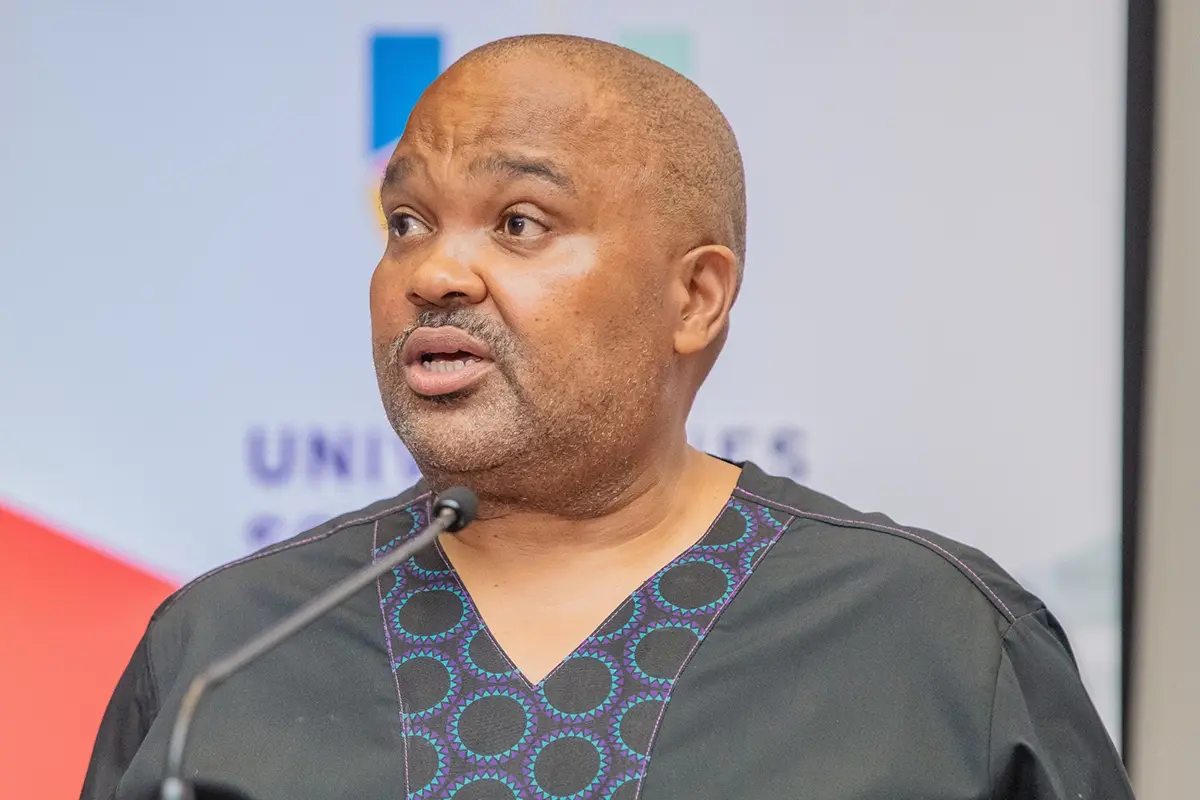
Professor Bismark Tyobeka, Vice-Chancellor and Principal of North-West University, delivers the closing remarks on behalf of Professor Francis Petersen, Chairperson of Universities South Africa, at the fourth USAf Higher Education Conference, 9 October 2026, CSIR International Convention Centre, Pretoria.
Professor Bismark Tyobeka challenged South African universities to identify two concrete commitments after the 4th Universities South Africa (USAf) Higher Education Conference: one change they could implement themselves and another that would require collaboration. He wanted named leaders, realistic milestones and evidence of progress within a year.
The North-West University Vice-Chancellor and Principal delivered the closing remarks on Friday, 9 October 2026, on behalf of Professor Francis Petersen, Chairperson of the USAf Board and Vice-Chancellor and Principal of the University of Pretoria. The conference took place from 7 to 9 October at the Council for Scientific and Industrial Research (CSIR) International Convention Centre in Pretoria under the theme ‘Co-Creating a Resilient Future’.
‘We should be able to look back in a year and explain what changed because we met here,’ Professor Tyobeka told delegates. He proposed that USAf and its strategy groups agree on a manageable set of shared priorities, with responsibility for delivery.
From diagnosis to decisions
At the opening on Wednesday, USAf Chief Executive Officer Dr Phethiwe Matutu had organised the conference around three connected tasks. Day One, ‘Understanding the Present’, examined the conditions confronting universities. Day Two, ‘Reimagining Universities’, sought new institutional approaches. Day Three, ‘Co-Creating the Future’, turned towards joint responsibility and action.
Professor Tyobeka returned to that sequence in his closing address. ‘Understanding must inform choices. Imagination must find expression in institutions,’ he declared, calling for collaboration that students, staff and communities could experience. His proposed commitments supplied a practical measure for the ambition Dr Matutu had placed before delegates.
He suggested shared research facilities, stronger student support systems, more equitable international partnerships and preparation for artificial intelligence (AI) as possible projects. Where legislation or policy stood in the way, universities should approach government with coherent proposals supported by evidence.
Day One had tested the university’s intellectual purpose against pressures on funding, governance and academic autonomy. Professor Sizwe Mabizela of Rhodes University had questioned institutions that taught students to embrace change while resisting it themselves. On Day Two, the emphasis shifted to what universities could redesign: leadership, student support, collaboration, digital systems, and the incentives that shape research. Those conversations gave Professor Tyobeka’s closing demand a context. Decisions about resilience would have to be visible in how institutions operated, not only in what their leaders promised.
A different test of resilience
Professor Tyobeka questioned whether a university could claim resilience simply because it survived financial pressures. An institution could balance its books while reducing access, expand enrolment without providing students with adequate support, or acquire technology while weakening the relationships on which learning depends.
‘Resilience, therefore, must be judged partly by whose future we make more secure,’ he insisted. University leaders, he added, should listen to difficult truths before they developed into crises. Public trust rested on how institutions managed resources, acknowledged failures and treated people with less power.
His argument followed the previous afternoon’s reflections, when Professor Thokozani Majozi had asked universities to confront the tensions between technological speed and institutional capacity, efficiency and equity, and cooperation and competition. Dr Sanele Nene had returned to student success, distinguishing admission from the financial, academic and social conditions required to complete a qualification.
Dr Nene, Director of National Standards and Reviews at the Council on Higher Education, had also challenged the practice of inviting students to meetings without allowing their contributions to influence decisions. In his closing remarks, Professor Tyobeka asked institutions to examine what happened after admission, how quickly barriers were identified and whether their responses were coordinated.
Sharing capacity, preserving independence
Professor Tyobeka called for more credible discussions with government about sustainable public funding and for targeted partnerships with industry and philanthropy. He also demanded scrutiny of institutional spending: what universities duplicated, what they postponed and whether budgets reflected their declared priorities.
Sharing laboratories, research platforms, specialist expertise, and selected services could increase capacity without each institution having to build the same facilities. But partnerships had to preserve academic independence and account for their financial obligations. He warned that a resilient national system could not leave universities facing structural disadvantages to struggle alone.
The same issue had surfaced in Day Two’s reflections. Professor Thoko Mayekiso, former Vice-Chancellor and Principal of the University of Mpumalanga, urged leaders to anticipate recurring registration problems and cooperate with senates, organised labour, students and alumni. For Professor Tyobeka, collaboration now needed to translate into agreed projects and accountable leadership.
Technology, knowledge and students
On digital transformation, Professor Tyobeka refused to equate progress with purchasing software. Students needed the capacity to test claims, evaluate evidence, recognise assumptions and take responsibility for their answers. Universities, he maintained, should review assessment, develop academics’ skills and strengthen data governance as AI changes teaching and research.
Professor Lynn Morris, Deputy Vice-Chancellor: Research and Innovation at the University of the Witwatersrand, had raised related questions in Day Two’s closing reflections. She pressed for better coordination of universities’ AI expertise and safeguards for intellectual property and research data. Professor Tyobeka’s proposal offered a route for institutions to identify shared work rather than duplicate separate responses.
He also wanted African universities to shape the research questions addressed through international partnerships and secure fair recognition for intellectual contributions. Knowledge drawn from African histories and local conditions had to influence the work, while emerging scholars needed mentoring, opportunity and time to develop their careers.
Student success, he argued, required that teaching, academic advice, financial assistance, mental health support, and belonging be treated as connected responsibilities. His remarks followed the Day Two student-success session, where Professor Francois Strydom had described using learning-management data to identify students in need of help. At the same time, Dr Thato Masekoa had questioned consultations that left student representatives unable to influence fee decisions.
Research that reaches society
Professor Tyobeka drew on the final day’s presentations about research and societal impact, including a solid-waste project in which communities helped define problems and possible responses. He urged universities to involve those communities in research from the outset rather than present solutions after the work was finished.
He also defended research without an immediate commercial application. Recalling Professor Majozi’s argument for protecting unconventional, ‘blue-skies’ ideas, he acknowledged that discoveries might become useful decades later. Universities needed applied innovation and fundamental inquiry, including scholarship in the humanities and social sciences.
Sports, culture and community service also belonged in that account of universities’ public contribution. They provided ways to build trust and relationships beyond campus, Professor Tyobeka argued, even when they could not be captured in patent totals or publication counts.
A deadline beyond the conference
Professor Tyobeka ended with a call for action that delegates could test. Every university should choose one change within its control and one that required a partner. USAf’s strategy groups should identify shared priorities, assign people to lead them and establish milestones that could be reviewed.
‘The conference is closing today. The responsibility it places before us continues,’ he told delegates. His final instruction was equally direct: ‘Let the most powerful closing statement be the work we now undertake together.’
Bhekisisa Mncube is a contract writer for Universities South Africa.