Public and private universities can co-exist in harmony in South Africa
At Universities South Africa’s (USAf’s) Thought Leadership Dialogue on 2 October 2025, Dr Carin Stoltz-Urban, Chief Operations Officer of Inscape Education Group, reflected on the challenges faced by private higher education institutions.
Addressing the 130 senior education practitioners at the hybrid event that was hosted at the University of Pretoria’s Future Africa Campus, she admitted she was tempted to complain: “We do not receive any NSFAS [the National Student Financial Aid Scheme] support. We don’t receive any subsidies… The accreditation hoops that we have to jump through are the same as those that public higher education institutions must overcome. That means we are subjected to the same quality standards. Yet we don’t get to name ourselves ‘universities’.”
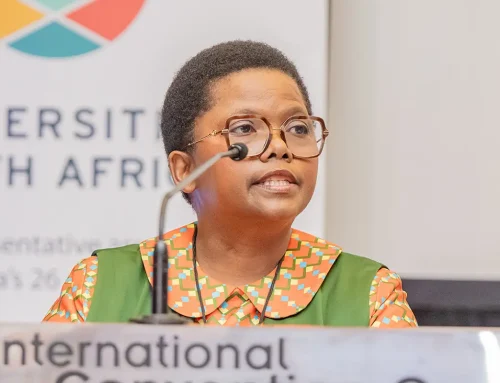
Rather than dwell on grievances, Stoltz-Urban (right) used her platform to advocate for a more integrated post-school education and training system—one in which both public and private institutions are recognised for their contributions to national development. She argued that collaboration, rather than competition, should define the sector.
Her remarks came just two weeks before a government gazette published the new Policy for the Recognition of South African Higher Education Institutional Types, which now allows private institutions to name themselves ‘universities’ under specific conditions.
As Chairperson of the South African Private Higher Education (SAPHE) Board, Stoltz-Urban addressed the Dialogue alongside four other guest speakers. She posited that South Africa’s higher education system can only thrive if every player is valued equally, and if both public and private universities are empowered to work in harmony to meet the country’s growing demand for quality education.

The state of private higher education provision
Dr Carin Stoltz-Urban highlighted that private higher education in South Africa had doubled between 2011 and 2021, a clear sign of demand-driven and sustainable growth. Today, private institutions account for around 20% of national higher education provision, with the potential to expand even further.
Yet, she cautioned that the road to growth is far from smooth. Lengthy accreditation processes often leave institutions in limbo—“empty buildings with some staff but no students”—for as long as two years. The financial strain of surviving under such conditions makes it costly to establish and sustain private institutions.
Despite these challenges, Stoltz-Urban pointed to encouraging developments. As of October 2025, private providers had just completed the first round of the Council on Higher Education’s (CHE) revised Institutional Audit process, underscoring their commitment to maintaining excellent quality standards.
Coupled with the new policy enabling private institutions to call themselves “universities” under certain conditions, these steps have injected fresh optimism. Stoltz-Urban believes this shift could help reshape perceptions, granting private institutions the respect they deserve and strengthening their ability to attract greater demand.
Private providers as a niche market
Dr Carin Stoltz-Urban identified three attributes that give private higher education providers a distinct advantage in South Africa’s education landscape:
• Smaller classes, greater student support
Using Inscape Education Group as an example, she explained their studio-based teaching pedagogy: “We are a design school. We follow a studio teaching pedagogy that shows our students how to, rather than engage in lengthy lectures only. This approach allows them to do and provides them with constructive feedback. That’s how we train and educate designers. It’s a space for individual attention, and not for 300 students in a class. We therefore take an absolute maximum of 26 students per class.

This demand-driven model, she argued, allows flexibility and creates an environment where students receive tailored support—something unique to private institutions.
• Strong industry partnerships
Private institutions often enjoy closer ties with industry, giving students valuable workplace experience. Stoltz-Urban noted that partners not only provide internships but also contribute to scholarships and study assistance, strengthening the link between education and employability.
• Willingness to take risks
Highlighting innovation, she pointed to Inscape’s degree in Ideation. While some parents question its relevance, asking: “What is this thing, and will my child get a job?” Stoltz-Urban described it as a vital future skill.“We forget that 10 years ago, there was no such thing as a social media manager,” she said. “We must open our minds and educate parents about the possibilities.”This willingness to pioneer new fields of study, she argued, reflects the forward-looking nature of private institutions and their role in preparing students for emerging careers.
Are we in it for the money?
Dr Carin Stoltz-Urban admitted she is still taken aback by the widespread perception that private institutions exist purely for profit. “That is a misconception,” she remarked firmly.
She pointed to Inscape Education Group as a proud example of what she calls a redemptive business—an enterprise committed to restoration and correcting past wrongs.
“As directors of that business, we do not take dividends. We reinvest our profits into our scholarship programme so that we can grant access to more students. We are a medium-sized business, but we have spent in excess of R22million of our own profit on scholarships.”
While she could not provide figures for like-minded other private institutions, Stoltz-Urban noted that many also offer bursaries, affordable tuition rates, and flexible payment plans to broaden access.
“Tell me again that we are in it for the money,” she challenged the detractors.
The missing data on private providers

Representing the Association of Private Providers of Education, Training and Development (APPETD), Dr Shirley Lloyd (left), raised concerns that government planning for the PSET sector continues to overlook private institutions. Speaking online at the USAf event, she noted:
“Private institutions are excluded from the statistics given in the PSET system research reports, for example, and this skews the real ‘picture’ about the state of higher education and private college/TVET in South Africa. Similarly, the state of readiness of the PSET system reports often excludes reference to private providers.”
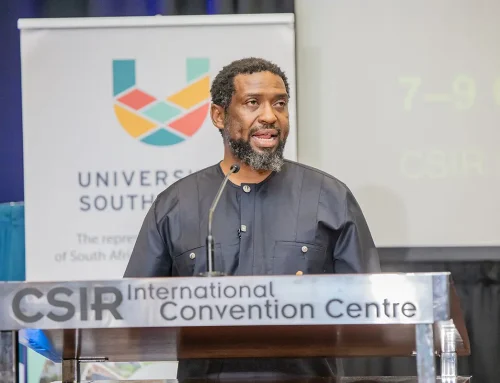
Her concerns were echoed by Mr Odwa Mntonintshi (right), Director of Quality Assurance and Information Management at the University of the Western Cape. He argued that private institutions remain poorly integrated into the higher education system, with black communities in particular excluded due to limited communication and lack of access to state funding [at private institutions].
“While DHET is quick to close private institutions with compliance issues, public institutions with similar problems face no equivalent sanctions. This inconsistency undermines trust and equity in the sector.”
Against this backdrop, Dr Lloyd questioned whether the Department of Basic Education’s projection of 9% growth in university enrolments by 2029 had factored in private providers. Due to time constraints, however, the panel was unable to respond to these questions and comments.

We’re in this together
In closing, Dr Carin Stoltz-Urban emphasised that every player in the broader PSET sector deserves recognition for the vital role they play in serving South Africa, adding that there are enough students to fill all available spaces across the board.
Drawing on the principles of the National Qualifications Framework, she urged institutions to collaborate in advancing access, mobility, and progression for learners.
“This is about our children and our future. There shouldn’t be any such thing as public vs private. We have one PSET system, and we’re building it together.”
‘Mateboho Green is the Manager: Corporate Communications at Universities South Africa