The positive impact of university sport reaches far beyond the playing field
Varsity Sport’s biggest wins happen off the field as a recent study shows that belonging and not winning is what students value most and that the community and social impacts created by sport are as important as the competitions themselves.
This was the message from Chief Executive Officer (CEO) of the University SportCompany (USC), Mr Flip van Zyl, when addressing delegates at the recent 4th Universities South Africa (USAf) Higher Education Conference.

“We thought Varsity Sports was just a sporting competition,” said Van Zyl. “We did not realise the massive impact this competition has on the whole ecosystem.”
From rugby to 25 universities
Varsity Sports, Van Zyl explained, grew out of the Varsity Cup, the university rugby competition launched in 2008 and broadcast on SuperSport. In 2010, former Springbok rugby captain Francois Pienaar, who had been pivotal in establishing the Varsity Cup, approached the universities to ask whether other sports codes could also be commercialised.
This led to the creation of USC, an entity which holds the commercial and media rights to administer, develop, coordinate and promote non-professional university sport across the country’s higher education institutions. Managed by Advent Sport Entertainment and Media (ASEM) on behalf of USC, Varsity Sports features various different sport tournaments and works closely with its 25 member universities.
Sport codes currently and/or previously presented include athletics, basketball, cricket, beach volleyball, football (men’s & women’s), hockey (men’s & women’s), netball, mountain biking and rugby 7s (men’s & women’s).
Varsity Sports launched in 2012 with seven sport codes. By 2016 it had entered a phase of diversification and development, with 12 codes and participation peaking at 1751 athletes. However, the Covid-19 epidemic forced a shut-down with competitions returning slowly in 2021, some of them in bio-secure bubbles. While the programme has since stabilised, Van Zyl said the sponsorship environment remains difficult.
A study with 829 voices
The recent study – undertaken by Professor Cora Burnett, an expert in sport impact assessment and Director of the South African Centre of Olympic Studies and Social Impact (SACOSSI) at the University of Stellenbosch and Emeritus Professor at the University of Johannesburg – looked at the contribution of Varsity Sports since its establishment 14 years ago, how its different stakeholders have experienced it, and what roadmap should guide strategic decisions in a changing higher education and sport environment.
Van Zyl said the Terms of Reference for the study required a mixed-methods approach, combining quantitative and qualitative data so that decisions would be robust, and for all stakeholders to take part.
In all, 829 people from 19 universities participated. 85 interviews were conducted, 64 focus groups were held, and 553 people completed surveys. Participants included university executives, heads of sport, support departments, student leaders, coaches, student-athletes, and national federations.
“The idea was not for us to ‘publish’,” Van Zyl said. “We wanted to improve what we offer, as a company, as a business and to the universities.”
The story of possibility
The strongest evidence, he said, came from the voices in the interviews who saw sport as central to their institution’s story. Executives agreed that sport is an integrated value proposition, with returns that are both financial and indirect, through recruitment, reputation and social media.
“Varsity Sports is central in helping us tell that story, the story of excellence, the story of possibility and what is possible through hard work,” commented one respondent.
Skills that spill over
Support staff, in marketing, operations and facilities, told a similar story. “Varsity Sports helps young people imagine themselves attending university,” said one. Another called it “the biggest marketing tool that sport has”.
A Varsity Sports match, Van Zyl pointed out, is not just a rugby or football game. It is a full broadcast production and over time the university’s support departments have become involved in hosting it. One of the biggest impacts the study found is that these departments gain event management skills which they now use for graduation ceremonies and other university events.
Caption
These broadcasts also raise standards. “Our facilities needed to look good on television,” one staff member said, which has created a push to improve infrastructure on campus.
Crucially the experience also opens doors for students.
“Some of them find that it’s the first time sleeping in a hotel, the first time going on an airplane or the first time going to other provinces,” explained another respondent.
Not only about who wins
The finding that Van Zyl said the USC had not expected came from student leaders. For them, he said, it is not about the competition or who was the winner: “It is about belonging, friendship, identity, being part of a community, and the chance to build skills through volunteering and leadership.”
“The entire campus comes together around one event,” was a phrase that recurred throughout the interviews. Students develop loyalty to their team, their university and its culture. Many want to be involved, whether scanning tickets or volunteering. One student leader asked: “What can I put in place that five years from now will still make a difference?” Another said: “Learning logistics and event management gave me skills I can use for my future.”
A laboratory for leadership
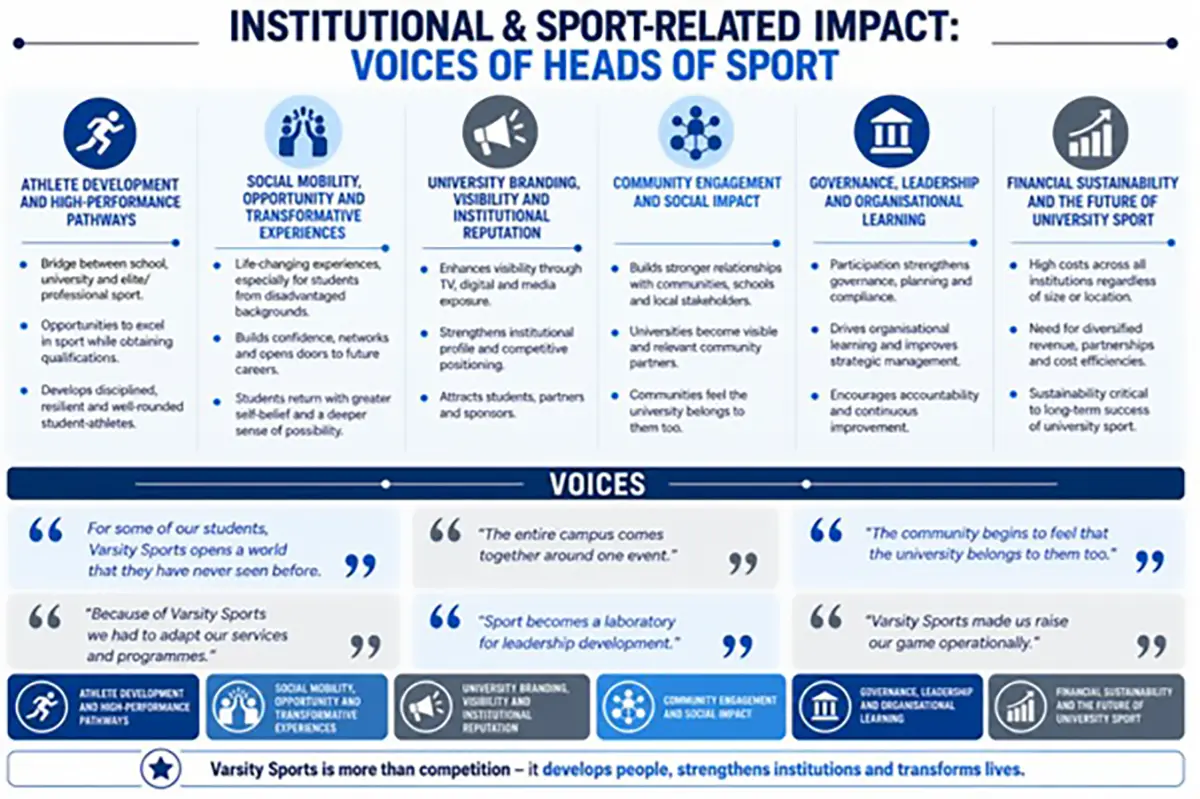
Heads of sport emphasised high-performance pathways that deliver athletes to national federations and national teams. They also stressed what the competition means to students from disadvantaged backgrounds.
“For some of our students, Varsity Sports opens a world that they have never seen before,” said one. Many have never attended a big event, never flown and never visited another province.
“Sport becomes a laboratory for leadership development,” said another. And the competitions draw communities in: “The community begins to feel that the university belongs to them too.”
Across all six stakeholder groups, Van Zyl said, the shared message was clear. Sport improves institutional visibility and reputation, drives student development and well-being, builds belonging and inclusion, opens partnerships and demands quality events.
However, there are other factors to be considered.
Said one respondent: “One has to understand that they are students before they are football players. So whatever you do, it has to be aligned with their academics.”
Student-athletes confirmed how hard the dual career can be. One netball player said: “I don’t even remember first year. It was just so much. I was sleeping, training and trying to keep up with my work.” However, a football player spoke of the soft skills learnt from balancing sport and academics.
From charity to strategy
Community impact, Van Zyl conceded, is still a work in progress. Varsity Sports has run community campaigns on themes such as mental health, gender-based violence and well-being but these have largely been advocacy and charity. To make a proper impact, he said, community engagement must be built into both the sport strategy and the university strategy, co-created with communities and partners in each region, and aligned with teaching and research. And its impact needs to be measured.
The numbers
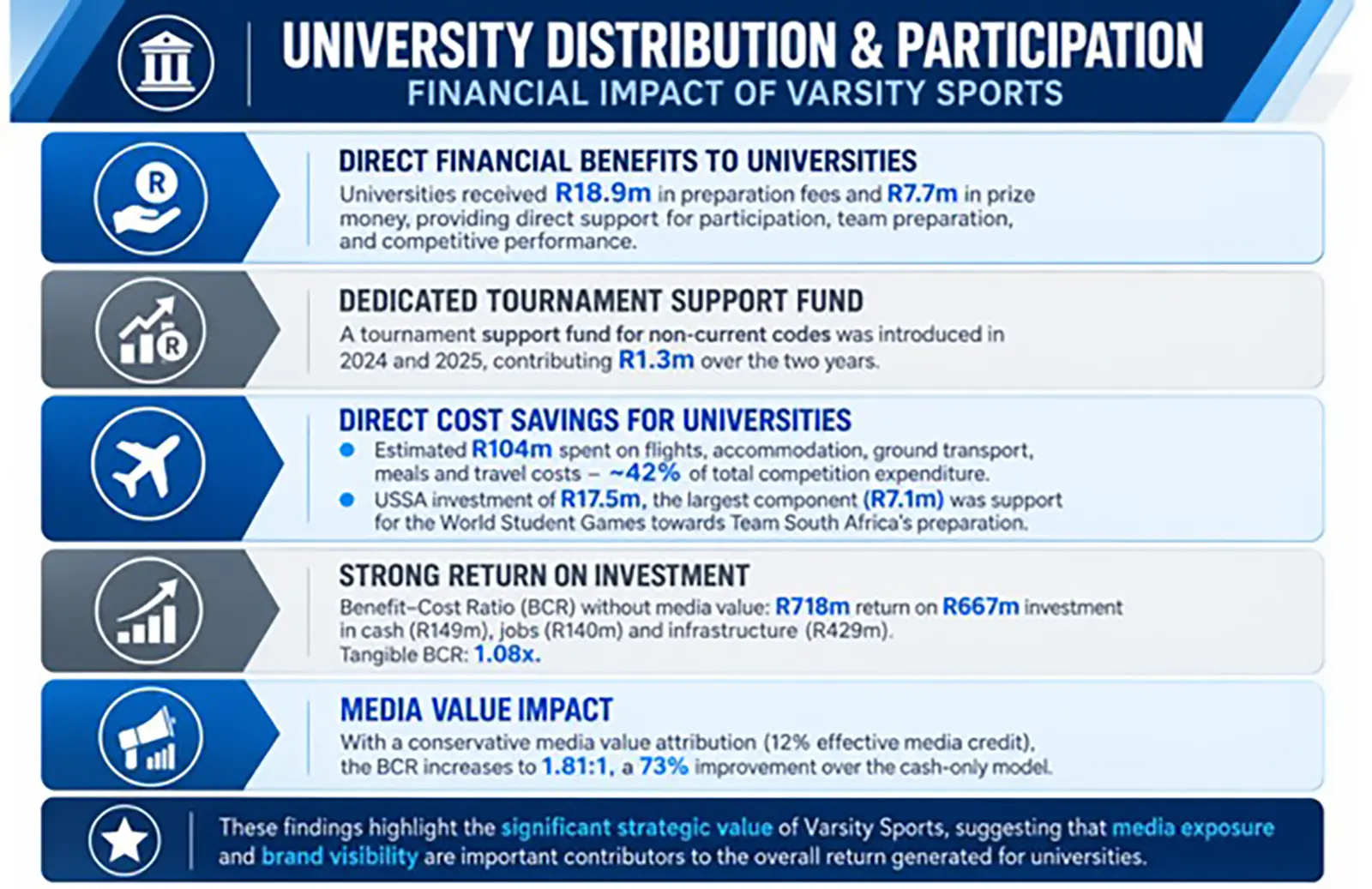
The study also puts a rand value on Varsity Sports. Universities received R18.9 million in preparation fees, along with R7.7 million in prize money, according to the research. Return-on-investment modelling showed that over the past 12 to 13 years, universities invested an additional R667 million in sport because of Varsity Sports, and the return on that investment was R718 million, made up of cash, jobs and infrastructure.
The media value of Varsity Sports over the life of the programme was R4.1 billion. The study found that when a conservative share of that media value is included, the benefit-cost ratio rises from 1.08 to 1.81.
Recommendations
The study recommends that the USC and member universities share value and should reinvest together. The USC generates commercial value that benefits the universities, while the universities invest in access, infrastructure and growth.
Its six key priorities are:
- to enhance student-athlete development and well-being
- maximise commercial value and reinvest it
- strengthen the USC’s enabling role
- build capable staff and leadership
- deepen community engagement
- integrate with the national sport sector.
Van Zyl advised university executives to position sport strategically, invest for stronger impact, leverage the brand and partnerships built through Varsity Sports and make decisions based on data.
The aim, he said, is to make competition fairer, because universities are at very different levels, and in the long run build stronger universities with a lasting social impact.
Questions from the floor
Mr. Richard Flame, Executive Director – Operations at University of Mpumalanga asked how an institution at the beginning of its sporting journey should professionalise and bring the different parts of the university together.
Van Zyl said the study identified three types of universities (in terms of sport participation): emerging, developing and established. His advice to emerging universities would be to focus first on facilities and a ‘proper’ sport programme, and on community leagues that use local officials and managers. His second suggestion was to bring all the support departments together as soon as possible. At one university, the head of sport presented the study’s findings to senior management and showed that if they were serious about sport, they needed to sit around the table with all the departments, from operations and security to marketing and recruitment, and draw up a combined plan for the next five years.
Asked about the inclusion of disabled athletes, Van Zyl said university sport departments are making a concerted effort to give these students access to facilities, and to link them with national federations so that they can compete at a high level. There are not yet enough students with disabilities to sustain parasport competitions between universities, he said, but sport departments are working hard to open up their facilities and programmes to them.
Janine Greenleaf Walker is a contract writer for Universities South Africa.