Teaching should count as much as research, says NUTA chair
Just as we have a National Research Foundation (NRF) rating, it is now time to introduce a rating syatem for teaching,” says Professor Clever Ndebele who believes that university teaching should be accorded the same status as research
Prof Ndebele, Full Professor in the Faculty of Education at iYunivesithi Walter Sisulu and Chair of South African University Teachers (SAUT), was speaking to delegates at the recent 4th Universities South Africa (USAf) Higher Education Conference where he provided an update on the National University Teaching Awards (NUTA).
This year, 25 of the country’s 26 public universities submitted entries, up from just 14 under the awards NUTA replaced.

From joint awards to a national framework
South Africa previously had national teaching awards run jointly by the Council on Higher Education (CHE) and the Higher Education Learning and Teaching Association of Southern Africa (HELTASA).
As the debate around the standing of teaching against research gained momentum, Prof Ndebele said that the sector convinced the Department of Higher Education and Training (DHET) to recognise and support teaching awards in the same way that it supports the NRF.
In 2017 a ministerial committee was set up to draft a framework, followed by a national workshop with the CHE, DHET and other stakeholders. The result was a ministerial statement, the “National Framework for Enhancing Academics as University Teachers”, approved in 2018 with the Minister of Higher Education as patron. The framework was integrated into the University Capacity Development Programme (UCDP), which provides its core funding.
Each university sends a representative to what has become the National Coordinating Committee for Enhancing Academics as University Teachers, which Prof Ndebele has chaired since the end of 2023. The body has since been renamed SAUT and its secretariat is hosted at Walter Sisulu.
The name is deliberate, explained Prof Ndebele. Under the framework, academics are referred to as “university teachers”, not lecturers.
Lessons from the old awards
NUTA was designed to fix problems that the sector identified in the former CHE/HELTASA awards between 2015 and 2019.
Most of those awards went to white women, reflecting what Prof Ndebele described as systemic inequities in access.On average, only 14 of the 26 public universities were represented under the previous awards, institutions seem to have given potential nominees little guidance, while submission guidelines lacked clarity and consistency. Unsuccessful applicants received generic feedback which made it difficult for them to improve their entries the following year.
What counts as excellence?
Part of the answer is to rethink what “excellence” means.
Prof Ndebele said the term excellence “is elusive and difficult to define clearly in teaching contexts”. In a system with historically disadvantaged institutions and a rural-urban divide, teaching excellence is interpreted differently depending on context
Therefore NUTA, he said, puts the emphasis on innovation and on the scholarship of teaching and learning, as a more inclusive and contextually appropriate measure. The panel looks for eight attributes in what it calls the innovative teacher.
These are:
- creativity
- a focus on students
- teaching grounded in research
- reflective practice
- awareness of context
- sensible use of technology
- collaboration with colleagues
- evidence of a real effect on student learning.
Prizes and categories
Prof Ndebele said that in each year up to five awards may be made. Winners in the Experienced Teacher and Collaboration Team categories each receive R60 000 and winners in the Beginner Teacher category receive R30 000. The committee can also award commendations.
Sixteen academics will be honoured, with awards or commendations, at a ceremony in Johannesburg on November 20. Each will showcase their scholarship, and the winning portfolios are included on the SAUT website for others to reference.
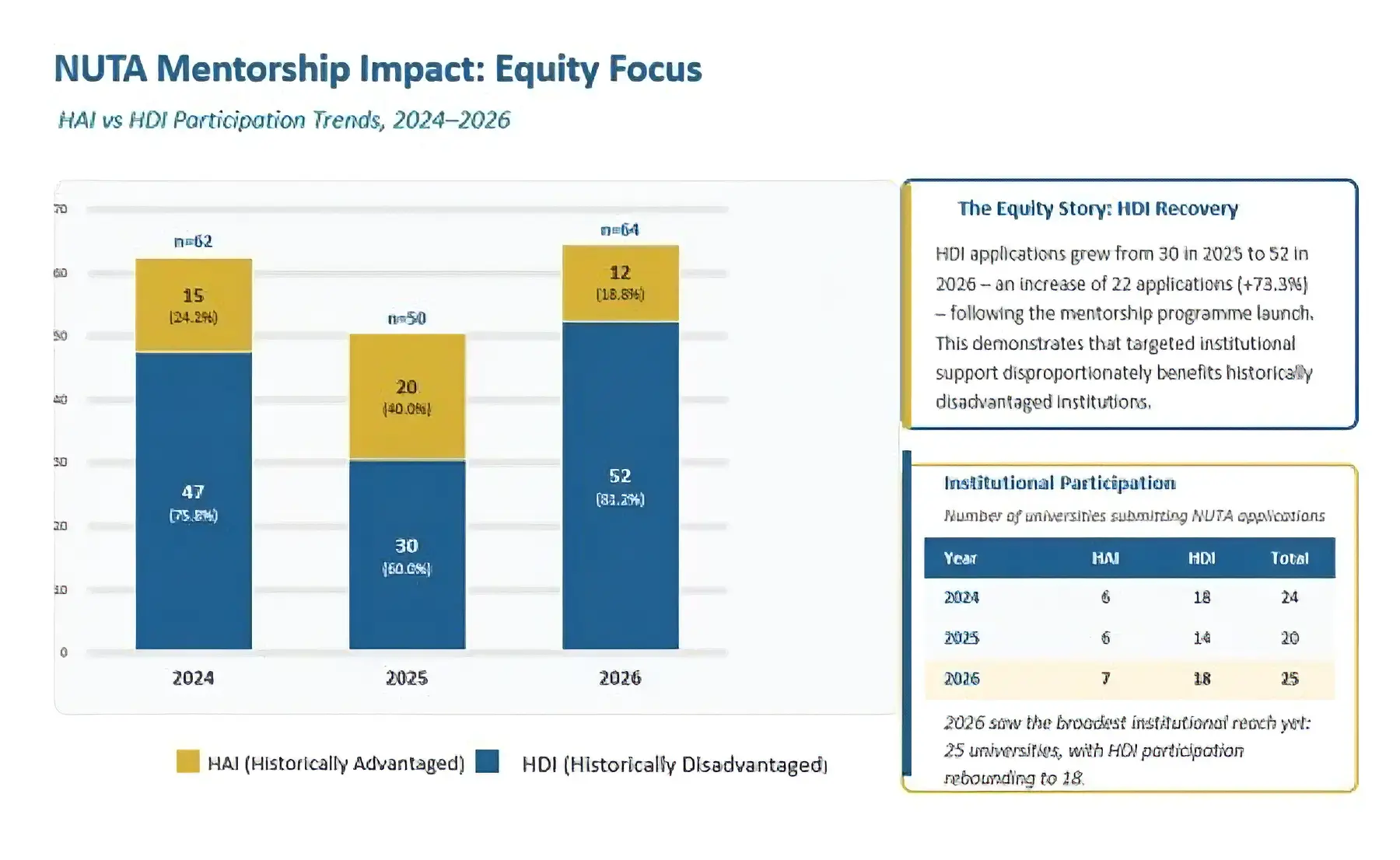
SAUT has worked hard to enable more universities to participate in the awards. It runs portfolio workshops for teaching and learning centre directors and the staff who help applicants. First-time applicants are mentored by past winners and by fellows of the Teaching Advancement at University programme. Much of the support goes to previously disadvanged universities.
Prof Ndebele said the results show that these mentorship initiatives are already paying dividends. University participation has grown from 20 universities in 2025 to 25 this year, with applications rising from 50 last year to 64.
Discussions are also under way to inducting awardees into a permanent national Hall of Fame.
Lost on technicalities
Prof Ndebele said that he was frustrated that portfolios continue to be disqualified on technical grounds that have nothing to do with the quality of the teaching.
“The most common (mistakes) include nomination forms not signed by the relevant deputy vice-chancellor, CVs longer than two pages or not focused on teaching, reflective narratives that exceed 10 000 words and appendices that are too long or cannot be accessed off campus. Others are weaker on substance with claims made without evidence, a lack of theoretical depth and little use of student data to show what students have actually learnt,” he said.
In a bid to rectify this, SAUT now sends a compliance and eligibility checklist to every university to help applicants avoid these errors.
Four more projects
NUTA is one of five collaborative projects under SAUT, and Ndebele encouraged universities to make use of the others through their SAUT representatives. They cover continuous professional learning (led by Dr Rosaline Govender of the Durban University of Technology); academic development as a profession (Professor Jo-Anne Vorster of Rhodes University) and university teaching leadership development (Professor Kasturi Behari-Leak of the University of Cape Town). A fifth project, on blended and online learning, has been discontinued in the current funding cycle.
Parity with research
SAUT’s longer-term aim, Prof Ndebele said, is parity in how the country recognises teaching and research, with NUTA wanting to eventually match the prestige of the NRF’s awards. Prof Ndebele said NUTA has the backing of the Minister of Higher Education, who serves as its patron and will be attending this year’s awards ceremony.
Prof Ndebele’s last request was to the university leaders in the room: “Please encourage your academics to submit portfolios. One university missed out this year. I want all 26 in next year.”
Janine Greenleaf Walker is a contract writer for Universities South Africa.