The hard facts informing enrolment planning and admissibility at public universities
Faced with a sustained demand for spaces against limited capacity to absorb aspiring students, universities are confronted with two pressing questions: Is the growing National School Certificate (NSC) pass rate enough justification for universities to expand their absorption capacity, or should the higher education system look elsewhere for solutions? Can distance learning meaningfully close the access gap while protecting quality and improving employability outcomes?
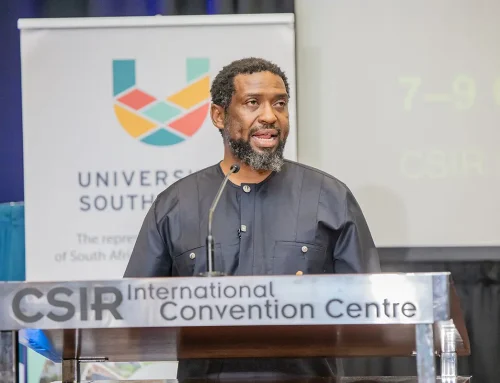
Dr Denyse Webbstock (right), Senior Director for Institutional Planning, Evaluation and Monitoring at the University of Johannesburg, attempted to answer these questions at Universities South Africa’s (USAf) inaugural Thought Leadership event in Pretoria, on 2 October 2025. She was speaking on the topic: Complexities of universities’ institutional and enrolment planning and the policy constraints hindering public universities from leveraging distance learning.
Her presentation addressed the event’s theme, Rethinking Post-School Pathways for Youth Employability, focusing on widening youth access to tertiary education and fostering their meaningful participation in South Africa’s economy.
Dr Webbstock thus laid out the structural context that determines who enters university, why institutions’ capacity remains constrained, and where distance education could help.

The post-school landscape and the long tail of system design
Locating today’s pressures in the long history of post-school education design, Dr Webbstock described the post-school education and training sector as resembling an inverted pyramid, occupied, at the top, by universities carrying the largest share of enrolments, while the technical and vocational education and training (TVET) and community colleges remain comparatively small.

She said, in 1994, public universities enrolled just under 495,000 students, while technical colleges (now TVET) enrolled about 110,000, and Adult Basic Education and Training (ABET) centres reached roughly 360,000 learners. The National Development Plan 2030 later set a more balanced vision, projecting a system of 1.6 million university students, 2.5 million in TVET colleges, and 1 million in community education by 2030. This shift was intended to strengthen the vocational core and expand lifelong learning opportunities alongside a proportionately growing university sector.

Dr Webbstock said the most recent pattern showed a negligibly shifted system in terms of shape. By 2023, universities enrolled around 1.3 million students across public, private and distance provision, while TVET enrolment sat at roughly 564,000 and community programmes around 120,000. This means the shape of the system remains university-heavy, which places long-term pressure on admissions at public institutions, limits room to manoeuvre on programme mix and keeps the question of alternative pathways on the agenda.
She explained that the point of this historical reminder was not to rehearse targets, but to show that today’s capacity constraint was baked into the system’s shape and incentives. A university-dominant system creates intense pressure at the point of entry, especially when school throughput improves faster than institutional capacity.
How enrolment planning works
The central feature of Dr Webbstock’s analysis was the enrolment planning machinery. In practice, universities negotiate five-year enrolment plans with the Department of Higher Education and Training (DHET). These plans set the size and shape of the student body in advance, with a mid-term review, and they underpin the core public subsidy that most institutions rely on. Because teaching grants are calculated using lagged enrolment data, and because universities draw around 60% of their grant income from teaching input subsidies, institutions cannot casually exceed their planned enrolments. Even a small over-enrolment carries financial penalties and could destabilise budgets that are agreed years ahead.

The executive planner pointed to first-time entering numbers as the key signal used for planning, which explains why the annual intake draws particular attention. Those numbers inform both the departmental funding envelope and the NSFAS pipeline. In recent years, a larger share of public funding has flowed through NSFAS for student support, which, while easing household affordability, tightens the funding space within which institutions must maintain quality, staffing, infrastructure and student support.

“The result is a careful balancing act: universities need to admit as many qualifying students as possible while staying true to five-year plans that fund laboratories, digital platforms, teaching posts and professional services,” Dr Webbstock deduced.
UJ exemplifies a system designed for a few
Dr Webbstock illustrated the magnitude of demand through the University of Johannesburg’s 2025 intake. In 2024, the institution received well over half a million applications for approximately 11,000 first-year spaces. (This bears in mind that students presenting two programme choices could have inflated the application numbers.) The majority of applicants were rejected based on Grade 12 results, while a significant number were placed on waiting lists. Only a small proportion were offered admission, including top-performing learners identified through the university’s Orange Carpet criteria.

The national picture followed a similar pattern. Of the about 615,000 candidates who achieved National Senior Certificate (NSC) passes in 2024, roughly 337,000 obtained Bachelor passes. However, only around 200,000 first-year places were available across the higher education system for the 2025 intake. As Dr Webbstock explained, the evident gap is what creates the annual sense of crisis around university admissions. In reality, the recurring oversubscription reflects the structural limitations of a system that is planned, funded, and resourced for fewer students than the number who qualify to enter.
Quality, programme mix and admission criteria
Dr Webbstock said admission practices are designed to protect academic standards at the programme level. At UJ, for instance, Grade 12 (NSC) results remain the core criterion for entry to all programmes rather than demographic targets or other balancing criteria. Each programme specifies its own entry requirements. A specific mathematics score may be non-negotiable for some degrees, while a design portfolio or other proficiency may be the gatekeeper elsewhere. Dr Webbstock was illustrating that a Bachelor’s pass opens the door to possible admission, but it does not guarantee entry to a specific programme. This detail matters for public understanding. It helps explain why a learner with a Bachelor’s pass can still be unsuccessful, and it clarifies why programme-level capacity and academic prerequisites, not just overall institutional size, determine who is admitted.

She also linked quality and capacity to staffing and infrastructure. Universities plan for the number of academics who can supervise postgraduate students, the number of lab seats for practical classes, the availability of seminar placements where required, and the student support needed to maintain throughput. “These capacity limits cannot be changed at short notice,” Dr Webbstock said. “Enrolment targets and funding are determined through long-term planning cycles, which makes it difficult for universities to expand admissions immediately in response to public pressure. Without additional and sustained investment, doing so could stretch resources and compromise quality.”
Operational realities and the public narrative
The Senior Director: Institutional Planning said the first-year intake cycle typically rolls by very quickly, because institutions have a narrow window to process applications, issue offers and manage waiting lists.
Since applicants can select more than one programme, raw application numbers tend to overstate the number of individual people in the pipeline, which can confuse public perception when figures are reported without explanation. This is the context within which the moderator, Ms Cathy Mohlahlana, asked the familiar question today: ‘Why does it appear that the system is surprised every year by the number of students seeking admission?’ “
Having explained the planning context above, Dr Webbstock maintained that universities know what to expect because enrolment plans are negotiated years ahead, and undergraduate spaces are non-negotiable. “The misconception comes when learners and families read a Bachelor’s pass as a general entitlement to a seat at university, rather than a threshold for eligibility that still requires programme-level selection against available capacity. There is also a subject choice issue that may work against applicants. Some learners opt for mathematical literacy to maximise final marks, which might assist overall performance but can disqualify them from degrees that require pure mathematics. The result is an application that looks strong on the surface, yet falls short of the specific prerequisites, especially in programmes that feed into science, technology and quantitative disciplines.”
Thoriso Kolobe is a Communication Consultant at Universities South Africa.