Twenty years of existence celebrated with pride, affirming USAf’s role in higher education
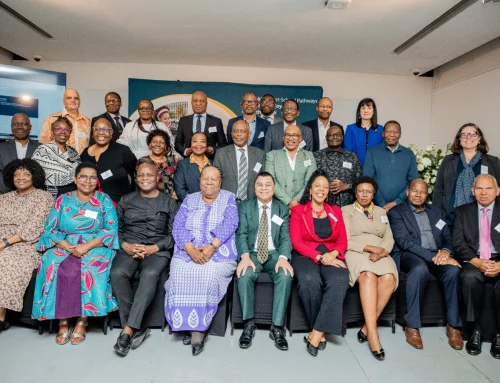
Friday, 11 July 2025, marked a special day for Universities South Africa (USAf) as staff gathered at an off-site venue to commemorate 20 years of existence that could only be attributed to an exceptional work ethos and commitment.
This was a belated internal celebration in remembrance of 6 May 2005, the day the then Higher Education South Africa (HESA) was born. HESA resulted from a merger between the then Committee of University Principals (CUP), also previously known as the South African Vice-Chancellors’ Association (SAUVCA), and the Committee of Technikon Principals (CTP). HESA was later renamed and rebranded as Universities South Africa in July 2015.
Over the past two decades, USAf has consistently tackled pressing challenges in higher education — from funding and student access to academic freedom and institutional autonomy. USAf’s dedicated staff received due credit throughout the day’s speeches, culminating in the CEO’s vote of appreciation to both current and former employees, including those who have since left or retired.

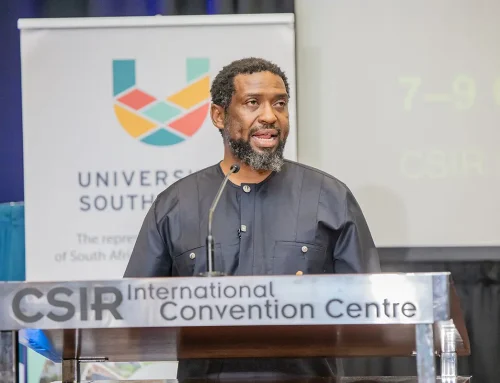
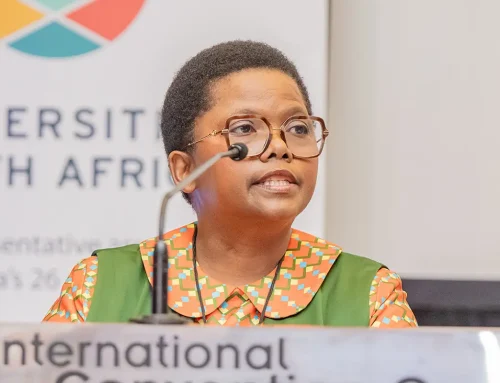
Director of Operations and Sector Support, Mr Mahlubi “Chief” Mabizela (right, above), and the Stakeholder Relations Administrator in the Entrepreneurship Development in Higher Education (EDHE) Programme, Ms Lerato Makgonyane, as co-masters of the ceremony, steered the programme along. Mabizela set the stage by narrating the history of South Africa’s higher education spanning almost 300 years.
“You cannot talk about the history of USAf without acknowledging the history of our universities,” he said, illustrating how the early institutions started as colleges such as the Victoria College in Stellenbosch, which became the latter-day Stellenbosch University; the Grey College in Bloemfontein which became today’s University of the Free State; the St Andrews College now known as Rhodes University in the town of Makhanda, formerly known as Grahamstown, and the Transvaal University College turned University of Pretoria, to cite a few examples. He also narrated how technikons of the apartheid era became universities of technology and how many of those merged with universities in the post-1994 transformation project.
Against that backdrop, Mabizela emphasised the importance of staff understanding the policy and legislative shifts that have shaped the higher education sector into the 26 public universities we know today. It was equally important, he noted, to appreciate the heritage that USAf staff have been entrusted to serve.
Then Ms Makgonyane, eager to test colleagues’ attention to detail, quizzed them on the USAf history and values, rewarding those who proved themselves attentive and knowledgeable.

Makgonyane poses with the colleagues who passed her test, namely (from the far left), Ms Nomvula Tsebe, Manager: Finance; Dr Tebogo Tsebe, Senior Manager: Student Success and Collaborative Forum (SSCF) in the Higher Education Leadership and Management Programme (HELM); and Ms Lorinda Crous, Executive Secretary in the Office of the CEO.
Remarkable growth
Ms Annie Viljoen, Senior Manager in the Matriculation Board (MB) and one of the organisation’s longest-serving employees (now in her 28th year), explained how two statutory bodies which had previously represented universities (the Committee of University Principals / South African Universities’ Vice-Chancellors’ Association — SAUVCA) and technikons (the Committee of Technikon Principals) merged in May 2005 to become Higher Education South Africa (HESA).

Ms Viljoen described the change as gruesome, with each organisation striving to stay relevant, and, in the process, bringing painful uncertainty and job insecurity to staff. She acknowledged the staff who were part of the merger process and are still with USAf after 20 years. These are Clayton Lesufi, Louise Graham, Gracious Shabangu, Elizabeth Lottering and Molefe Kolokoto, all of whom remain with the MB.
She added that when the two bodies eventually reached an agreement and people adapted to the transition, things normalised, and a unified higher education sector was born. The change endured until HESA rebranded itself to become Universities South Africa in July 2015.
She commended the advancements introduced by the Directorate: Finance and Administration, highlighting the shift from manual processes, such as paper-based leave applications and procurement requisitions, to more efficient digital systems, a transformation the USAf Office continues to build on today. She noted that this progress was also evident in the professionalisation of ICT infrastructure, processes, and support, as well as the digitisation of finance, procurement, and Matriculation Board operations. Annie further pointed to the evolution of governance structures, with the expansion of committees into strategic groups and communities of practice.
“USAf has grown,” she emphasised. “I never thought I would see this 20-year celebration, but here I am.”

The afternoon’s programme unfolded alongside a three-course meal at the Capital Menlyn Maine Hotel in Pretoria.
Regarding the MB, which she heads, Viljoen highlighted the digitisation of the Joint Matriculation Board’s archives of examination results dating back to 1865. This meticulous preservation of records proved invaluable when a government minister once requested the matric results of the late Oliver Tambo, one of South Africa’s liberation icons and an exceptional student of his time. “We were able to produce the results with great pride,” she recalled. “Today, instead of flipping through thick bound volumes, we simply conduct an electronic search and find the results in no time.”
She also reflected on the changes in leadership at the USAf Office, beginning with Ms Piyushi Kotecha during the early HESA era (2005–2006), who had previously served as CEO of SAUVCA. She was succeeded by Professor Duma Malaza (2006–2011), who later became Vice-Chancellor and Principal of the Mangosuthu University of Technology. Dr Jeffrey Mabelebele, who had acted as CEO following Professor Malaza’s departure in 2011, was formally appointed from 2013 to 2015 and now serves as Registrar at Sefako Makgatho Health Sciences University. Dr Mabelebele is the new Vice-Chancellor Designate of the University of Limpopo, set to assume the new position on 1 January, 2026. Within USAf, he was succeeded by Professor Ahmed Bawa (2016–2022), now a professor at the University of Johannesburg Business School. The incumbent, Dr Phethiwe Matutu, has held the position since October 2022.
Dr Oliver Seale, initially Senior Manager: Higher Education Leadership and Management during this programme’s formative years in the early 2002s, took up acting CEO roles at different stages of the Office’s evolution, including from May 2015 to April 2016, at which point he handed over the baton taken from Dr Mabelebele to Professor Bawa.
“All these leaders brought in their unique style of leadership and direction, each significantly growing the organisation to what it has become today,” Annie concluded.
She recalled how the discussions over migrating the Matriculation Board to a statutory entity in the education sector started with the revision of the Higher Education Act as far back as 1997. “Everyone thought Section 74 of the Act, which provides for CTP and CUP, would be repealed at that time, but here we are, still lobbying for the abolishment of this clause today.
“At this rate, most of us will be retired by the time the change materialises,” she joked, adding that “the day we celebrate our 30th anniversary, someone from the Matriculation Board, again, will be able to speak, because they will still be the longest-serving employees of USAf,” she said to loud laughter in the room.
“But I hope by then, we will have outgrown the Hatfield campus and moved to even bigger premises, because USAf has that potential. I am certain we will all, well…I will not be there as I will have retired. But I am certain that we will have reached even bigger heights,” she concluded to a staff applause.
Celebrating Ms Felicity Kokose
The day would have been incomplete without recognising long-serving individuals in the organisation.

Ms Pearl Mokwena, Human Resources Officer (left in the photo), bestowed a certificate of 10 years of dedicated service to Ms Felicity Kokose, Manager: Sector Support, for which the latter expressed much appreciation.
“Thank you. It has been a decade of growth and development, a decade of learning, but most importantly, a decade of employment. One has to be grateful for employment in this grey economy.”
“I thank the colleagues who have supported me through the years, who have shared their experience and wisdom, and created an enabling environment for my development,” she said.
While stating with certainty that she did not anticipate staying another 10 years, Ms Kokose referred to the arduous role of supporting her share of strategy groups and communities of practice, highlighting that learning had been the key focus of her 10-year tenure.
Nqobile Tembe is a commissioned Communication Consultant.